Design of a 5G MIMO-OFDM System Using Artificial Neural Networks Under Realistic Channel Impairments
DOI:
https://doi.org/10.29304/jqcsm.2026.18.12454Keywords:
5GAbstract
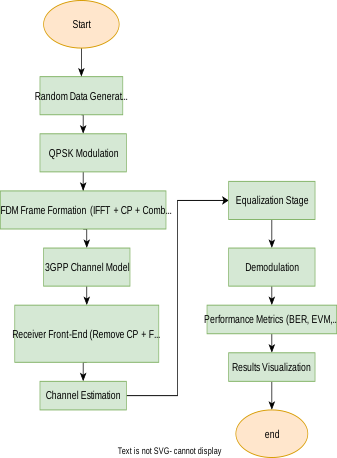
This paper attempts to design and compare an equalizer for a 5G 2×2 MIMO-OFDM system employing a data-driven ANN equalizer for realistic wireless channel impairments. The focus here is whether a data-driven equalizer approach can attain better or a comparable equalizer performance to classic linear techniques: Zero-Forcing (ZF), Minimum Mean Square Error (MMSE), MMSE-Successive Interference Cancellation MMSE-SIC, Decision Feedback Equalizer (DFE) but taking into account both accuracy and complexity. Build a 5G MIMO-OFDM simulator in Python for the physical 3GPP TDL-C and TDL-E and do add hurts like Doppler spread and existent inaccuracies like carrier frequency offset CFO phase noise and outdated or imperfect channel state information CSI. Propose a deep fully connected ANN and train using supervised learning on pairs of OFDMs exchanged using Monte Carlo simulating the wireless channel from the previous step. Vast range of SNR/Doppler/CFO/phase noise. Use the ANN as equalizer. For evaluation use BER/EVM/NMSE/and FLOPs and inference time per OFDM frame. Simulation results show that the ANN equalizer is much better than ZF and DFE. And matches / slightly better than MMSE and MMSE-SIC across varying SNR/Doppler/CFO/and phase noise – even in more severe settings with TDL-E with imperfect CSI. Finally, the ANN once trained has better latency for inference and FLOPs/value performance than classic equalizer results. Concluding that ANN based is a good avenue with a 5G MIMO-OFDM reception in mind.
Downloads
References
References
3GPP. (2020). Study on channel model for frequencies from 0.5 to 100 GHz (3GPP TR 38.901, v16.1.0).
Fabien, J. (2018). Channel model implementation and application for New Radio (NR) 3GPP Rel-15. NTIA Technical Report.
Yang, H. (2005). A road to future broadband wireless access: MIMO-OFDM-based air interface. IEEE Communications Magazine, 43(1), 53–60.
Ladaycia, A., Belouchrani, A., Abed-Meraim, K., & Mokraoui, A. (2010). Performance analysis of ZF and MMSE equalizers for MIMO systems. In Proceedings of the International Conference on Telecommunications.
Huang, H., Guo, S., Gui, G., Yang, Z., & Zhang, Y. (2019). Deep learning for physical-layer 5G wireless techniques: Opportunities, challenges and future research directions. arXiv preprint arXiv:1904.09673.
Mohammed, A. S. M., Henkel, M. A., & Alshebeili, S. A. (2023). Deep learning channel estimation for OFDM 5G systems. Wireless Personal Communications, 131.
Ly, A., & Yao, Y.-D. (2021). A review of deep learning in 5G research: Channel coding, massive MIMO, multiple access, resource allocation, and network security. IEEE Open Journal of the Communications Society, 2, 396–408.
Omondi, G., Liu, X., & Zhang, Z. (2023). Towards artificial intelligence-aided MIMO detection for 6G wireless networks. Engineering Applications of Artificial Intelligence, 126.
Hanoon, S. S., & Hazim, H. T. (2024). A deep learning approach to evaluating SISO-OFDM systems under nonlinear impairments. Iraqi Journal of Electrical and Electronic Engineering, 20(2).
Ababneh, J., Al-Badarneh, R., Jaradat, M., et al. (2025). Enhanced nonlinear equalization for OFDM systems in IoT-oriented networks. Scientific Reports, 15.
He, H., Wen, C.-K., Jin, S., & Li, G. Y. (2020). Model-driven deep learning for MIMO detection. IEEE Transactions on Signal Processing, 68, 1702–1715.
Hu, Q., Cai, Y., Yu, G., et al. (2023). Understanding deep MIMO detection. IEEE Transactions on Wireless Communications (early access).
Mohammed, A. S. M., Taman, A. I. A., Hassan, A. M., & Zekry, A. (2023). Deep learning channel estimation for OFDM 5G systems with different channel models. Wireless Personal Communications, 128, 2891–2912.
Yao, R., Wang, S., Zuo, X., Xu, J., & Qi, N. (2019). Deep learning aided signal detection in OFDM systems with time-varying channels. In Proceedings of the 2019 IEEE Pacific Rim Conference on Communications, Computers and Signal Processing (PACRIM) (pp. 1–5), Victoria, BC, Canada.
Kumar, A., Gaur, N., Gupta, M., & Nanthaamornphong, A. (2024). Implementation of the deep learning method for signal detection in massive-MIMO-NOMA systems. Heliyon, 10(3), e25374.
Yang, H. (2005). A road to future broadband wireless access: MIMO-OFDM-based air interface. IEEE Communications Magazine, 43(1), 53–60.
Stüber, G. L., Barry, J. R., McLaughlin, S. W., Li, Y., Ingram, M. A., & Pratt, T. G. (2004). Broadband MIMO-OFDM wireless communications. Proceedings of the IEEE, 92(2), 271–294.
Hwang, T., Yang, C., Wu, G., Li, S., & Li, G. Y. (2009). OFDM and its wireless applications: A survey. IEEE Transactions on Vehicular Technology, 58(4), 1673–1694.
3GPP. (2020). Study on channel model for frequencies from 0.5 to 100 GHz (3GPP TR 38.901, v16.1.0).
Lin, D. D., Pacheco, R. A., Lim, T. J., & Hatzinakos, D. (2006). Joint estimation of channel response, frequency offset, and phase noise in OFDM. IEEE Transactions on Signal Processing, 54(9), 3542–3554.
Schmidl, T. M., & Cox, D. C. (1997). Robust frequency and timing synchronization for OFDM. IEEE Transactions on Communications, 45(12), 1613–1621.
Tse, D., & Viswanath, P. (2005). Fundamentals of wireless communication. Cambridge University Press.
Al-Dhahir, N., & Sayed, A. H. (2000). The finite-length multi-input multi-output MMSE-DFE. IEEE Transactions on Signal Processing, 48(10), 2921–2936.
Kulkarni, A. (2014). Performance analysis of zero forcing and minimum mean square error equalizer (Master’s thesis). Missouri University of Science and Technology, Rolla, MO, USA.
Huang, H., Guo, S., Gui, G., Yang, Z., & Zhang, Y. (2020). Deep learning for physical-layer 5G wireless techniques: Opportunities, challenges and solutions. IEEE Wireless Communications, 27(1), 214–222.
Ye, H., Li, G. Y., & Juang, B.-H. F. (2018). Power of deep learning for channel estimation and signal detection in OFDM systems. IEEE Wireless Communications Letters, 7(1), 114–117.
He, H., Wen, C.-K., Jin, S., & Li, G. Y. (2020). Model-driven deep learning for MIMO detection. IEEE Transactions on Signal Processing, 68, 1702–1715.
Lv, C., & Luo, Z. (2023). Deep learning for channel estimation in physical-layer wireless communications: Fundamentals, methods, and challenges. Electronics, 12, 4965.
N. Samuel, T. Diskin, and A. Wiesel, “Learning to Detect,” IEEE Transactions on Signal Processing, vol. 67, no. 10, pp. 2554–2564, May 2019, doi: 10.1109/TSP.2019.2899805.
S. Takabe, M. Imanishi, T. Wadayama, R. Hayakawa, and K. Hayashi, “Trainable Projected Gradient Detector for Massive Overloaded MIMO Channels: Data-Driven Tuning Approach,” IEEE Access, vol. 7, pp. 93326–93338, 2019, doi: 10.1109/ACCESS.2019.2927997.
T. J. O’Shea and J. Hoydis, “An Introduction to Deep Learning for the Physical Layer,” IEEE Transactions on Cognitive Communications and Networking, vol. 3, no. 4, pp. 563–575, Dec. 2017, doi: 10.1109/TCCN.2017.2758370.
S. Dörner, S. Cammerer, J. Hoydis, and S. ten Brink, “Deep Learning Based Communication Over the Air,” IEEE Journal of Selected Topics in Signal Processing, vol. 12, no. 1, pp. 132–143, Feb. 2018, doi: 10.1109/JSTSP.2017.2784180.
A. Felix, S. Cammerer, S. Dörner, J. Hoydis, and S. ten Brink, “OFDM-Autoencoder for End-to-End Learning of Communications Systems,” in Proc. IEEE 19th Int. Workshop on Signal Processing Advances in Wireless Communications (SPAWC), 2018, pp. 1–5, doi: 10.1109/SPAWC.2018.8445920.
F. Bai, J. Wang, Y. Zhang, and Z. Song, “Deep Learning-Based Channel Estimation Algorithm Over Time Selective Fading Channels,” IEEE Transactions on Cognitive Communications and Networking, vol. 6, no. 1, pp. 125–134, Mar. 2020, doi: 10.1109/TCCN.2019.2943455.
S. Kumari, K. K. Srinivas, and P. Kumar, “Channel and Carrier Frequency Offset Equalization for OFDM Based UAV Communications Using Deep Learning,” IEEE Communications Letters, vol. 25, no. 3, pp. 850–853, Mar. 2021, doi: 10.1109/LCOMM.2020.3036493.
V. Ninkovic, A. Valka, D. Dumic, and D. Vukobratovic, “Deep Learning-Based Packet Detection and Carrier Frequency Offset Estimation in IEEE 802.11ah,” IEEE Access, vol. 9, pp. 99853–99865, 2021, doi: 10.1109/ACCESS.2021.3096853.
N. Shlezinger, N. Farsad, Y. C. Eldar, and A. J. Goldsmith, “ViterbiNet: A Deep Learning Based Viterbi Algorithm for Symbol Detection,” IEEE Transactions on Wireless Communications, vol. 19, no. 5, pp. 3319–3331, May 2020, doi: 10.1109/TWC.2020.2972352.
S. Brennsteiner, T. Arslan, J. Thompson, and A. McCormick, “A Real-Time Deep Learning OFDM Receiver,” ACM Transactions on Reconfigurable Technology and Systems, vol. 15, no. 3, Art. no. 26, pp. 1–25, Dec. 2021, doi: 10.1145/3494049.
Downloads
Published
How to Cite
Issue
Section
License
Copyright (c) 2026 Zahraa Luay Fouad

This work is licensed under a Creative Commons Attribution-NonCommercial-NoDerivatives 4.0 International License.