A Review of Techniques for Muscle Fatigue Analysis and the Associated Noise Challenges
DOI:
https://doi.org/10.29304/jqcsm.2026.18.12484Keywords:
Electromyography (EMG) bio-signal,, muscle fatigue, noise, machine learning, deep learningAbstract
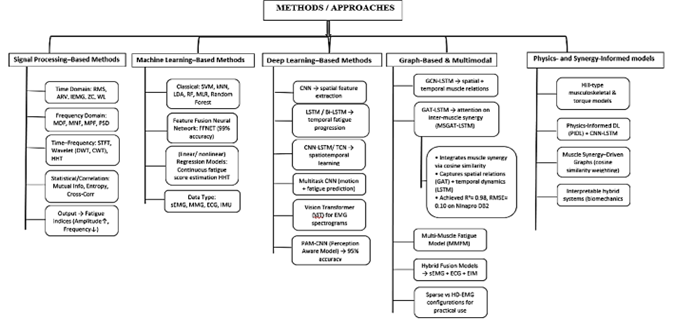
To reduce the risk of impression muscle fatigue in the medical field, sports, and rehabilitation of disorders and it is muscles are a critical neuromuscular phenomenon. Electromyography (EMG) is the most important Bio signal used to detect muscle fatigue. Many studies over the past few years have been conducted to address the challenge of muscle fatigue (detection, recognition, and prediction). This study presents a review of various approaches to build models, and evaluation metrics, and applications for each structure begins with exploring artificial intelligence (AI) methods such as machine learning (ML) and deep learning (DL), as well as hybrid model showing the way of data acquisition (sensors types, techniques, preprocessing, models…) specially noise affected of data collection of each type of power spectrum. Furthermore, this review compares fatigue detection, recognition, and prediction approaches, highlighting their performance, strengths, and limitations. Finally, a discussion of various aspects of bio-signal-based muscle fatigue, with specific applications and descriptions, and analyses of the datasets used in muscle fatigue to address the most trending issues and challenges in applying upper limb muscle fatigue. The synthesis presented here aims to guide future developments toward robust, interpretable, and real-time neuromuscular fatigue monitoring systems.
Downloads
References
Ma, L.; Chablat, D.; Bennis, F.; Zhang, W. A new simple dynamic muscle fatigue model and its validation. Int. J. Ind. Ergon. 2009, 39, 211–220. https://doi.org/10.1016/j.ergon.2008.04.004.
A. Shahid, K. Wilkinson, S. Marcu, and C. M. Shapiro, Fatigue Severity Scale (FSS). New York, NY, USA: Springer, 2012, pp. 167–168.
J. Frith and J. Newton, “Fatigue impact scale,” Occupational Med., vol. 60, no. 2, p. 159, Mar. 2010.
B. Y. Tseng, B. J. Gajewski, and P. M. Kluding, “Reliability, respon siveness, and validity of the visual analog fatigue scale to measure exertion fatigue in people with chronic stroke: A preliminary study,” Stroke Res. Treatment, vol. 2010, pp. 1–7, Dec. 2010.
E. M. A. Smets, B. Garssen, B. Bonke, and J. C. de Haes, “The multidimensional fatigue inventory (MFI) psychometric qualities of an instrument to assess fatigue,” J. Psychosomatic Res., vol. 39, no. 3, pp. 315–325, Apr. 1995.
T. R. Mendoza et al., “The rapid assessment of fatigue severity in cancer patients: Use of the brief fatigue inventory,” Cancer, vol. 85, no. 5, pp. 1186–1196, Mar. 1999.
WangJ, Tang L, BronlundJE. Surface EMG signal amplification and filtering. Int J Comput Appl 2013;82(1).
Mugnosso, M., Marini, F., Holmes, M. et al. Muscle fatigue assessment during robot-mediated movements. J NeuroEngineering Rehabil 15, 119 (2018). https://doi.org/10.1186/s12984-018-0463-y
Arabadzhiev TI, Dimitrov VG, Dimitrova NA, Dimitrov GV. Interpretation of EMG integral or rms and estimates of neuromuscular efficiency can be misleading in fatiguing contraction. J Electromyog Kinesiol 2010;20(2):223–32.
Candotti CT, Loss JF, Melo MDO, La Torre M, Pasini M, Dutra LA, et al. Comparing the lactate and EMG thresholds of recreational cyclists during incremental pedaling exercise. Can J Physiol Pharmacol 2008;86(5):272–8.
Gonza´lez-Izal M, Malanda A, Gorostiaga E, Izquierdo M. Electromyographic models to assess muscle fatigue. J Electromyogr Kinesiol 2012;22(4):501–12.
Gonzalez-Izal M, Cadore EL, Izquierdo M. Muscle conduction velocity, surface electromyography variables, and echo intensity during concentric and eccentric fatigue. Muscle Nerve 2014;49(3):389–97.
Wu Q, Wei C, Cai Z, Ding L, Law R. An improved ensemble empirical mode decomposition and hilbert transform for fatigue evaluation of dynamic EMG signal. Optik 2015;126 (24):5903–8.
Gu¨ndogdu U, Sayin A, Akan A, Arslan Y, Orhan E, Baslo M. Investigation of muscle fatigue using temporal and spectral moments. In: Proceedings of the 5th WSEAS International Conference on Signal Processing (SIP’06), Citeseer. p. 10–4.
Yavuz E, Eyupoglu C. A cepstrum analysis-based classification method for hand movement surface EMG signals. Med Biol Eng Comput 2019;57(10):2179–201.
Biagetti G, Crippa P, Curzi A, Orcioni S, Turchetti C. Analysis of the EMG signal during cyclic movements using multicomponent am–fm decomposition. IEEE J Biomed Health Informat 2014;19(5):1672–81.
Krishnamani DB, Karthick P, Swaminathan R. Variational mode decomposition based differentiation of fatigue conditions in muscles using surface electromyography signals. IET Signal Proc 2021;14(10):745–53.
Avila ER, Williams SE, Disselhorst-Klug C. Advances in EMG measurement techniques, analysis procedures, and the impact of muscle mechanics on future requirements for the methodology. J Biomech. 2023 Jul;156:111687. doi: 10.1016/j.jbiomech.2023.111687. Epub 2023 Jun 15. PMID: 37339541.
M. A. Oskoei and H. Hu, "Support Vector Machine-Based Classification Scheme for Myoelectric Control Applied to Upper Limb," in IEEE Transactions on Biomedical Engineering, vol. 55, no. 8, pp. 1956-1965, Aug. 2008, doi: 10.1109/TBME.2008.919734.
P. Tu, J. Li and H. Wang, "A Multitask Deep Learning Approach for sEMG-Based Human Motion Intention and Muscle Fatigue Levels Recognition," in IEEE Transactions on Instrumentation and Measurement, vol. 74, pp. 1-10, 2025, Art no. 2518710, doi: 10.1109/TIM.2025.3550611.
M. Li, Z. Wei, Z. -Q. Zhang, S. Ma and S. Q. Xie, "Continuous Joint Kinematics Prediction Using GAT-LSTM Framework Based on Muscle Synergy and Sparse sEMG," in IEEE Transactions on Neural Systems and Rehabilitation Engineering, vol. 33, pp. 1763-1773, 2025, doi: 10.1109/TNSRE.2025.3565305.
Lin, C., Zhang, X. & Zhao, C. A parallel and efficient transformer deep learning network for continuous estimation of hand kinematics from electromyographic signals. Sci Rep 15, 36150 (2025). https://doi.org/10.1038/s41598-025-16268-y .
L. Mesin, C. Cescon, M. Gazzoni, R. Merletti, and A. Rainoldi, “A bi-dimensional index for the selective assessment of myoelectric man ifestations of peripheral and central muscle fatigue,” J. Electromyogr. Kinesiol., vol. 19, no. 5, pp. 851–863, Oct. 2009.
G. C. Knowlton, R. L. Bennett, and R. McClure, “Electromyography of fatigue,” Arch. Phys. Med. Rehabil., vol. 32, no. 10, pp. 648–652, Oct. 1951.
R. Merletti, B. Indino, T. Graven-Nielsen, and D. Farina, “Sur face EMG crosstalk evaluated from experimental recordings and simulated signals: Reflections on crosstalk interpretation, quantifica tion and reduction,” Methods Inf. Med., vol. 43, no. 1, pp. 30–35, 2004.
R. S. Witte, D. E. Dow, R. Olafsson, Y. Shi, and M. O’Donnell, “High resolution ultrasound imaging of skeletal muscle dynamics and effects of fatigue,” in Proc. IEEE Ultrason. Symp., vol. 1, Apr. 2005, pp. 764–767.
Z. Sheng, N. Sharma, and K. Kim, “Quantitative assessment of changes in muscle contractility due to fatigue during NMES: An ultrasound imaging approach,” IEEE Trans. Biomed. Eng., vol. 67, no. 3, pp. 832–841, Mar. 2019.
M. R. Al-Mulla, F. Sepulveda, and M. Colley, “A review of non-invasive techniques to detect and predict localised muscle fatigue,” Sensors, vol. 11, no. 4, pp. 3545–3594, Mar. 2011.
M. Sarillee, M. Hariharan, M. Anas, M. Omar, M. Aishah, and Q. Oung, “Non-invasive techniques to assess muscle fatigue using biosensors: A review,” in Proc. IEEE 5th Control Syst. Graduate Res. Colloq., Aug. 2014, pp. 187–192.
M. A. Islam, K. Sundaraj, R. B. Ahmad, and N. U. Ahamed, “Mechanomyogram for muscle function assessment: A review,” PLoS ONE, vol. 8, no. 3, Mar. 2013, Art. no. e58902.
E. M. Bartels et al., “Muscle function assessed by the non-invasive method acoustic myography (AMG) in a Danish group of healthy adults,” Current Res. Physiol., vol. 2, pp. 22–29, Jun. 2020.
D. T. Barry, S. R. Geiringer, and R. D. Ball, “Acoustic myography: A noninvasive monitor of motor unit fatigue,” Muscle Nerve, vol. 8, no. 3, pp. 189–194, Mar. 1985.
S. Galle, P. Malcolm, S. H. Collins, and D. D. Clercq, “Reducing the metabolic cost of walking with an ankle exoskeleton: Interaction between actuation timing and power,” J. NeuroEng. Rehabil., vol. 14, no. 1, pp. 1–16, Dec. 2017.
J. R. Franz, C. M. Wierzbinski, and R. Kram, “Metabolic cost of running barefoot versus shod: Is lighter better?” Med. Sci. Sports Exercise, vol. 44, no. 8, pp. 1519–1525, Aug. 2012.
J. Bangsbo, F. M. Iaia, and P. Krustrup, “Metabolic response and fatigue in soccer,” Int. J. Sports Physiol. Perform., vol. 2, no. 2, pp. 111–127, Jun. 2007.
A. Tyagi, M. Cohen, J. Reece, and S. Telles, “An explorative study of metabolic responses to mental stress and yoga practices in yoga practitioners, non-yoga practitioners and individuals with metabolic syndrome,” BMC Complementary Alternative Med., vol. 14, no. 1, pp. 1–10, Dec. 2014.
D. Roetenberg, H. Luinge, and P. Slycke, “Xsens MVN: Full 6DOF human motion tracking using miniature inertial sensors,” Xsens Motion Technol. BV, Enschede, The Netherlands, Tech. Rep., pp. 1–7, 2009, vol.
Y. W. Hen and R. Paramesran, “Single camera 3D human pose estimation: A review of current techniques,” in Proc. Int. Conf. Tech. Postgraduates (TECHPOS), Dec. 2009, pp. 1–8.
Y. Yu, H. Li, X. Yang, L. Kong, X. Luo, and A. Y. L. Wong, “An automatic and non-invasive physical fatigue assessment method for construction workers,” Autom. Construct., vol. 103, pp. 1–12, Jul. 2019.
M. J. Pinto-Bernal, C. A. Cifuentes, O. Perdómo, M. Rincón Roncancio, and M. Múnera, “A data-driven approach to physi cal fatigue management using wearable sensors to classify four diagnostic fatigue states,” Sensors, vol. 21, no. 19, p. 6401, Sep. 2021.
P. Li, R. Meziane, M. J.-D. Otis, H. Ezzaidi, and P. Cardou, “A smart safety helmet using IMU and EEG sensors for worker fatigue detec tion,” in IEEE Int. Symp. Robot. Sensors Environ. (ROSE), Oct. 2014, pp. 55–60.
Pires, N.; Macedo, M.P. A Bimodal EMG/FMG System Using Machine Learning Techniques for Gesture Recognition Optimization. Signals 2025, 6, 8. https://doi.org/10.3390/signals6010008
A Comprehensive Dataset of Surface Electromyography and Self-Perceived Fatigue Levels for Muscle Fatigue Analysis Sara M. Cerqueira,Rita Vilas Boas, Joana Figueiredo and Cristina P. Santos.
B. Bigland-Ritchie and J. J. Woods, “Changes in muscle contractile properties and neural control during human muscular fatigue,” Muscle & Nerve, vol. 7, no. 9, pp. 691–699, Nov.–Dec. 1984. doi: 10.1002/mus.880070902
C. J. De Luca, "The Use Of Surface Electromyography In Biomechanics" , Journal of Applied Biomechanics, vol. 13, no. 2, pp. 135–163, 1997. doi: 10.1123/jab.13.2.135
S. K. S. Perry, N. J. O’Neill, and G. R. McGill, “Time–frequency analysis of EMG signals for fatigue assessment using STFT,” IEEE Trans. Neural Syst. Rehabil. Eng., vol. 12, no. 3, pp. 378–385, 2004.
M. Coorevits, T. Danneels, and G. Cambier, “Use of wavelet and spectral analysis to evaluate muscle fatigue ,” Eur. J. Appl. Physiol., vol. 97, no. 3, pp. 250–256, 2006.
Y. Ren, W. Wang, and J. Wang, “Hilbert–Huang transform analysis of EMG signals for dynamic muscle fatigue assessment,” Med. Biol. Eng. Comput., vol. 48, no. 6, pp. 631–640, 2010.
C. J. De Luca and S. Roy, “Fatigue and its quantification in EMG analysis,” J. Electromyogr. Kinesiol., vol. 17, no. 3, pp. 345–356, 2007.
Yue Zhang, Zhenchen Bao, Rixi Huang, Xiangyu Yin, Bingwei He, Yuqing Liu, SE-CNN integrated with transfer learning: Enhancing myoelectric pattern recognition amid electrode shift and damage interferences, Biomedical Signal Processing and Control, Volume 111, 2026, ISSN 1746-8094, doi.org/10.1016/j.bspc.2025.108411.
Atzori, M., Gijsberts, A., Castellini, C. et al. Electromyography data for non-invasive naturally- controlled robotic hand prostheses. Sci Data 1, 140053 (2014), https://doi.org/10.1038/sdata.2014.53
M. R. Chowdhury et al., “Bidirectional LSTM-based fatigue estimation during dynamic contractions,” Biomed. Signal Process. Control, vol. 75, 104317, 2022.
T. Ma, Y. Zhang, X. Chen, and Z. Guo, “Spatio-temporal convolutional neural networks for fatigue detection from multichannel EMG,” Frontiers in Neuroscience, vol. 15, Art. no. 658012, 2021. DOI: 10.3389/fnins.2021.658012.
S. N. H. Alalwan, A. M. Mohammed, A. Taşcıkaraoğlu and J. P. S. Catalão, "An Improved Energy Management Strategy for a DC Microgrid including Electric Vehicle Fast Charging Stations," 2021 International Conference on Smart Energy Systems and Technologies (SEST), Vaasa, Finland, 2021, pp. 1-6, doi: 10.1109/SEST50973.2021.9543312.
R. Córdova, C. Lam, A. Vargo, B. O. Conway, and B. Chen, “EMGTFNet: A Fuzzy Vision Transformer Network for Upper-Limb EMG Decoding,”, arXiv:2310.03754, 2023. https://arxiv.org/pdf/2310.03754.pdf
C. Lin, Y. Wang and M. Dai, “Robust gesture recognition based on attention-deep fast convolutional neural network and surface electromyographic signals,” Frontiers in Neuroscience, vol. 18, Article 1306047, 2024, doi: 10.3389/fnins.2024.1306047.
K. Taneja, X. He, Q. He, and J. S. Chen,
“A multi-resolution physics-informed recurrent neural network: Formulation and application to musculoskeletal systems,” arXiv preprint, arXiv:2305.16593, 2023.
Abdallah, I.B., Bouteraa, Y. & Alotaibi, A. Hybrid EMG–NMES control for real-time muscle fatigue reduction in bionic hands. Sci Rep 15, 22467 (2025). https://doi.org/10.1038/s41598-025-05829-w
J. V. Basmajian, “Muscles alive: Their functions revealed by electromyography,” J. Med. Educ., vol. 37, no. 8, p. 802, Aug. 1962.
Shinji Kubota, Kazumasa Uehara, Takuya Morishita, Masato Hirano, Kozo Funase, Inter-individual variation in reciprocal Ia inhibition is dependent on the descending volleys delivered from corticospinal neurons to Ia interneurons, Journal of Electromyography and Kinesiology, Volume 24, Issue 1, 2014, Pages 46-51, ISSN 1050-6411, https://doi.org/10.1016/j.jelekin.2013.11.004.
Halson, S.L. Monitoring Training Load to Understand Fatigue in Athletes. Sports Med 44 (Suppl 2), 139–147 (2014). https://doi.org/10.1007/s40279-014-0253-z.
Boyer, M.; Bouyer, L.; Roy, J.-S.; Campeau-Lecours, A. Reducing Noise, Artifacts and Interference in Single-Channel EMG Signals: A Review. Sensors 2023, 23, 2927. https://doi.org/10.3390/s23062927
T. Ma, X. Bin, M. Lin, Z. Yue, S. Ji, “A PAM-CNN recognition approach to Muscle Fatigue of Special Operators by sEMG signals,” Preprint (biorXiv), Jul. 20, 2025. doi: 10.1101/2025.07.20.665786
Ayoub, Harith & Abdulrazaq, Zaid & Ahmed, Ahmed. (2025). Advanced Denoising of EMG Signals for Medical Applications: A Novel Arduino-Based Enhancement Approach. 3. 20-26. 10.56472/25839233/IJAST-V3I2P103.
C. H. Hansen, Understanding Active Noise Cancellation. Boca Raton, FL, USA: CRC Press, 2018.
M. Mugnosso, F. Marini, M. Holmes, P. Morasso, and J. Zenzeri, “Muscle fatigue assessment during robot-mediated movements,” J. NeuroEng. Rehabil., vol. 15, no. 1, p. 119, Dec. 2018.
M. S. Rubin, “Anatomy, Shoulder and Upper Limb,” StatPearls, 2023.
L. Masia, M. Casadio, G. Sandini, and P. Morasso, “Eye-hand coordi nation during dynamic visuomotor rotations,” PLoS ONE, vol. 4, no. 9, p. e7004, Sep. 2009.
V. Kanal, M. Abujelala, J. Brady, G. Wylie, and F. Makedon, “Adaptive robotic rehabilitation using muscle fatigue as a trigger,” in Proc. 16th EAI Int. Conf. Mobile Ubiquitous Syst., Comput., Nov. 2019, pp. 135–142.
R. C. Clark et al., “The Structure, Function, and Adaptation of Lower-Limb Aponeuroses,” Sports Medicine – Open, 2024
S.-W. Chen, J. Liaw, H. Chan, Y. Chang, and C. Ku, “A real-time fatigue monitoring and analysis system for lower extremity muscles with cycling movement,” Sensors, vol. 14, no. 7, pp. 12410–12424, Jul. 2014.
S. L. Chaparro-Cárdenas, E. Castillo-Castañeda, A. A. Lozano Guzmán, M. Zequera, R. M. Gallegos-Torres, and J. A. Ramirez Bautista, “Characterization of muscle fatigue in the lower limb by sEMG and angular position using the WFD protocol,” Biocybernetics Biomed. Eng., vol. 41, no. 3, pp. 933–943, Jul. 2021.
A. Radecka, A. Knyszy´nska, and A. Lubkowska, “Assessment of muscle fatigue in multiple sclerosis patients in electromyographic examinations,” Eur. J. Phys. Rehabil. Med., vol. 59, pp. 152–163, Mar. 2023.
M. Beretta-Piccoli et al., “Upper and lower limb performance fatiga bility in people with multiple sclerosis investigated through surface electromyography: A pilot study,” Physiolog. Meas., vol. 41, no. 2, Feb. 2020, Art. no. 025002.s
Sun J, Zhang C, Liu G, Cui W, Sun Y and Zhang C (2025) Detecting muscle fatigue during lower limb isometric contractions tasks: a machine learning approach. Front. Physiol. 16:1547257. doi: 10.3389/fphys.2025.1547257
B. Gupta, P. Tvs, G. G and A. Veluppal, "Muscle Fatigue Detection Integrating EMG and PPG with Explainable Machine Learning Across Key Shoulder Muscles in Rotational Movements," 2025 11th International Conference on Communication and Signal Processing (ICCSP), Melmaruvathur, India, 2025, pp. 650-655, doi: 10.1109/ICCSP64183.2025.11088759
Keshavarz Panahi A, Cho S. Prediction of Muscle Fatigue during Minimally Invasive Surgery Using Recurrence Quantification Analysis. Minim Invasive Surg. 2016;2016:5624630. doi: 10.1155/2016/5624630. Epub 2016 May 24. PMID: 27313884; PMCID: PMC4895041
M. J. Shariatzadeh, E. H. Hafshejani, C. J. Mitchell, M. Chiao, and D. Grecov, “Predicting muscle fatigue during dynamic contractions using wavelet analysis of surface electromyography signal,” Biocybernetics and Biomedical Engineering, vol. 43, pp. 428–441, 2023. https://doi.org/10.1016/j.bbe.2023.04.002.
Downloads
Published
How to Cite
Issue
Section
License
Copyright (c) 2026 Noor Bahaa Jaber Aldalal , Mohammad Khalaf Rahim Al-juaifari

This work is licensed under a Creative Commons Attribution-NonCommercial-NoDerivatives 4.0 International License.