Multi-Objective Dynamic Workflow Scheduling for Energy-Efficient and Cost-Effective Cloud Computing
DOI:
https://doi.org/10.29304/jqcsm.2026.18.12509Keywords:
: Average Secrecy, Key Scheduling Algorithm, RC4, Logistic Maps.Abstract
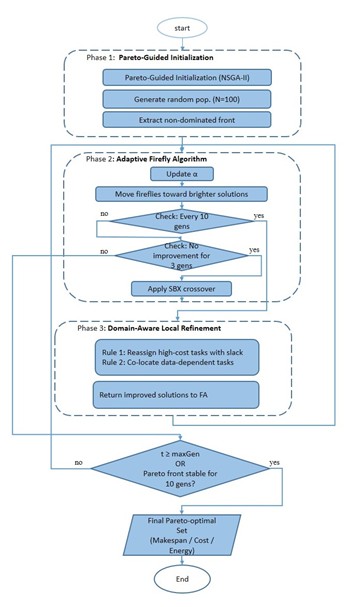
Scheduling scientific workflows in cloud environments under competing objectives—makespan, cost, and energy—remains a challenging multi-objective optimization problem. While hybrid metaheuristics have been explored, they often suffer from random initialization, premature convergence, and static parameter settings. To address these limitations, we propose a novel dynamic scheduling framework that integrates NSGA-II and an enhanced Firefly Algorithm. The method begins with a Pareto-based, non-dominated initial population generated by NSGA-II, ensuring high diversity and quality. This population is then refined using a Firefly Algorithm with adaptive randomness and a stagnation-aware local search mechanism. The model is evaluated on Montage, CyberShake, and Epigenomics workflows using CloudSim with Amazon EC2-like VMs. Results demonstrate statistically significant improvements over state-of-the-art schedulers: up to 31.2% reduction in makespan, 28.7% in cost, and 17.4% in energy consumption, while preserving solution diversity. This work advances the state of the art by synergistically combining evolutionary guidance, swarm intelligence, and domain-aware refinement for sustainable cloud workflow orchestration.
Downloads
References
A. B. Kathole, K. Vhatkar, S. Lonare, & A. P. Kshirsagar, “Optimization-based resource scheduling techniques in cloud computing environment: A review of scientific workflows and future directions.” Computers and Electrical Engineering, 123, 110080., 2025
E. Saeedizade, & M. Ashtiani, “Scientific workflow scheduling algorithms in cloud environments: a comprehensive taxonomy, survey, and future directions”. Journal of Scheduling, 28(1), 1-63., 2025.
A. S. Sofia and P. GaneshKumar, "Multi-objective task scheduling to minimize energy consumption and makespan of cloud computing using NSGA-II," Journal of Network and Systems Management, vol. 26, pp. 463-485, 2018.
C. Blum, J. Puchinger, G. R. Raidl and A. Roli, " Hybrid metaheuristics in combinatorial optimization: A survey," Applied Soft Computing, 11(6), 4135-4151, 2011.
M. G. Huang and Z. Q. Ou, "Review of task scheduling algorithm research in cloud computing," in Advanced Materials Research, 2014, pp. 3236-3239.
A. Pradhan, A. Das, & S. K. Bisoy, “Modified parallel PSO algorithm in cloud computing for performance improvement”. Cluster Computing, 28(2), 131, 2025.
R. Jena, "Multi objective task scheduling in cloud environment using nested PSO framework," Procedia Computer Science, vol. 57, pp. 1219-1227, 2015.
Z. Wu, Z. Ni, L. Gu, and X. Liu, "A revised discrete particle swarm optimization for cloud workflow scheduling," in 2010 International Conference on Computational Intelligence and Security, 2010, pp. 184-188.
L. Wang and L. Ai, "Task scheduling policy based on ant colony optimization in cloud computing environment," in LISS 2012, ed: Springer, 2013, pp. 953-957.
S. Xue, M. Li, X. Xu, J. Chen, and S. Xue, "An ACO-LB algorithm for task scheduling in the cloud environment," Journal of Software, vol. 9, pp. 466-473, 2014.
K. R. Babu and P. Samuel, "Enhanced bee colony algorithm for efficient load balancing and scheduling in cloud," in Innovations in bio-inspired computing and applications, ed: Springer, 2016, pp. 67-78.
F. Ebadifard, S.M. Babamir, and S.Barani, "A dynamic task scheduling algorithm improved by load balancing in cloud computing," In 2020 6th International Conference on Web Research (ICWR), IEEE, 2020, (pp. 177-183).
P. Kaur and S. Mehta, "Resource provisioning and work flow scheduling in clouds using augmented Shuffled Frog Leaping Algorithm," Journal of Parallel and Distributed Computing, 2017, 101, pp. 41-50.
H. Wang, W. Wang, Z. Cui, X. Zhou, J. Zhao, and Y. Li, "A new dynamic firefly algorithm for demand estimation of water resources," Information Sciences, vol. 438, pp. 95-106, 2018.
D. K. Sharma, D. K. Shukla, V. K. Dwivedi, A. K. Gupta, and M. C. Trivedi, " An efficient Makespan reducing task scheduling algorithm in cloud computing environment," in ICT Analysis and Applications, Springer, Singapore,2021, pp. 309-315.
J. H. Holland, "Genetic algorithms and the optimal allocation of trials," SIAM Journal on Computing, vol. 2, pp. 88-105, 1973.
S. Vila, F. Guirado, J. L. Lerida, and F. Cores, "Energy-saving scheduling on IaaS HPC cloud environments based on a multi-objective genetic algorithm," The Journal of Supercomputing, vol. 75, pp. 1483-1495, 2019.
X. J. Wei, W. Bei, and L. Jun, "SAMPGA task scheduling algorithm in cloud computing," in 2017 36th Chinese Control Conference (CCC), 2017, pp. 5633-5637.
G.-n. Gan, T.-l. Huang, and S. Gao, "Genetic simulated annealing algorithm for task scheduling based on cloud computing environment," in 2010 International Conference on Intelligent Computing and Integrated Systems, 2010, pp. 60-63.
C. Jian, Y. Wang, M. Tao, and M. Zhang, "Time-Constrained Workflow Scheduling In Cloud Environment Using Simulation Annealing Algorithm," Journal of Engineering Science & Technology Review, vol. 6, 2013.
A. V. Bharathy, V. Chandrasekar, and D. Sujatha, "A Modified Firefly Swarm Optimization Technique to Improve the Efficiency of Underwater Wireless Sensor Networks," in Soft Computing and Signal Processing, ed: Springer, 2019, pp. 57-66.
H. Wang, W. Wang, Z. Cui, X. Zhou, J. Zhao, and Y. Li, "A new dynamic firefly algorithm for demand estimation of water resources," Information Sciences, vol. 438, pp. 95-106, 2018.
M. P. Garg, A. Jain, and G. Bhushan, "Modelling and multi-objective optimization of process parameters of wire electrical discharge machining using non-dominated sorting genetic algorithm-II," Proceedings of the Institution of Mechanical Engineers, Part B: Journal of Engineering Manufacture, vol. 226, pp. 1986-2001, 2012.
M. H. Abed and Y. Alicia, "Hybridizing Genetic Algorithm and Record-to-Record Travel Algorithm for Solving Uncapacitated Examination Timetabling Problem," Electronic Journal of Computer Science and Information Technology: eJCIST, vol. 4, 2013.
C. A. C. Coello, G. B. Lamont, and D. A. Van Veldhuizen, Evolutionary algorithms for solving multi-objective problems vol. 5: Springer, 2007.
F. A. Omara and M. M. Arafa, "Genetic algorithms for task scheduling problem," in Foundations of Computational Intelligence Volume 3, ed: Springer, 2009, pp. 479-507.
R. N. Calheiros, R. Ranjan, A. Beloglazov, C. A. De Rose, and R. Buyya, "CloudSim: a toolkit for modeling and simulation of cloud computing environments and evaluation of resource provisioning algorithms," Software: Practice and experience, vol. 41, pp. 23-50, 2011.
F. Wahid, R. Ghazali, and H. Shah, "An improved hybrid firefly algorithm for solving optimization problems," in international conference on soft computing and data mining, 2018, pp. 14-23.
Z. Xu, W. Bao, H.Wang, H.Yan, Y.Zhang, X. Li, & J. Wang, “Enhanced Multi-Objective Particle Swarm Optimization for Personalized Task Scheduling in Cloud Computing”. Available at SSRN 5166971., 2025
S. Banerjee, M. Adhikari, S. Kar, and U. Biswas, "Development and analysis of a new cloudlet allocation strategy for QoS improvement in cloud," Arabian Journal for Science and Engineering, vol. 40, pp. 1409-1425, 2015.
F. Wahid, R. Ghazali, and H. Shah, “An Improved Hybrid Firefly Algorithm with Adaptive Parameter Control for Multi-Objective Optimization,” Soft Computing and Data Mining (SCDM), Communications in Computer and Information Science, vol. 1893, pp. 14–23, Springer, 2024.
Z. Xu, W. Bao, H. Wang, et al.,“Enhanced Multi-Objective Particle Swarm Optimization for Personalized Task Scheduling in Cloud Computing,” SSRN Electronic Journal, 2025. [doi:10.2139/ssrn.5166971]
S. Vila, F. Guirado, J. L. Lerida, and F. Cores, “Energy-Saving Scheduling on IaaS HPC Cloud Environments Based on a Multi-Objective Genetic Algorithm,” The Journal of Supercomputing, vol. 81, no. 4, pp. 1483–1495, 2025.
Downloads
Published
How to Cite
Issue
Section
License
Copyright (c) 2026 Suha Mubdir Farhood

This work is licensed under a Creative Commons Attribution-NonCommercial-NoDerivatives 4.0 International License.