Fourier Neural Operators with Shock-Aware Loss for the Burgers Equation
DOI:
https://doi.org/10.29304/jqcsm.2026.18.22553Keywords:
Nonlinear PDEs, Operator learning, Gradient-based weighting, Scientific machine learning, Spatio-temporal modelingAbstract
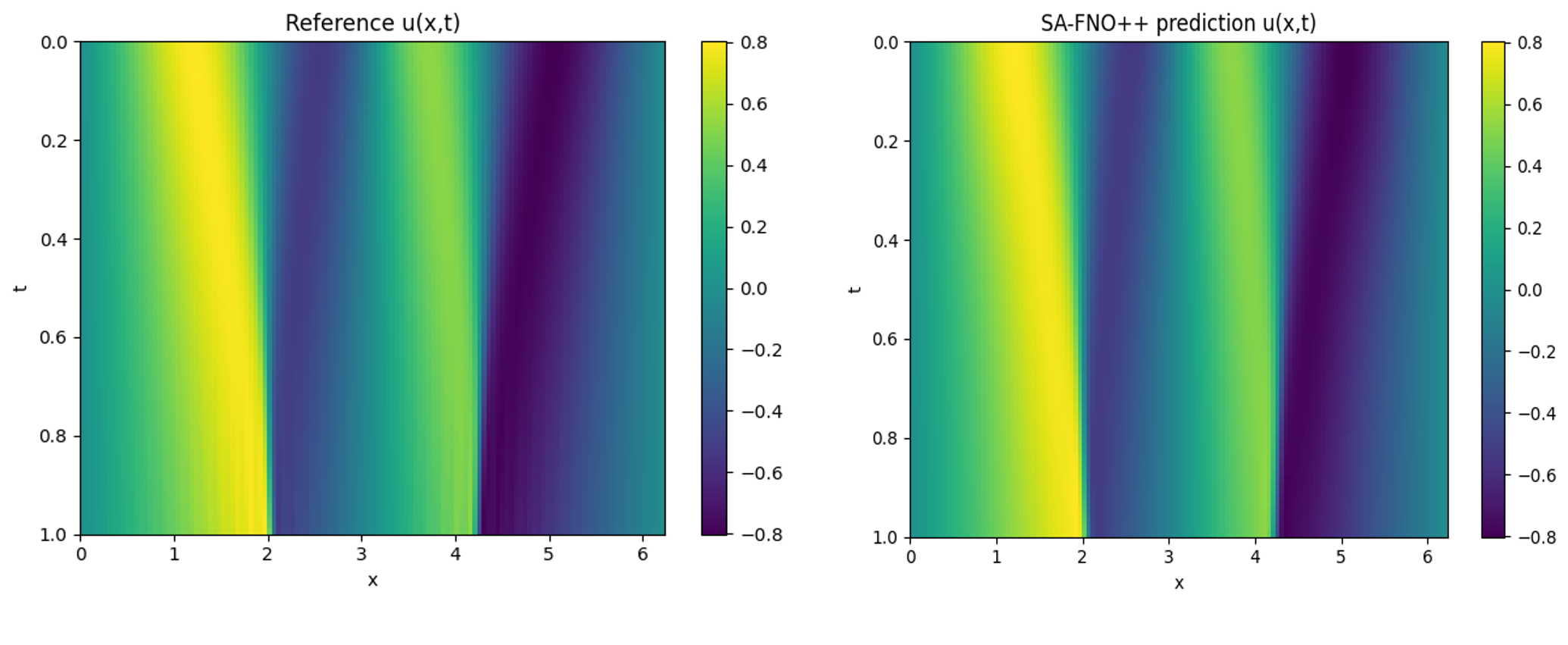
The viscous Burgers equation is a benchmark for nonlinear conservation laws with shock formation, and poses a difficulty in obtaining accurate numerical solutions of non-smooth problems. We propose an operator-learning neural network to solve the one-dimensional viscous Burgers equation using Fourier transforms, which we term shock-aware Fourier neural operator (SA-FNO). The SA-FNO model employs a mixed loss function combining a mean squared error associated with the model output with a component that incorporates the effects of shocks via a shock-aware weighted loss function derived from the spatial gradient magnitude of the reference solution at each spatial location. The model learns an operator mapping from the initial conditions and time to the solution field. The operator allows for direct predictions across the entire spatio-temporal solution field. Our numerical results demonstrate that the SA-FNO model achieves a relative L2 error of 0.0248 for the entire time interval, an improvement of approximately 22% over a baseline FNO model trained with only shock-aware loss. We conclude that by training with a mixed shock-aware loss, the SA-FNO model can provide improved representation of non-smooth solutions, without modifying the underlying neural network architecture.
Downloads
References
G. B. Whitham, Linear and Nonlinear Waves. New York, NY, USA: Wiley, 1974, ISBN: 978-0471940906.
X. Wang, S. Yi, H. Gu, J. Xu and W. Xu, “WF-PINNs: solving forward and inverse problems of Burgers equation with steep gradients using weak-form physics-informed neural networks,” Scientific Reports, vol. 15, art. 40555, 2025, doi: 10.1038/s41598-025-40555-4.
N. K. Kumar, “A review on Burgers’ equations and its applications,” J. Inst. Sci. Technol., vol. 28, no. 2, pp. 49–52, 2023, doi:10.3126/jist.v28i2.61073.
H. H. Abada and M. N. Nemah, “Numerical Solution of Burgers Equation using Finite Difference Methods: Analysis of Shock Waves in Aircraft Dynamics,” CFD Letters, vol. 17, no. 4, pp. 153–169, 2025.
S. S. V. Kolluru, N. Besse, and R. Pandit, “Novel spectral methods for shock capturing and the removal of tygers in computational fluid dynamics,” J. Comput. Phys., vol. 519, p. 113446, Sept. 2024, doi:10.1016/j.jcp.2024.113446.
A. H. Ali, A. S. Jaber, M. T. Yaseen, M. Rasheed, O. Bazighifan, and T. A. Nofal, “A Comparison of Finite Difference and Finite Volume Methods with Numerical Simulations: Burgers Equation Model,” Complexity, vol. 2022, pp. 1–9, 2022, doi: 10.1155/2022/9367638.
J. Chen, J. Nakao, J.-M. Qiu, and Y. Yang, “A high-order Eulerian-Lagrangian Runge-Kutta finite volume (EL-RK-FV) method for scalar nonlinear conservation laws,” arXiv, May 2024.
G. E. Karniadakis, I. G. Kevrekidis, L. Lu, P. Perdikaris, S. Wang, and L. Yang, “Physics-informed machine learning,” Nat. Rev. Phys., vol. 3, pp. 422–440, Jun. 2021, doi: 10.1038/s42254-021-00314-5.
M. Raissi, P. Perdikaris, and G. E. Karniadakis, “Physics-informed neural networks: A deep learning framework for solving forward and inverse problems involving nonlinear partial differential equations,” J. Comput. Phys., vol. 378, pp. 686–707, Feb. 2019, doi: 10.1016/j.jcp.2018.10.045.
L. Lu, P. Jin, G. Pang, Z. Zhang, and G. E. Karniadakis, “Learning nonlinear operators via DeepONet based on the universal approximation theorem of operators,” Nat. Mach. Intell., vol. 3, no. 3, pp. 218–229, 2021, doi: 10.1038/s42256-021-00302-5.
N. Kovachki et al., “Neural operator: Learning maps between function spaces,” J. Mach. Learn. Res., vol. 24, no. 89, pp. 4061–4157, 2023.
Z. Li, N. Kovachki, K. Azizzadenesheli, B. Liu, K. Bhattacharya, A. M. Stuart, and A. Anandkumar, “Fourier neural operator for parametric partial differential equations,” in Proc. Int. Conf. Learn. Representations (ICLR), 2021. [Online]. Available: OpenReview.
Z. Li, D. Z. Huang, B. Liu, and A. Anandkumar, “Fourier neural operator with learned deformations for PDEs on general geometries,” J. Mach. Learn. Res., vol. 24, no. 388, pp. 1–26, 2023.
Z. Li, D. Zhengyu Huang, B. Liu, and A. Anandkumar, “Physics-informed neural operator for learning partial differential equations,” ACM Trans. Math. Softw., 2024, doi: 10.1145/3648506.
J. Han, J. Chen, F. Hu, and L. Mei, “A study on shock capturing in the Burgers’ equation based on RH-piecewise PINNs,” Comput. Math. Appl., vol. 199, pp. 309–324, Dec. 2025, doi: 10.1016/j.camwa.2025.10.003.
Z. Li, N. Kovachki, K. Azizzadenesheli, B. Liu, K. Bhattacharya, A. M. Stuart, and A. Anandkumar, “Fourier neural operator for parametric partial differential equations,” in Proc. Int. Conf. Learn. Representations (ICLR), 2021.
N. Kovachki et al., “Neural operator: Learning maps between function spaces,” J. Mach. Learn. Res., vol. 24, no. 89, pp. 4061–4157, 2023.
L. Lu, P. Jin, G. Pang, Z. Zhang, and G. E. Karniadakis, “Learning nonlinear operators via DeepONet based on the universal approximation theorem of operators,” Nat. Mach. Intell., vol. 3, no. 3, pp. 218–229, 2021, doi: 10.1038/s42256-021-00302-5.
G. E. Karniadakis, I. G. Kevrekidis, L. Lu, P. Perdikaris, S. Wang, and L. Yang, “Physics-informed machine learning,” Nat. Rev. Phys., vol. 3, no. 6, pp. 422–440, Jun. 2021, doi: 10.1038/s42254-021-00314-5.
N. Liu, Y. Fan, X. Zeng, M. Klöwer, L. Zhang, and Y. Yu, “Harnessing the power of neural operators with automatically encoded conservation laws,” arXiv preprint arXiv:2403.03770, 2024. [Online]. Available: https://arxiv.org/abs/2403.03770
S. S. V. Kolluru, N. Besse, and R. Pandit, “Novel spectral methods for shock capturing and the removal of tygers in computational fluid dynamics,” J. Comput. Phys., vol. 519, p. 113446, 2024, doi: 10.1016/j.jcp.2024.113446.
X. Wang, S. Yi, H. Gu, J. Xu, and W. Xu, “WF-PINNs: Solving forward and inverse problems of Burgers equation with steep gradients using weak-form physics-informed neural networks,” Sci. Rep., vol. 15, art. no. 40555, 2025, doi: 10.1038/s41598-025-40555-4.
J. Han, J. Chen, F. Hu, and L. Mei, “A study on shock capturing in the Burgers’ equation based on RH-piecewise PINNs,” Comput. Math. Appl., vol. 199, pp. 309–324, 2025, doi: 10.1016/j.camwa.2025.10.003.
J. Chen, J. Nakao, J.-M. Qiu, and Y. Yang, “A high-order Eulerian–Lagrangian Runge–Kutta finite volume (EL-RK-FV) method for scalar nonlinear conservation laws,” arXiv preprint arXiv:2405.09835, 2024.
Downloads
Published
How to Cite
Issue
Section
License
Copyright (c) 2026 Dhuha Amer jaleel

This work is licensed under a Creative Commons Attribution-NonCommercial-NoDerivatives 4.0 International License.