Enhancing Software Requirements Classification Using AI-Based Text Processing Techniques
DOI:
https://doi.org/10.29304/jqcsm.2026.18.12595Keywords:
Software Requirements, Classification, Natural Language Processing, Deep Learning, BERT, Transformer Models, Requirements EngineeringAbstract
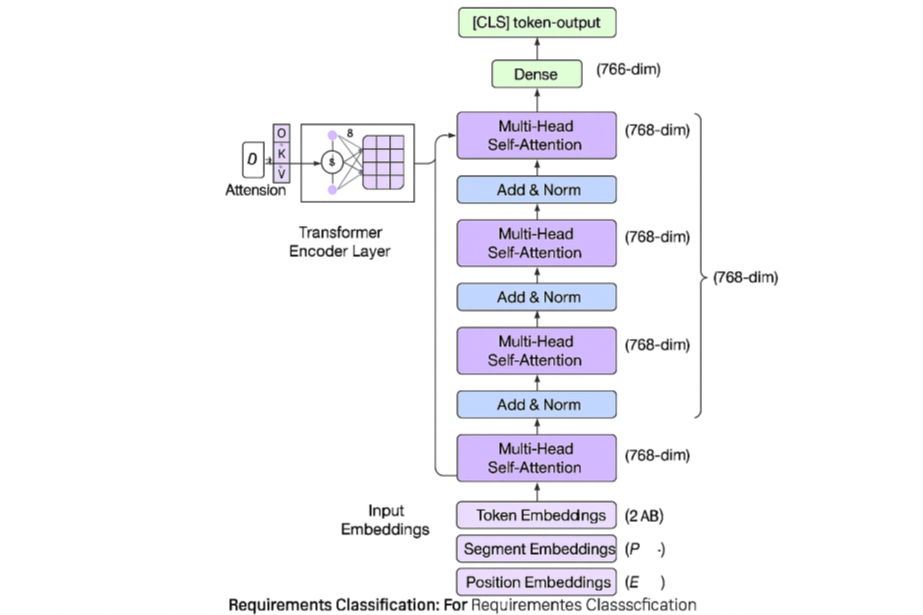
The categorization of software requirements as functional (FR) and non-functional requirements (NFR) is an important problem in software engineering that is widely performed using manual analysis by domain experts. The process is tedious, prone to errors, and lacks consistency from one project to another and from one organization to the next. New approaches are needed to address this challenge, we present such an approach, a new hybrid approach, which combines pre-trained transformer models to automate the requirements classification process, and machine learning techniques. We propose a novel methodology that utilizes BERT (Bidirectional Encoder Representations from Transformers) for contextual feature extraction, supplemented with multi-head attention mechanisms and bidirectional LSTM layers for capturing sequential dependencies in requirements text. We combine this deep learning architecture using ensemble classifiers (Support Vector Machines and Random Forest) with a weighted voting mechanism. We perform an experimental validation using two of the most common datasets (PROMISE with 625 requirements and PURE with 969 requirements), showing that our approach can achieve 94.2% accuracy and 94.1% F1 score for binary classification and an average of 89.7 F1 score across six categories (Security, Performance, Usability, Reliability, Portability, and Maintainability) for the multi-class NFR categorization task. Statistical significance tests further confirm that our hybrid model substantially outperforms each of the state-the-art approaches, with absolute gain ranging from 2.1% to 14.4% respective to different evaluation criteria. This directly addresses some of the main challenges in automated requirements engineering, and hence a unique, pragmatic approach towards large-scale software development processes.
Downloads
References
L. Zhao, W. Alhoshan, A. Ferrari, and K. J. Letsholo, "Natural language processing for requirements engineering: A systematic mapping study," ACM Computing Surveys, vol. 54, no. 3, pp. 1-35, 2021.
K. Kaur and P. Kaur, "The application of AI techniques in requirements classification: a systematic mapping," Artificial Intelligence Review, vol. 57, no. 1, pp. 1-40, 2024.
Q. A. Shreda and A. A. Hanani, "Identifying non-functional requirements from unconstrained documents using natural language processing and machine learning approaches," IEEE Access, vol. 9, pp. 19062-19075, 2021.
K. Liu, S. Reddivari, and K. Reddivari, "Artificial intelligence in software requirements engineering: State-of-the-art," in Proc. IEEE 23rd Int. Conf. Inf. Reuse Integration Data Sci., 2022, pp. 198-205.
G. Y. Quba, H. Al Qaisi, and A. Althunibat, "Software requirements classification using machine learning algorithms," in Proc. Int. Conf. Inf. Technol., 2021, pp. 485-490.
D. Kici, G. Malik, M. Cevik, D. Parikh, and A. Basar, "A BERT-based transfer learning approach to text classification on software requirements specifications," in Proc. Canadian Conf. AI, 2021, pp. 410-422.
A. F. Subahi, "BERT-based approach for greening software requirements engineering through non-functional requirements," IEEE Access, vol. 11, pp. 99234-99247, 2023.
A. Alhaizaey and M. Al-Mashari, "Automated classification and identification of non-functional requirements in agile-based requirements using pre-trained language models," IEEE Access, vol. 13, pp. 2156-2168, 2025.
X. Luo, Y. Xue, Z. Xing, and J. Sun, "PRCBERT: Prompt learning for requirement classification using BERT-based pretrained language models," in Proc. 37th IEEE/ACM Int. Conf. Automated Softw. Eng., 2022, pp. 1-12.
J. Winkler and A. Vogelsang, "Automatic classification of requirements based on convolutional neural networks," in Proc. IEEE 24th Int. Requirements Eng. Conf., 2016, pp. 39-45.
A. Vaswani, N. Shazeer, N. Parmar, J. Uszkoreit, L. Jones, A. N. Gomez, L. Kaiser, and I. Polosukhin, "Attention is all you need," in Proc. Advances Neural Inf. Process. Syst., 2017, pp. 5998-6008.
K. Kaur and P. Kaur, "SABDM: A self‐attention based bidirectional‐RNN deep model for requirements classification," Journal of Software: Evolution and Process, vol. 36, no. 2, e2430, 2024.
G. Li, C. Zheng, M. Li, and H. Wang, "Automatic requirements classification based on graph attention network," IEEE Access, vol. 10, pp. 28344-28356, 2022.
J. Abbas, A. Ahmad, and S. M. Shaheed, "Classification and comprehension of software requirements using ensemble learning," Computers, Materials & Continua, vol. 80, no. 2, pp. 2891-2908, 2024.
A. Rahman, A. Nayem, and S. Siddik, "Non-functional requirements classification using machine learning algorithms," International Journal of Intelligent Systems and Applications in Engineering, vol. 11, no. 6s, pp. 450-459, 2023.
F. Khayashi, B. Jamasb, R. Akbari, and M. Loni, "Deep learning methods for software requirement classification: A performance study on the PURE dataset," arXiv preprint arXiv:2211.05286, 2022.
Downloads
Published
How to Cite
Issue
Section
License
Copyright (c) 2026 Maryam Jawad Kadhim, Hasanain Hazim Azeez

This work is licensed under a Creative Commons Attribution-NonCommercial-NoDerivatives 4.0 International License.