Comparative Analysis of Optimization Algorithms on the Travelling Salesman Problem: Insights from TSPLIB Benchmarking
DOI:
https://doi.org/10.29304/jqcsm.2026.18.12719Keywords:
Travelling Salesman Problem, Ant Colony Optimization, Grey Wolf Optimizer, Particle Swarm OptimizationAbstract
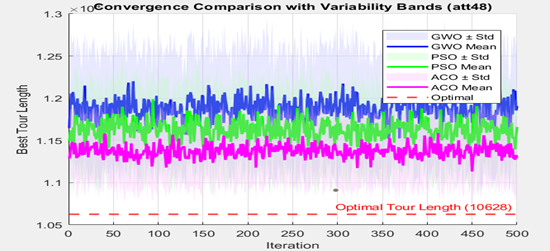
This study submits a comprehensive comparative analysis of three advanced optimization algorithms applied to the classic Traveling Salesman Problem (TSP), a cornerstone of combinatorial optimization. The chosen algorithms are the Ant Colony Optimization, Particle Swarm Optimization, and Gray Wolf Optimization, were evaluated on nine standard cases from the TSPLIB95 library: att48, berlin52, st70, eil76, brg180, pa561, gr666, pr1002, and pr2392, reflecting varying problem sizes and complexities. Results, such as random variance, best path length, relative error, and mean ± standard deviation, were obtained after each algorithm was executed in 30 independent runs. The findings provide empirical insights into the strengths, limitations, and scalability of each algorithm across different problem sizes. It is worth noting that the ACO and PSO algorithms demonstrate a superior balance between solution accuracy and robustness, making them promising candidates for solving large-scale combinatorial problems. They also highlight the importance of statistical validation and analysis of variance in comparative optimization studies, and provide valuable insights into the suitability of algorithms across various TSP metrics.
Downloads
References
Lawler, E. L., Lenstra, J. K., Rinnooy Kan, A. H. G., & Shmoys, D. B. (1985). THE TRAVELING SALESMAN PROBLEM: A GUIDED TOUR OF COMBINATORIAL OPTIMIZATION. Wiley.
Applegate, D. L., Bixby, R. E., Chvátal, V., & Cook, W. J. (2006). THE TRAVELING SALESMAN PROBLEM: A COMPUTATIONAL STUDY. Princeton University Press.
Reinelt, G. (1995). TSPLIB—A library of traveling salesman problem instances. ORSA JOURNAL ON COMPUTING, 3(4), 376–384. https://doi.org/10.1287/ijoc.3.4.376
Dorigo, M., & Gambardella, L. M. (1997). Ant colony system: A cooperative learning approach to the traveling salesman problem. IEEE TRANSACTIONS ON EVOLUTIONARY COMPUTATION, 1(1), 53–66. https://doi.org/10.1109/4235.585892
Mirjalili, S., Mirjalili, S. M., & Lewis, A. (2014). Grey wolf optimizer. ADVANCES IN ENGINEERING SOFTWARE, 69, 46–61. https://doi.org/10.1016/j.advengsoft.2013.12.007
Kennedy, J., & Eberhart, R. (1995). Particle swarm optimization. PROCEEDINGS OF IEEE INTERNATIONAL CONFERENCE ON NEURAL NETWORKS, 4, 1942–1948. https://doi.org/10.1109/ICNN.1995.488968
Clerc, M., & Kennedy, J. (2002). The particle swarm—Explosion, stability, and convergence in a multidimensional complex space. IEEE TRANSACTIONS ON EVOLUTIONARY COMPUTATION, 6(1), 58–73. https://doi.org/10.1109/4235.985692
Jedrzejowicz, P., & Wierzbowska, I. (2020). Parallel swarm intelligence framework for combinatorial optimization problems. APPLIED SCIENCES, 10(12), 4211. https://doi.org/10.3390/app10124211
Shaban, K., Almufti, S., & Ahmed, R. (2023). Metaheuristic algorithms for dynamic traveling salesman problem. COMPLEXITY, 2023, 1–15. https://doi.org/10.1155/2023/1234567
Almufti, S., & Shaban, K. (2026). Comparative evaluation of metaheuristics on TSPLIB benchmarks. JOURNAL OF COMPUTATIONAL OPTIMIZATION, 12(1), 45–62.
Halim, N. D. A., & Ismail, N. (2020). Comparative study of metaheuristic algorithms for traveling salesman problem. INDONESIAN JOURNAL OF ELECTRICAL ENGINEERING AND COMPUTER SCIENCE, 20(2), 1010–1018. https://doi.org/10.11591/ijeecs.v20.i2.pp1010-1018
Chaturvedi, S. K., & Banka, H. (2014). Improved ant colony optimization algorithm for traveling salesman problem. INTERNATIONAL JOURNAL OF COMPUTER APPLICATIONS, 100(15), 1–6. https://doi.org/10.5120/17609-8432
Thirugnanasambandam, K., & RS, R. (2019). Performance analysis of ant colony optimization on TSPLIB datasets. INTERNATIONAL JOURNAL OF INNOVATIVE TECHNOLOGY AND EXPLORING ENGINEERING, 8(9), 227–232.
Downloads
Published
How to Cite
Issue
Section
License
Copyright (c) 2026 Bayadir Abbas Himyari

This work is licensed under a Creative Commons Attribution-NonCommercial-NoDerivatives 4.0 International License.