Prediction of the Surface Air Temperature in Iraq based on LSTM With Random Forest Regressor
DOI:
https://doi.org/10.29304/jqcsm.2026.18.22842Keywords:
Surface Air Temperature, Random Forest Regressor, ARIMA, predictionAbstract
A B S T R A C T
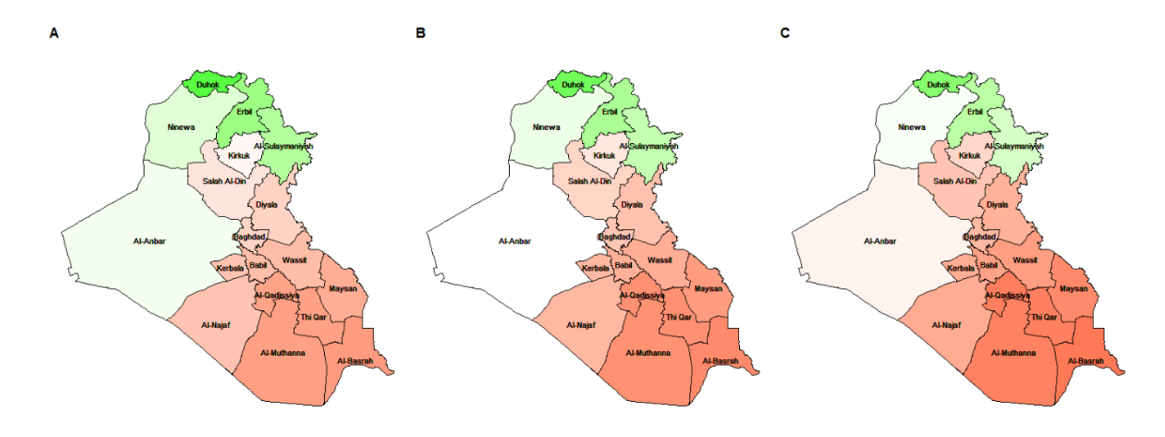
The increasing temperature in the world in this recent century convert to one of the most important challenges in the literatures. It affects many aspects of life in economy, productivity, income, health and environments. In this regard, the appropriate forecasting of temperature is the main task of this research. The annual average mean surface air temperature from 1900 to 2022 were gathered for 18 provinces in Iraq. The annual observation and five-year smoothing data were imported into the LSTM models with the Random Forest Regressor. Finally, the 10 years forecast are provided intro two periods: 1) 2023-2027 and 2) 2028-2032 for each province. The top 3 provinces with the lowest and highest temperature in all over the time are: The Duhok, Erbil and Sulaymaniyah have the lowest average 15.30°, 17.26° and 18.00° respectively. The Basrah, Dhi Qar and Muthanna have the highest average with 25.17°, 24.83° and 24.71°, respectively. The average and standard deviation of five-year forecast for Iraq with smooth data are 23.781 (0.013) for 2023-2027 and 23.767 (0.012) for 2028-2032.The LSTM models select the best model for temperature forecast and they estimate the positive increment on each province.
Downloads
References
K. Riahi et al., “RCP 8.5—A scenario of comparatively high greenhouse gas emissions,” CLIMATIC CHANGE, vol. 109, (2011), pp. 33–57.
M. Kalkuhl and L. Wenz, “The impact of climate conditions on economic production: Evidence from a global panel of regions,” J. ENVIRON. ECON. MANAGE., vol. 103, (2020), p. 102360.
A. Ahmadalipour and H. Moradkhani, “Escalating heat-stress mortality risk due to global warming in the Middle East and North Africa (MENA),” ENVIRON. INT., vol. 117, (2018), pp. 215–225.
S. A. Salman et al., “Selection of climate models for projection of spatiotemporal changes in temperature of Iraq with uncertainties,” ATMOS. RES., vol. 213, (2018), pp. 509–522.
T. Dimri, S. Ahmad, and M. Sharif, “Time series analysis of climate variables using seasonal ARIMA approach,” J. EARTH SYST. SCI., vol. 129, (2020), pp. 1–16.
M. Amjad et al., “Analysis of temperature variability, trends and prediction in the Karachi Region of Pakistan using ARIMA models,” ATMOSPHERE, vol. 14, no. 1, (2022), p. 88.
A. H. Nury, K. Hasan, and M. J. B. Alam, “Comparative study of wavelet-ARIMA and wavelet-ANN models for temperature time series data in northeastern Bangladesh,” J. KING SAUD UNIV.–SCI., vol. 29, no. 1, (2017), pp. 47–61.
E. De Saa and L. Ranathunga, “Comparison between ARIMA and deep learning models for temperature forecasting,” ARXIV PREPRINT ARXIV:2011.04452, (2020).
“Average Mean Surface Air Temperature 1991–2020,” WORLD BANK CLIMATE KNOWLEDGE PORTAL, (2024). [Online]. Available: https://climateknowledgeportal.worldbank.org/country/iraq/climate-data-historical
J. S. Racine, REPRODUCIBLE ECONOMETRICS USING R. Oxford: Oxford University Press, (2019).
R. J. Hyndman et al., “Package ‘forecast’,” (2020). [Online]. Available: https://cran.r-project.org/web/packages/forecast/forecast.pdf
Z. M. Mohammed and W. H. Hassan, “Climate change and the projection of future temperature and precipitation in southern Iraq using a LARS-WG model,” MODEL. EARTH SYST. ENVIRON., vol. 8, no. 3, (2022), pp. 4205–4218.
W. H. Hassan and B. K. Nile, “Climate change and predicting future temperature in Iraq using CanESM2 and HadCM3 modeling,” MODEL. EARTH SYST. ENVIRON., vol. 7, (2021), pp. 737–748.
S. A. Al-Asadi et al., “Modeling the impact of land use changes on the trend of monthly temperature in Basrah province, Southern Iraq,” MODEL. EARTH SYST. ENVIRON., vol. 10, no. 3, (2024), pp. 3727–3744.
H. Tao et al., “Megacities’ environmental assessment for Iraq region using satellite image and geo-spatial tools,” ENVIRON. SCI. POLLUT. RES., vol. 30, no. 11, (2023), pp. 30984–31034.
B. M. Hashim et al., “Seasonal correlation of meteorological parameters and PM2.5 with the COVID-19 confirmed cases and deaths in Baghdad, Iraq,” INT. J. DISASTER RISK REDUCT., vol. 94, (2023), p. 103799.
M. Fayaz, “The lock-down effects of COVID-19 on the air pollution indices in Iran and its neighbors,” MODEL. EARTH SYST. ENVIRON., vol. 9, no. 1, (2023), pp. 669–675.
B. M. Hashim et al., “Impact of COVID-19 lockdown on NO₂, O₃, PM2.5 and PM10 concentrations and assessing air quality changes in Baghdad, Iraq,” SCI. TOTAL ENVIRON., vol. 754, (2021), p. 141978.
A. Rasul and S. A. Ibrahim, “Relationship between weather and sociodemographic indicators and COVID-19 infection in Iraq,” SSRN, (2020).
H. N. Nasir and A. N. A. Hamdan, “Short-term and long-term drought forecasts in Iraq using neural networks and GIS,” in IOP CONF. SER.: MATER. SCI. ENG.. IOP Publishing, (2021).
M. S. Sachit et al., “Combining re-analyzed climate data and landcover products to assess the temporal complementarity of wind and solar resources in Iraq,” SUSTAINABILITY, vol. 14, no. 1, (2021), p. 388.
W. Terink, W. W. Immerzeel, and P. Droogers, “Climate change projections of precipitation and reference evapotranspiration for the Middle East and Northern Africa until 2050,” INT. J. CLIMATOL., vol. 33, no. 14, (2013), pp. 3055–3072.
Downloads
Published
How to Cite
Issue
Section
License
Copyright (c) 2026 Nadhim Azeez Sayel, Mohammed Ali Mohammed

This work is licensed under a Creative Commons Attribution-NonCommercial-NoDerivatives 4.0 International License.