A Two-Dimensional Reaction–Diffusion Model for Tumor–Drug Interaction: Analytical Solution via Triple Laplace Transform and Accelerated Adomian Method
DOI:
https://doi.org/10.29304/jqcsm.2026.18.32873Keywords:
Reaction–Diffusion equation, Triple Laplace Transform, Adomian decomposition Method.Abstract
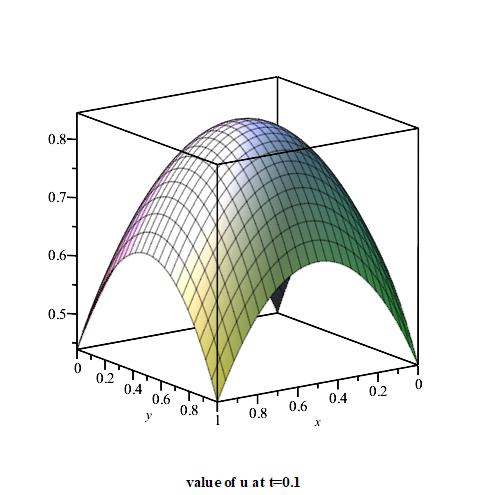
Mathematical modeling emerged as an important tool for understanding the dynamics of tumors and improving strategies for drug delivery. In this study, we constructed a two-dimensional reaction-diffusion model of a chemotherapeutic agent and a proliferating tumor which describes their spatiotemporal interaction. The model captures nonlinear decay of the tumor due to drug effect, logistic growth of the tumor up to a carrying capacity, and biological diffusion for both species. The solution is found using a hybrid approach which consists of the triple Laplace transform in space and time along with a modified Accelerated Adomian Decomposition Method (AADM). We start our analysis with bio plausible initial conditions which arise from a parabolic profile to simulate localized drug infusion and study the dynamics of drug concentration as well as the tumor concentration for a variety of parameters. Our findings illustrate the existence of critical drug and tumor suppression levels, and reinforce the nonlinearity of treatment response with diffusion, reaction parameters, and their efficacy. The analysis in this study is a step towards formulating clinically relevant solutions, optimizing treatment designs, and serving as a starting point for more bio realistic model additions.
Downloads
Downloads
Published
How to Cite
Issue
Section
License
Copyright (c) 2026 Azhar Mohamed Hajo, Ahmed Farooq Qasim

This work is licensed under a Creative Commons Attribution-NonCommercial-NoDerivatives 4.0 International License.