Rigorous Error Quantification and Adaptive Sampling Diagnostics for Physics-Informed Neural Networks
DOI:
https://doi.org/10.29304/jqcsm.2026.18.33006Keywords:
Physics-informed neural networks, generalization error, 5G Networks, residual-based adaptive sampling, conditional stability, quadrature error, partial differential equations, scientific machine learningAbstract
Physics-informed neural networks solve partial differential equations by including differential operators and auxiliary conditions in the training objective. Nevertheless, since approximation error, optimization error, sampling error, and PDE stability interact with one another, one cannot infer their practical reliability from simply the ultimate training loss. This study develops a stability-based numerical framework for quantifying and diagnosing PINN errors. The framework separates the empirical residual loss from continuous residual norms, creates explicit quadrature defects, and derives a sampling-aware residual-to-solution estimate within the stated conditional stability assumption. The analysis includes Poisson, Heat, Wave, and Stokes equations, for elliptic, parabolic, hyperbolic, and saddle-point systems.
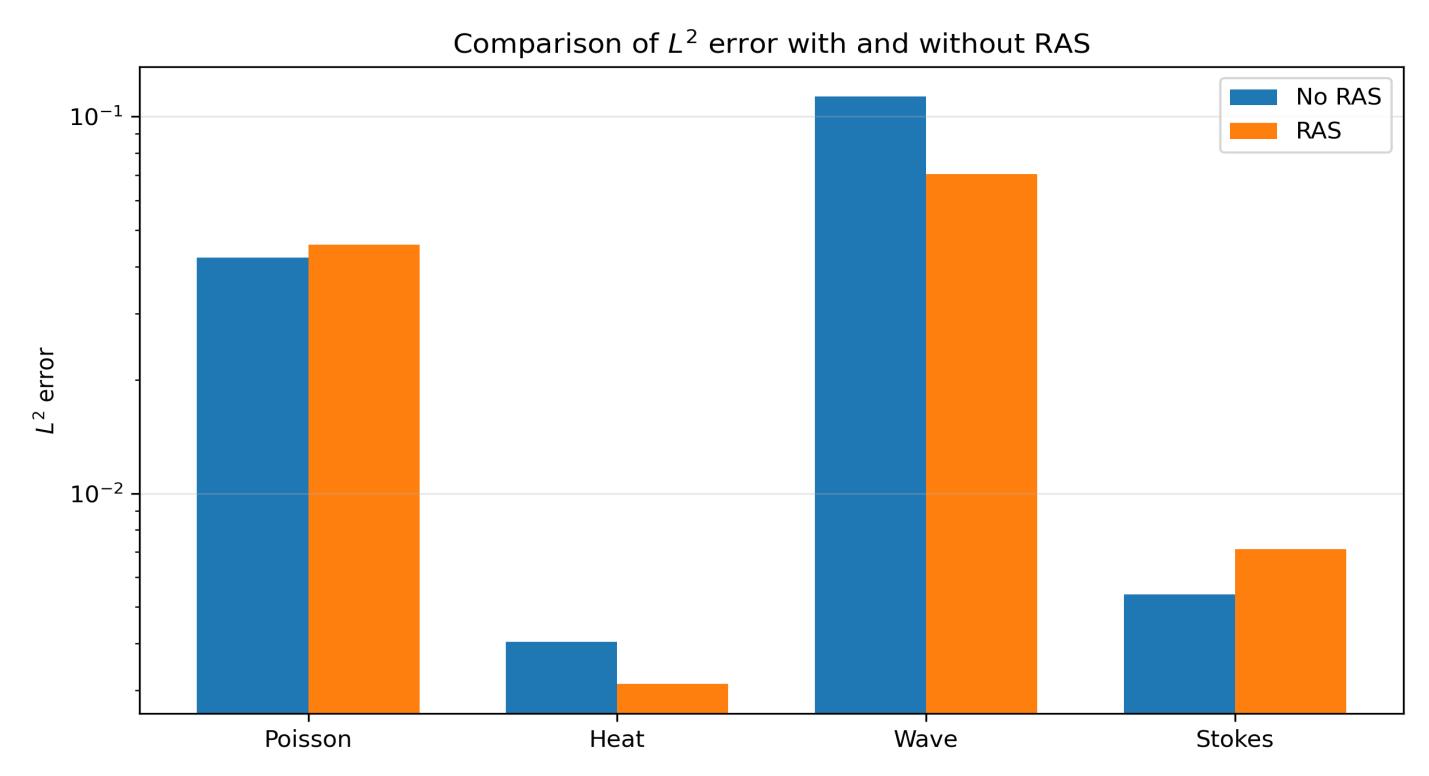
Existing numerical experiments have compared fixed collocation sampling with residual-based adaptive sampling and explored the sensitivity to collocation-set size and network depth. Adaptive sampling decreases the generalization error of Heat and Wave equations by roughly 25.3% and 35.9%, respectively, but it raises it for Poisson and Stokes, which reflects adaptive enrichment to be problem dependent. The results also show non-monotone error behavior with respect to training-point count and network depth, emphasizing the need for replicated experiments and cost-aware model selection. The proposed framework provides a mathematically explicit route from empirical training diagnostics to defensible numerical validation and identifies the experiments required for reliable high-standard PINN assessment.
Downloads
Downloads
Published
How to Cite
Issue
Section
License
Copyright (c) 2026 Bilal Ahmed Shihab

This work is licensed under a Creative Commons Attribution-NonCommercial-NoDerivatives 4.0 International License.