A hybrid of Grey Wolf (GWO) and Particle Swarm Optimization (PSO) to predict chronic kidney disease
DOI:
https://doi.org/10.29304/jqcsm.2026.18.22597Keywords:
Chronic Kidney Disease (CKD), Feature Selection, Hybrid Binary Grey Wolf Optimization and Particle Swarm Optimization (BGWOPSO), Classification, Machine LearningAbstract
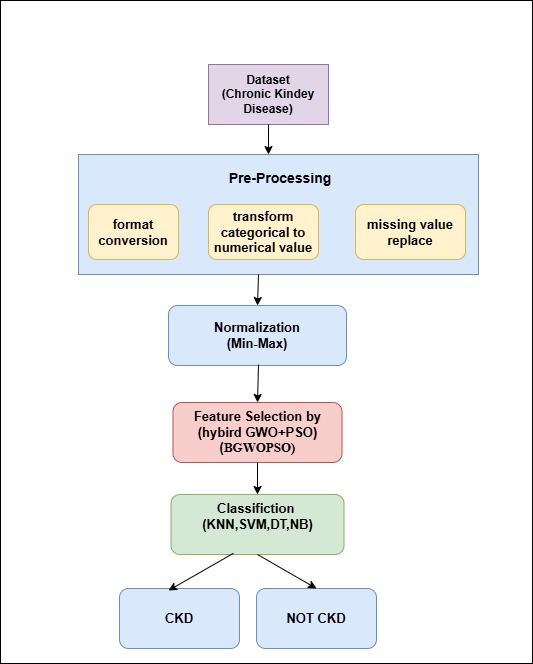
Chronic kidney illness represents one of the greatest chronic ailments, with a considerable rate of mortality around the globe. It is also one of the most critical illnesses nowadays, where an accurate diagnosis must be made as soon as feasible. Several studies have recently focused on creating computer-aided techniques to identify CKD in the early stages. In medical science, machine learning methods are now a valuable tool, contributing significantly to disease predictions. The primary purpose of the present research is to construct a reliable prognostic model using a hybrid of Grey Wolf and Particle Swarm Optimization for the choice of features to support classifiers on the CKD dataset. This approach helps reduce dimensionality and enhance model performance. In CKD data analysis, four ML algorithms are applied: KNN, NB, DT, and SVM. The experimental findings were implemented on the CKD dataset, and the results show that the suggested approach achieved exceptional matching performance (100%, 98.75%, 100%, and 100%), respectively. In this aspect, machine learning algorithms have proven to be promising and point towards the future of disease diagnosis.
Downloads
References
M. M. Nishat et al., “A Comprehensive Analysis on Detecting Chronic Kidney Disease by Employing Machine Learning Algorithms,” EAI Endorsed Trans. Pervasive Heal. Technol., vol. 7, no. 29, Nov. 2021, doi: 10.4108/eai.13-8-2021.170671.
M. Evans et al., “A Narrative Review of Chronic Kidney Disease in Clinical Practice: Current Challenges and Future Perspectives,” Advances in Therapy, vol. 39, no. 1. Adis, pp. 33–43, Jan. 01, 2022. doi: 10.1007/s12325-021-01927-z.
S. Elkholy, A. Rezk, A. A. El, and F. Saleh, “Enhanced Optimized Classification Model of Chronic Kidney Disease.” [Online]. Available: www.ijacsa.thesai.org
P. Düsing et al., “Vascular pathologies in chronic kidney disease: pathophysiological mechanisms and novel therapeutic approaches,” 2037, doi: 10.1007/s00109-021-02037-7/Published.
C. Kaur, M. S. Kumar, A. Anjum, M. B. Binda, M. R. Mallu, and M. S. Al Ansari, “Chronic Kidney Disease Prediction Using Machine Learning,” J. Adv. Inf. Technol., vol. 14, no. 2, pp. 384–391, 2023, doi: 10.12720/jait.14.2.384-391.
M. S. Arif, A. Mukheimer, and D. Asif, “Enhancing the Early Detection of Chronic Kidney Disease: A Robust Machine Learning Model,” Big Data Cogn. Comput., vol. 7, no. 3, Sep. 2023, doi: 10.3390/bdcc7030144.
D. Swain et al., “A Robust Chronic Kidney Disease Classifier Using Machine Learning,” Electron., vol. 12, no. 1, Jan. 2023, doi: 10.3390/electronics12010212.
P. Ramanaiah, “Feature Selection AI Technique for Predicting Chronic Kidney Disease,” Am. J. Artif. Intell., vol. 8, no. 2, pp. 32–40, Jul. 2024, doi: 10.11648/j.ajai.20240802.11.
E. N. Yildiz, E. Cengil, M. Yildirim, and H. Bingol, “Diagnosis of Chronic Kidney Disease Based on CNN and LSTM,” Acadlore Trans. AI Mach. Learn., vol. 2, no. 2, pp. 66–74, Jun. 2023, doi: 10.56578/ataiml020202.
R. H. Aswathy et al., “Optimized tuned deep learning model for chronic kidney disease classification,” Comput. Mater. Contin., vol. 70, no. 2, pp. 2097–2111, 2022, doi: 10.32604/cmc.2022.019790.
W. N. Ismail, “Snake-Efficient Feature Selection-Based Framework for Precise Early Detection of Chronic Kidney Disease,” Diagnostics, vol. 13, no. 15, Aug. 2023, doi: 10.3390/diagnostics13152501.
P. Chittora et al., “Prediction of Chronic Kidney Disease - A Machine Learning Perspective,” IEEE Access, vol. 9. Institute of Electrical and Electronics Engineers Inc., pp. 17312–17334, 2021. doi: 10.1109/ACCESS.2021.3053763.
V. Singh, V. K. Asari, and R. Rajasekaran, “A Deep Neural Network for Early Detection and Prediction of Chronic Kidney Disease,” Diagnostics, vol. 12, no. 1, Jan. 2022, doi: 10.3390/diagnostics12010116.
P. K. Kaur, K. P. S. Attwal, and H. Singh, “Firefly Optimization Based Noise Additive Privacy-Preserving Data Classification Technique to Predict Chronic Kidney Disease,” Rev. d’Intelligence Artif., vol. 35, no. 6, pp. 447–456, Dec. 2021, doi: 10.18280/ria.350602.
E. M. Senan et al., “Diagnosis of Chronic Kidney Disease Using Effective Classification Algorithms and Recursive Feature Elimination Techniques,” J. Healthc. Eng., vol. 2021, 2021, doi: 10.1155/2021/1004767.
F. Wang, H. Zhang, and A. Zhou, “A particle swarm optimization algorithm for mixed-variable optimization problems,” Swarm Evol. Comput., vol. 60, Feb. 2021, doi: 10.1016/j.swevo.2020.100808.
A. G. Gad, “Particle Swarm Optimization Algorithm and Its Applications: A Systematic Review,” Arch. Comput. Methods Eng., vol. 29, no. 5, pp. 2531–2561, Aug. 2022, doi: 10.1007/s11831-021-09694-4.
E. H. Houssein, A. G. Gad, K. Hussain, and P. Nagaratnam, “Major Advances in Particle Swarm Optimization : Theory , Analysis , and Application,” Swarm Evol. Comput., vol. 63, no. February, p. 100868, 2021, doi: 10.1016/j.swevo.2021.100868.
F. Al Thobiani, S. Khatir, B. Benaissa, E. Ghandourah, S. Mirjalili, and M. Abdel Wahab, “A hybrid PSO and Grey Wolf Optimization algorithm for static and dynamic crack identification,” Theor. Appl. Fract. Mech., vol. 118, Apr. 2022, doi: 10.1016/j.tafmec.2021.103213.
S. N. Makhadmeh et al., “Recent Advances in Grey Wolf Optimizer, its Versions and Applications: Review,” IEEE Access, vol. 12, pp. 22991–23028, 2024, doi: 10.1109/ACCESS.2023.3304889.
A. K. Abasi, A. T. Khader, and M. A. Al-betar, “An Improved Text Feature Selection for Clustering Using Binary Grey Wolf An Improved Text Feature Selection for Clustering Using Binary Grey Wolf Optimizer,” no. January, 2021, doi: 10.1007/978-981-15-5281-6.
Q. Al-Tashi, S. J. Abdul Kadir, H. M. Rais, S. Mirjalili, and H. Alhussian, “Binary Optimization Using Hybrid Grey Wolf Optimization for Feature Selection,” IEEE Access, vol. 7, pp. 39496–39508, 2019, doi: 10.1109/ACCESS.2019.2906757.
M. Bansal, A. Goyal, and A. Choudhary, “A comparative analysis of K-Nearest Neighbor , Genetic , Support Vector Machine , Decision Tree , and Long Short Term Memory algorithms in machine learning,” Decis. Anal. J., vol. 3, no. May, p. 100071, 2022, doi: 10.1016/j.dajour.2022.100071.
A. Roy and S. Chakraborty, “Support vector machine in structural reliability analysis: A review,” Reliability Engineering and System Safety, vol. 233. Elsevier Ltd, May 01, 2023. doi: 10.1016/j.ress.2023.109126.
A. Kurani, P. Doshi, A. Vakharia, and M. Shah, “A Comprehensive Comparative Study of Artificial Neural Network (ANN) and Support Vector Machines (SVM) on Stock Forecasting,” Annals of Data Science, vol. 10, no. 1. Springer Science and Business Media Deutschland GmbH, pp. 183–208, Feb. 01, 2023. doi: 10.1007/s40745-021-00344-x.
C. Series, “Naive Bayes Algorithm Implementation Based on Particle Swarm Optimization in Analyzing the Defect Product Naive Bayes Algorithm Implementation Based on Particle Swarm Optimization in Analyzing the Defect Product”, doi: 10.1088/1742-6596/1845/1/012020.
S. S. Reddy, N. Sethi, R. Rajender, and G. Mahesh, “Forecasting Diabetes Correlated Non-alcoholic Fatty Liver Disease by Exploiting Naïve Bayes Tree,” EAI Endorsed Trans. Scalable Inf. Syst., vol. 10, no. 1, 2023, doi: 10.4108/eai.29-4-2022.173975.
H. Dabiri, V. Farhangi, M. J. Moradi, M. Zadehmohamad, and M. Karakouzian, “Applications of Decision Tree and Random Forest as Tree-Based Machine Learning Techniques for Analyzing the Ultimate Strain of Spliced and Non-Spliced Reinforcement Bars,” Appl. Sci., vol. 12, no. 10, May 2022, doi: 10.3390/app12104851.
K. M. Sujon, R. Hassan, K. Choi, and A. Samad, “empirical evidence from advanced statistics , ML , and XAI for evaluating business predictive models,” 2025.
I. Ariawan et al., “Extraction of Morphometric Features the shape of mangrove leaves based on digital images and classification using the Support Vector Machine Extraction of Morphometric Features the shape of mangrove leaves based on digital images and classification using ”, doi: https://doi.org/10.33640/2405-609X.3349.
M. M. Nishat et al., “A Comprehensive Analysis on Detecting Chronic Kidney Disease by Employing Machine Learning Algorithms,” EAI Endorsed Trans. Pervasive Heal. Technol., vol. 7, no. 29, Nov. 2021, doi: 10.4108/eai.13-8-2021.170671.
M. Evans et al., “A Narrative Review of Chronic Kidney Disease in Clinical Practice: Current Challenges and Future Perspectives,” Advances in Therapy, vol. 39, no. 1. Adis, pp. 33–43, Jan. 01, 2022. doi: 10.1007/s12325-021-01927-z.
S. Elkholy, A. Rezk, A. A. El, and F. Saleh, “Enhanced Optimized Classification Model of Chronic Kidney Disease.” [Online]. Available: www.ijacsa.thesai.org
P. Düsing et al., “Vascular pathologies in chronic kidney disease: pathophysiological mechanisms and novel therapeutic approaches,” 2037, doi: 10.1007/s00109-021-02037-7/Published.
C. Kaur, M. S. Kumar, A. Anjum, M. B. Binda, M. R. Mallu, and M. S. Al Ansari, “Chronic Kidney Disease Prediction Using Machine Learning,” J. Adv. Inf. Technol., vol. 14, no. 2, pp. 384–391, 2023, doi: 10.12720/jait.14.2.384-391.
M. S. Arif, A. Mukheimer, and D. Asif, “Enhancing the Early Detection of Chronic Kidney Disease: A Robust Machine Learning Model,” Big Data Cogn. Comput., vol. 7, no. 3, Sep. 2023, doi: 10.3390/bdcc7030144.
D. Swain et al., “A Robust Chronic Kidney Disease Classifier Using Machine Learning,” Electron., vol. 12, no. 1, Jan. 2023, doi: 10.3390/electronics12010212.
P. Ramanaiah, “Feature Selection AI Technique for Predicting Chronic Kidney Disease,” Am. J. Artif. Intell., vol. 8, no. 2, pp. 32–40, Jul. 2024, doi: 10.11648/j.ajai.20240802.11.
E. N. Yildiz, E. Cengil, M. Yildirim, and H. Bingol, “Diagnosis of Chronic Kidney Disease Based on CNN and LSTM,” Acadlore Trans. AI Mach. Learn., vol. 2, no. 2, pp. 66–74, Jun. 2023, doi: 10.56578/ataiml020202.
R. H. Aswathy et al., “Optimized tuned deep learning model for chronic kidney disease classification,” Comput. Mater. Contin., vol. 70, no. 2, pp. 2097–2111, 2022, doi: 10.32604/cmc.2022.019790.
W. N. Ismail, “Snake-Efficient Feature Selection-Based Framework for Precise Early Detection of Chronic Kidney Disease,” Diagnostics, vol. 13, no. 15, Aug. 2023, doi: 10.3390/diagnostics13152501.
P. Chittora et al., “Prediction of Chronic Kidney Disease - A Machine Learning Perspective,” IEEE Access, vol. 9. Institute of Electrical and Electronics Engineers Inc., pp. 17312–17334, 2021. doi: 10.1109/ACCESS.2021.3053763.
V. Singh, V. K. Asari, and R. Rajasekaran, “A Deep Neural Network for Early Detection and Prediction of Chronic Kidney Disease,” Diagnostics, vol. 12, no. 1, Jan. 2022, doi: 10.3390/diagnostics12010116.
P. K. Kaur, K. P. S. Attwal, and H. Singh, “Firefly Optimization Based Noise Additive Privacy-Preserving Data Classification Technique to Predict Chronic Kidney Disease,” Rev. d’Intelligence Artif., vol. 35, no. 6, pp. 447–456, Dec. 2021, doi: 10.18280/ria.350602.
E. M. Senan et al., “Diagnosis of Chronic Kidney Disease Using Effective Classification Algorithms and Recursive Feature Elimination Techniques,” J. Healthc. Eng., vol. 2021, 2021, doi: 10.1155/2021/1004767.
F. Wang, H. Zhang, and A. Zhou, “A particle swarm optimization algorithm for mixed-variable optimization problems,” Swarm Evol. Comput., vol. 60, Feb. 2021, doi: 10.1016/j.swevo.2020.100808.
A. G. Gad, “Particle Swarm Optimization Algorithm and Its Applications: A Systematic Review,” Arch. Comput. Methods Eng., vol. 29, no. 5, pp. 2531–2561, Aug. 2022, doi: 10.1007/s11831-021-09694-4.
E. H. Houssein, A. G. Gad, K. Hussain, and P. Nagaratnam, “Major Advances in Particle Swarm Optimization : Theory , Analysis , and Application,” Swarm Evol. Comput., vol. 63, no. February, p. 100868, 2021, doi: 10.1016/j.swevo.2021.100868.
F. Al Thobiani, S. Khatir, B. Benaissa, E. Ghandourah, S. Mirjalili, and M. Abdel Wahab, “A hybrid PSO and Grey Wolf Optimization algorithm for static and dynamic crack identification,” Theor. Appl. Fract. Mech., vol. 118, Apr. 2022, doi: 10.1016/j.tafmec.2021.103213.
S. N. Makhadmeh et al., “Recent Advances in Grey Wolf Optimizer, its Versions and Applications: Review,” IEEE Access, vol. 12, pp. 22991–23028, 2024, doi: 10.1109/ACCESS.2023.3304889.
A. K. Abasi, A. T. Khader, and M. A. Al-betar, “An Improved Text Feature Selection for Clustering Using Binary Grey Wolf An Improved Text Feature Selection for Clustering Using Binary Grey Wolf Optimizer,” no. January, 2021, doi: 10.1007/978-981-15-5281-6.
Q. Al-Tashi, S. J. Abdul Kadir, H. M. Rais, S. Mirjalili, and H. Alhussian, “Binary Optimization Using Hybrid Grey Wolf Optimization for Feature Selection,” IEEE Access, vol. 7, pp. 39496–39508, 2019, doi: 10.1109/ACCESS.2019.2906757.
M. Bansal, A. Goyal, and A. Choudhary, “A comparative analysis of K-Nearest Neighbor , Genetic , Support Vector Machine , Decision Tree , and Long Short Term Memory algorithms in machine learning,” Decis. Anal. J., vol. 3, no. May, p. 100071, 2022, doi: 10.1016/j.dajour.2022.100071.
A. Roy and S. Chakraborty, “Support vector machine in structural reliability analysis: A review,” Reliability Engineering and System Safety, vol. 233. Elsevier Ltd, May 01, 2023. doi: 10.1016/j.ress.2023.109126.
A. Kurani, P. Doshi, A. Vakharia, and M. Shah, “A Comprehensive Comparative Study of Artificial Neural Network (ANN) and Support Vector Machines (SVM) on Stock Forecasting,” Annals of Data Science, vol. 10, no. 1. Springer Science and Business Media Deutschland GmbH, pp. 183–208, Feb. 01, 2023. doi: 10.1007/s40745-021-00344-x.
C. Series, “Naive Bayes Algorithm Implementation Based on Particle Swarm Optimization in Analyzing the Defect Product Naive Bayes Algorithm Implementation Based on Particle Swarm Optimization in Analyzing the Defect Product”, doi: 10.1088/1742-6596/1845/1/012020.
S. S. Reddy, N. Sethi, R. Rajender, and G. Mahesh, “Forecasting Diabetes Correlated Non-alcoholic Fatty Liver Disease by Exploiting Naïve Bayes Tree,” EAI Endorsed Trans. Scalable Inf. Syst., vol. 10, no. 1, 2023, doi: 10.4108/eai.29-4-2022.173975.
H. Dabiri, V. Farhangi, M. J. Moradi, M. Zadehmohamad, and M. Karakouzian, “Applications of Decision Tree and Random Forest as Tree-Based Machine Learning Techniques for Analyzing the Ultimate Strain of Spliced and Non-Spliced Reinforcement Bars,” Appl. Sci., vol. 12, no. 10, May 2022, doi: 10.3390/app12104851.
K. M. Sujon, R. Hassan, K. Choi, and A. Samad, “empirical evidence from advanced statistics , ML , and XAI for evaluating business predictive models,” 2025.
I. Ariawan et al., “Extraction of Morphometric Features the shape of mangrove leaves based on digital images and classification using the Support Vector Machine Extraction of Morphometric Features the shape of mangrove leaves based on digital images and classification using ”, doi: https://doi.org/10.33640/2405-609X.3349.
Downloads
Published
How to Cite
Issue
Section
License
Copyright (c) 2026 Nisreen Mizeheir AL-kardhi

This work is licensed under a Creative Commons Attribution-NonCommercial-NoDerivatives 4.0 International License.