Development and Comparative Evaluation of Hybrid EfficientNet-CapsNet Architecture for Glaucoma Diagnosis in Resource-Limited Settings
DOI:
https://doi.org/10.29304/jqcsm.2026.18.22629Keywords:
Glaucoma Detection, EfficientNet-B0 , Capsule Networks, Deep Learning,Fundus Images.Abstract
Glaucoma is a serious eye disease that causes significant damage to the optic nerve without pain or symptoms. Its long-term effects can lead to blindness. In this study, we designed a hybrid model, EfficientNet-CapsNet, which has shown significant improvements and superiority over both traditional CNN and CapsNet models. The model was developed using EyePACS-AIROGS data, which includes images of the healthy eye (NRG) and the eye affected by glaucoma (RG).
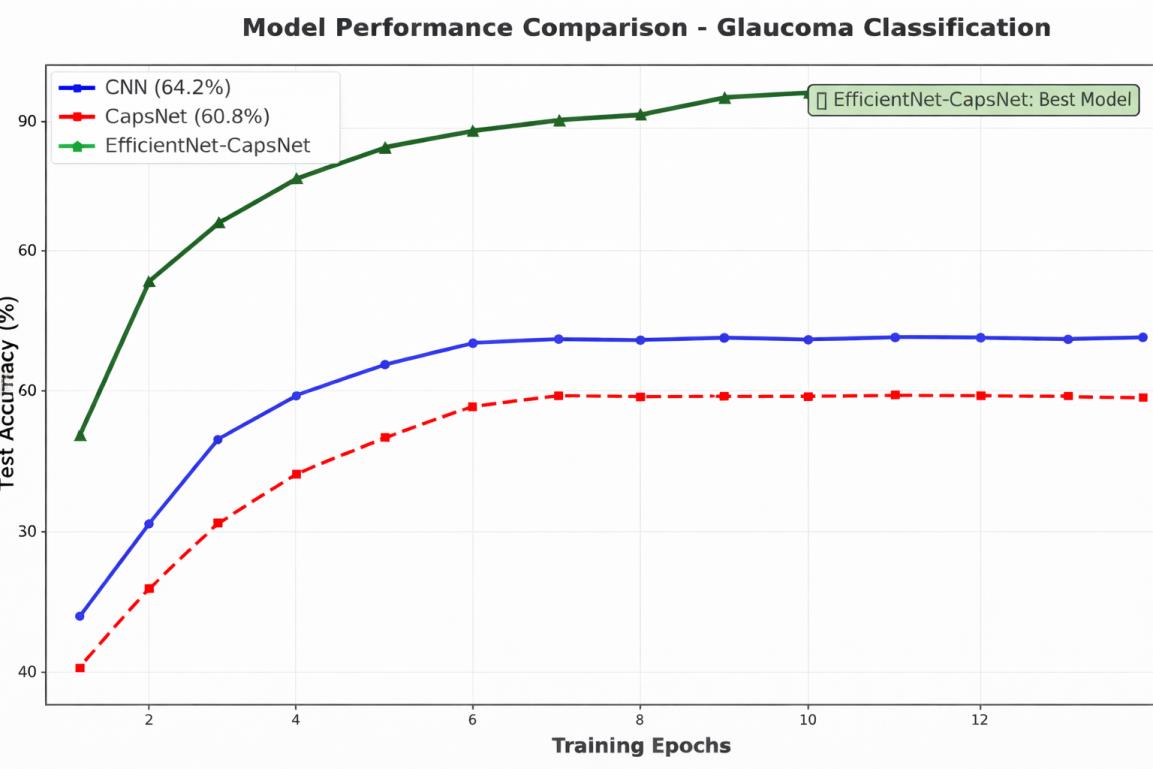
Based on the results of our study, the test accuracy was 80.7%, 64.2%, and 60.8% for the EfficientNet-CapsNet, CNN, and CapsNet models, respectively. The balance achieved by the hybrid model between accuracy and efficiency makes it suitable for routine clinical environments with limited computing resources that do not require advanced graphics processing (GPUs).
Downloads
References
Reference:
A. Albelaihi and D. M. Ibrahim, “DeepDiabetic: An Identification System of Diabetic Eye Diseases Using Deep Neural Networks,” IEEE Access, vol. 12, pp. 10769–10789, 2024, doi: 10.1109/ACCESS.2024.3354854.
B. U. Ahmad, J. E. Kim, and E. Rahimy, “Fundamentals of artificial intelligence for ophthalmologists,” Curr. Opin. Ophthalmol., vol. 31, no. 5, pp. 303–311, 2020, doi: 10.1097/ICU.0000000000000679.
F. Ghani, M. U. Sattar, H. W. Khan, M. Narmeen, and A. Mehmood, “A Methodology for Glaucoma Disease Detection Using Deep Learning Techniques,” Int. J. Comput. Digit. Syst., vol. 11, no. 1, pp. 401–411, 2022, doi: 10.12785/ijcds/110133.
D. Prins, S. Hanekamp, and F. W. Cornelissen, “Structural brain MRI studies in eye diseases: Are they clinically relevant? A review of current findings,” Acta Ophthalmol., vol. 94, no. 2, pp. 113–121, 2016, doi: 10.1111/aos.12825.
S. S. Roy, R. Sikaria, and A. Susan, “A deep learning based CNN approach on MRI for Alzheimer’s disease detection,” Intell. Decis. Technol., vol. 13, no. 4, pp. 495–505, 2020, doi: 10.3233/idt-190005.
J. W. Chan, N. C. Y. Chan, and A. A. Sadun, “Glaucoma as neurodegeneration in the brain,” Eye Brain, vol. 13, pp. 21–28, 2021, doi: 10.2147/EB.S293765.
H. Cho et al., “Deep Learning Ensemble Method for Classifying Glaucoma Stages Using Fundus Photographs and Convolutional Neural Networks,” Curr. Eye Res., vol. 46, no. 10, pp. 1516–1524, 2021, doi: 10.1080/02713683.2021.1900268.
M. Eye, D. Revisiting, E. Axis, and F. Pirot, “Diffuse Damage in Traumatic Brain Injury and Its Large-Spectrum Implications: Keys on Diffuse Axonal Injury and Indirect Traumatic Optic Neuropathy for Major Eye Diseases. Revisiting the ‘Eye-Brain Axis,’” J. Psychol. Neurosci., vol. 5, no. 3, pp. 1–5, 2023, doi: 10.47485/2693-2490.1076.
S. M. A. Banijamali, C. Versek, K. Babinski, S. Kamarthi, D. Green-LaRoche, and S. Sridhar, “Portable Multi-focal Visual Evoked Potential Diagnostics for Multiple Sclerosis/Optic Neuritis patients,” medRxiv, 2023.
G. Hemanth, M. Janardhan, and L. Sujihelen, “Design and implementing brain tumor detection using machine learning approach,” Proc. Int. Conf. Trends Electron. Informatics, ICOEI 2019, vol. 2019-April, no. Icoei, pp. 1289–1294, 2019, doi: 10.1109/icoei.2019.8862553.
H. Mohsen, E.-S. A. El-Dahshan, E.-S. M. El-Horbaty, and A.-B. M. Salem, “Classification using deep learning neural networks for brain tumors,” Futur. Comput. Informatics J., vol. 3, no. 1, pp. 68–71, 2018, doi: 10.1016/j.fcij.2017.12.001.
A. C. Thompson, A. A. Jammal, and F. A. Medeiros, “A review of deep learning for screening, diagnosis, and detection of glaucoma progression,” Transl. Vis. Sci. Technol., vol. 9, no. 2, pp. 1–19, 2020, doi: 10.1167/tvst.9.2.42.
V. Gulshan et al., “Development and validation of a deep learning algorithm for detection of diabetic retinopathy in retinal fundus photographs,” JAMA - J. Am. Med. Assoc., vol. 316, no. 22, pp. 2402–2410, 2016, doi: 10.1001/jama.2016.17216.
Adamopoulou M, Makrynioti D, Gklistis G, and Koutsojannis C, “Revolutionizing eye disease diagnosis with deep learning and machine learning,” World J. Adv. Res. Rev., vol. 18, no. 2, pp. 741–763, 2023, doi: 10.30574/wjarr.2023.18.2.0856.
T. Guergueb and M. A. Akhloufi, “A Review of Deep Learning Techniques for Glaucoma Detection,” SN Comput. Sci., vol. 4, no. 3, 2023, doi: 10.1007/s42979-023-01734-z.
Dr. N. Rajkumar, Dr. S. Megala, S. Muthukumaran, “Eye Disease Diagnosis and Classification using Deep Convolution Neural Network,” Tuijin Jishu/Journal Propuls. Technol., vol. 44, no. 4, pp. 3453–3467, 2023, doi: 10.52783/tjjpt.v44.i4.1483.
A. Pal, M. R. Moorthy, and A. Shahina, “G-Eyenet: A Convolutional Autoencoding Classifier Framework for the Detection of Glaucoma from Retinal Fundus Images,” Proc. - Int. Conf. Image Process. ICIP, pp. 2775–2779, 2018, doi: 10.1109/ICIP.2018.8451029.
A. M. Hasan, H. A. Jalab, F. Meziane, H. Kahtan, and A. S. Al-Ahmad, “Combining Deep and Handcrafted Image Features for MRI Brain Scan Classification,” IEEE Access, vol. 7, pp. 79959–79967, 2019, doi: 10.1109/ACCESS.2019.2922691.
R. W. Ibrahim, A. M. Hasan, and H. A. Jalab, “A new deformable model based on fractional Wright energy function for tumor segmentation of volumetric brain MRI scans,” Comput. Methods Programs Biomed., vol. 163, pp. 21–28, 2018, doi: 10.1016/j.cmpb.2018.05.031.
S. Sreng, N. Maneerat, K. Hamamoto, and K. Y. Win, “Deep learning for optic disc segmentation and glaucoma diagnosis on retinal images,” Appl. Sci., vol. 10, no. 14, 2020, doi: 10.3390/app10144916.
R. Sarki, K. Ahmed, H. Wang, and Y. Zhang, “Automated detection of mild and multi-class diabetic eye diseases using deep learning,” Heal. Inf. Sci. Syst., vol. 8, no. 1, pp. 1–9, 2020, doi: 10.1007/s13755-020-00125-5.
Downloads
Published
How to Cite
Issue
Section
License
Copyright (c) 2026 Nibras Yousif-Algburi

This work is licensed under a Creative Commons Attribution-NonCommercial-NoDerivatives 4.0 International License.