Evaluating the Impact of Data Volume on Deep Learning Performance: A Cloud-Based Experimental Study
DOI:
https://doi.org/10.29304/jqcsm.2026.18.22630Keywords:
: Cloud data, Digital petrol, Artificial intelligence, Autonomous vehicles, Big data analytics, Structured data.Abstract
The considered study discusses the impact of the data size on the efficiency of the deep learning in the framework of cloud-based computing with the specific emphasis on the significance of big data as one of the primary providers of the artificial intelligence (AI) efficiency. This paper takes into account the role of the augmentation of data as an essential digital resource in enhancing the learning and the generalization of the performance of the models and the precision of the decision-making of the modern AI systems. The paper looks at structured, semi structured and unstructured data stored in cloud environment and how the same can be used in scalable and efficient train AI pipelines.
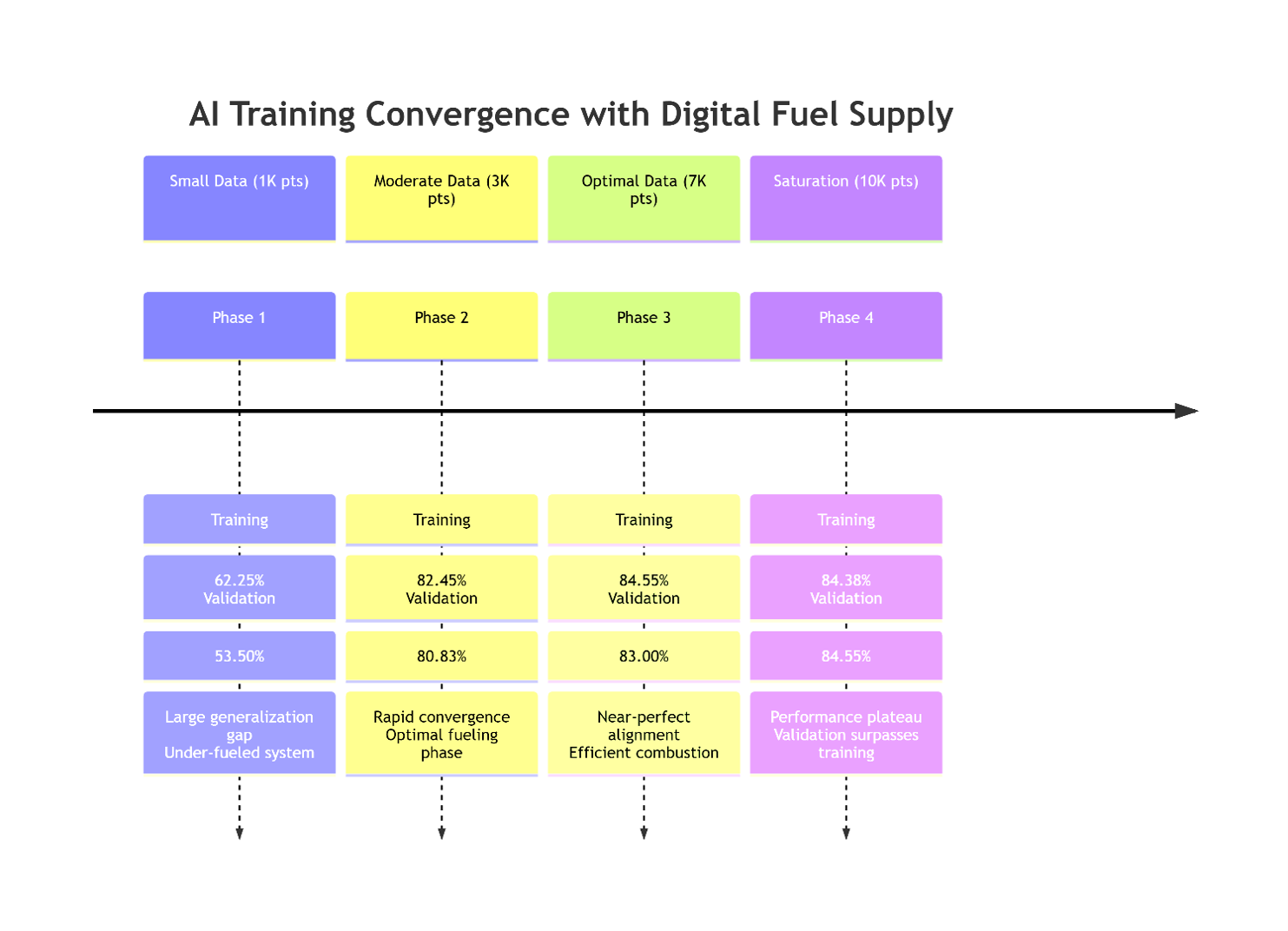
A detailed experimental framework is designed to determine the correlation between the dataset size and the model performance and the deep learning architecture that is deployed on the cloud. The results show the positive relationship that exists between the size of data and the model accuracy and the training and the validation accuracy is 84.55 and 84.38 with the size of data respectively. These findings confirm that the data scalability can have a dramatic impact on the convergence behavior, overfitting, and the generalization performance.
In addition, the study also reveals the significance of cloud computing in supporting the high-performance AI workflow, which can include the aspects of distributed training, elastic resource management, and real-time information processing. The practical implications are exemplified to applications that contain autonomous systems and data-driven intelligent systems where cloud-based infrastructures allow in enacting superior perception, decision-making and automation processes. In general, this piece confirms the fact that the volume of data, when properly handled by using cloud computing, serves as a core facilitator of the contemporary deep learning systems. The results offer an empirical basis in favor of the combination of cloud technologies and massive data analytics as the supporting elements of scalable, intelligent, and high-performance AI solutions.
Downloads
References
M. Greer and M. B. Greer, “Data: The Fuel Powering AI & Digital Transformation,” 2019. [Online]. Available: https://www.researchgate.net/publication/331177816
M. Greer and M. B. Greer, “Data: The Fuel Powering AI & Digital Transformation,” 2019. [Online]. Available: https://www.researchgate.net/publication/331177816
Z. Zheng-Ping, R.- Fang, C. Zhe, L. I. Gong-Quan, and Z. Guo-Sheng, “Analysis on Cloud Data Service Platform for Digital Oilfields,” 2016.
C. Muralidharan, Y. Mohamed Sirajudeen, and R. Anitha, “Synergy of Internet of Things with Cloud, Artificial Intelligence and Blockchain for Empowering Autonomous Vehicles,” in Studies in Computational Intelligence, vol. 945, Springer Science and Business Media Deutschland GmbH, 2021, pp. 225–244. doi: 10.1007/978-3-030-65661-4_11.
S. A. El-Seoud, H. F. El-Sofany, M. Abdelfattah, and R. Mohamed, “Big data and cloud computing: Trends and challenges,” International Journal of Interactive Mobile Technologies, vol. 11, no. 2, pp. 34–52, 2017, doi: 10.3991/ijim.v11i2.6561.
R. Kune, P. K. Konugurthi, A. Agarwal, R. Rao Chillarige, and R. Buyya, “The Anatomy of Big Data Computing.”
A. Sether, “Cloud Computing Benefits,” SSRN Electronic Journal, May 2016, doi: 10.2139/ssrn.2781593.
M. Muniswamaiah, T. Agerwala, and C. Tappert, “Big Data in Cloud Computing Review and Opportunities,” International Journal of Computer Science and Information Technology, vol. 11, no. 4, pp. 43–57, Aug. 2019, doi: 10.5121/ijcsit.2019.11404.
J. Oliveira E Sá, C. Martins, and P. Simões, “Big Data in Cloud: A data architecture.”
S. A. El-Seoud, H. F. El-Sofany, M. Abdelfattah, and R. Mohamed, “Big data and cloud computing: Trends and challenges,” International Journal of Interactive Mobile Technologies, vol. 11, no. 2, pp. 34–52, 2017, doi: 10.3991/ijim.v11i2.6561.
A. Ara and A. Ara, “Cloud for Big Data Analytics Trends,” IOSR J Comput Eng, vol. 18, no. 05, pp. 01–06, May 2016, doi: 10.9790/0661-1805040106.
“Data Analytics in Cloud Computing.”
T. Ahmad et al., “Energetics Systems and artificial intelligence: Applications of industry 4.0,” Energy Reports, vol. 8. Elsevier Ltd, pp. 334–361, Nov. 01, 2022. doi: 10.1016/j.egyr.2021.11.256.
G. Khan Tareen, “Using Artificial Intelligence with Cloud Computing: Methodologies and Implementation”, doi: 10.13140/RG.2.2.31040.92160.
W. M. Ashraf et al., “Artificial Intelligence enabled efficient power generation and emissions reduction underpinning net-zero goal from the coal-based power plants.”
F. P. Knebel, R. Trevisan, G. S. do Nascimento, M. Abel, and J. A. Wickboldt, “A study on cloud and edge computing for the implementation of digital twins in the Oil & Gas industries,” Computers and Industrial Engineering, vol. 182. Elsevier Ltd, Aug. 01, 2023. doi: 10.1016/j.cie.2023.109363.
G. Khan Tareen, “Using Artificial Intelligence with Cloud Computing: Methodologies and Implementation”, doi: 10.13140/RG.2.2.31040.92160.
M. Muniswamaiah, T. Agerwala, and C. Tappert, “Challenges of Big Data Applications in Cloud Computing,” Academy and Industry Research Collaboration Center (AIRCC), Jul. 2019, pp. 221–232. doi: 10.5121/csit.2019.90918.
A. G. Dykusova and N. V. Chernonozhkina, “Digitalization of the fuel and energy industry: A study of new technologies and their potential,” in E3S Web of Conferences, EDP Sciences, Jul. 2023. doi: 10.1051/e3sconf/202339202025.
F. Ojiemhende Ehiagwina, “Development of a Digital Gauge for Fuel Consumption in Vehicles,” 2022. [Online]. Available: www.ijrpr.com
N. Rai et al., “Digital Fuel Level and Battery Life Indicator SEE PROFILE Digital Fuel Level and Battery Life Indicator,” www.ierjournal.org International Engineering Research Journal (IERJ), vol. 3, pp. 6186–6189, 2020, doi: 10.13140/RG.2.2.18925.95205.
A. G. Dykusova and N. V. Chernonozhkina, “Digitalization of the fuel and energy industry: A study of new technologies and their potential,” in E3S Web of Conferences, EDP Sciences, Jul. 2023. doi: 10.1051/e3sconf/202339202025.
F. Ojiemhende Ehiagwina, “Development of a Digital Gauge for Fuel Consumption in Vehicles,” 2022. [Online]. Available: www.ijrpr.com
J. Bughin et al., “ARTIFICIAL INTELLIGENCE THE NEXT DIGITAL FRONTIER?” [Online]. Available: www.mckinsey.com/mgi.
P. Ranjana and S. L. Sridevi, “Machine Learning Algorithm in Two wheelers fuel Prediction.”
Global IT Research Institute, IEEE Communications Society, and Institute of Electrical and Electronics Engineers, The 18th International Conference on Advanced Communication Technology : “Information and Communications for Safe and Secure Life” : ICACT 2016 : Phoenix Park, Pyeongchang, Republic of Korea : Jan. 31 - Feb. 3, 2016 : proceeding & journal.
S. Bera, S. Misra, and J. J. P. C. Rodrigues, “Cloud Computing Applications for Smart Grid: A Survey,” IEEE Transactions on Parallel and Distributed Systems, vol. 26, no. 5, pp. 1477–1494, May 2015, doi: 10.1109/TPDS.2014.2321378.
Ion OPRIȘOR, “The Impact of Emerging And Disruptive Technologies on Security.” [Online]. Available:
https://efaidnbmnnnibpcajpcglclefindmkaj/https://intapi.sciendo.com/pdf/10.2478/raft-2021-0033
K. K. Kee and B. Y. L. Simon, “Cloud-based IoT solution for predictive modeling of ship fuel consumption,” in ACM International Conference Proceeding Series, Association for Computing Machinery, 2019, pp. 44–49. doi: 10.1145/3316615.3316710.
T. Ahmad et al., “Artificial Intelligence in Sustainable Energy Industry: Status Quo, Challenges and Opportunities,” 2021.
A.-B. Gil-González, “Artificial Intelligence in the Energy Industry.” [Online]. Available: www.mdpi.com/journal/energies
A. T. Vatuiu and G. Lazaroiu, “Section Renewable Energy Sources and Clean Technologies Using Renewable Energy Sources in The Context of Promoting a Conceptual Model for Sustainable Cloud Computing”, Doi: 10.5593/Sgem2019/4.1.
Machine Learning and the Rise of Smart Cars, https://www.octotelematics.com/blog/machine-learning-and-the-rise-of-smart-cars/
Last accessed 28 January 2024.
Autonomous vehicles worldwide - statistics & facts, https://www.statista.com/ Last accessed 28 January 2024
HaeOk Choi and Hwanll Park, “Oil is the New Data: Energy Technology Innovation in Digital Oil Fields”, Energies 2020, 13, 5547; doi:10.3390/en13215547
Downloads
Published
How to Cite
Issue
Section
License
Copyright (c) 2026 Shaymaa kaseb Layus

This work is licensed under a Creative Commons Attribution-NonCommercial-NoDerivatives 4.0 International License.