Integrating GAN-Generated Data into Real-Time IDS Workflows: A Practical Study
DOI:
https://doi.org/10.29304/jqcsm.2026.18.22649Keywords:
Generative Adversarial Networks (GANs), Intrusion Detection Systems (IDS), Real-Time Data Augmentation, Class Imbalance, Synthetic Data Generation, Suricata IntegrationAbstract
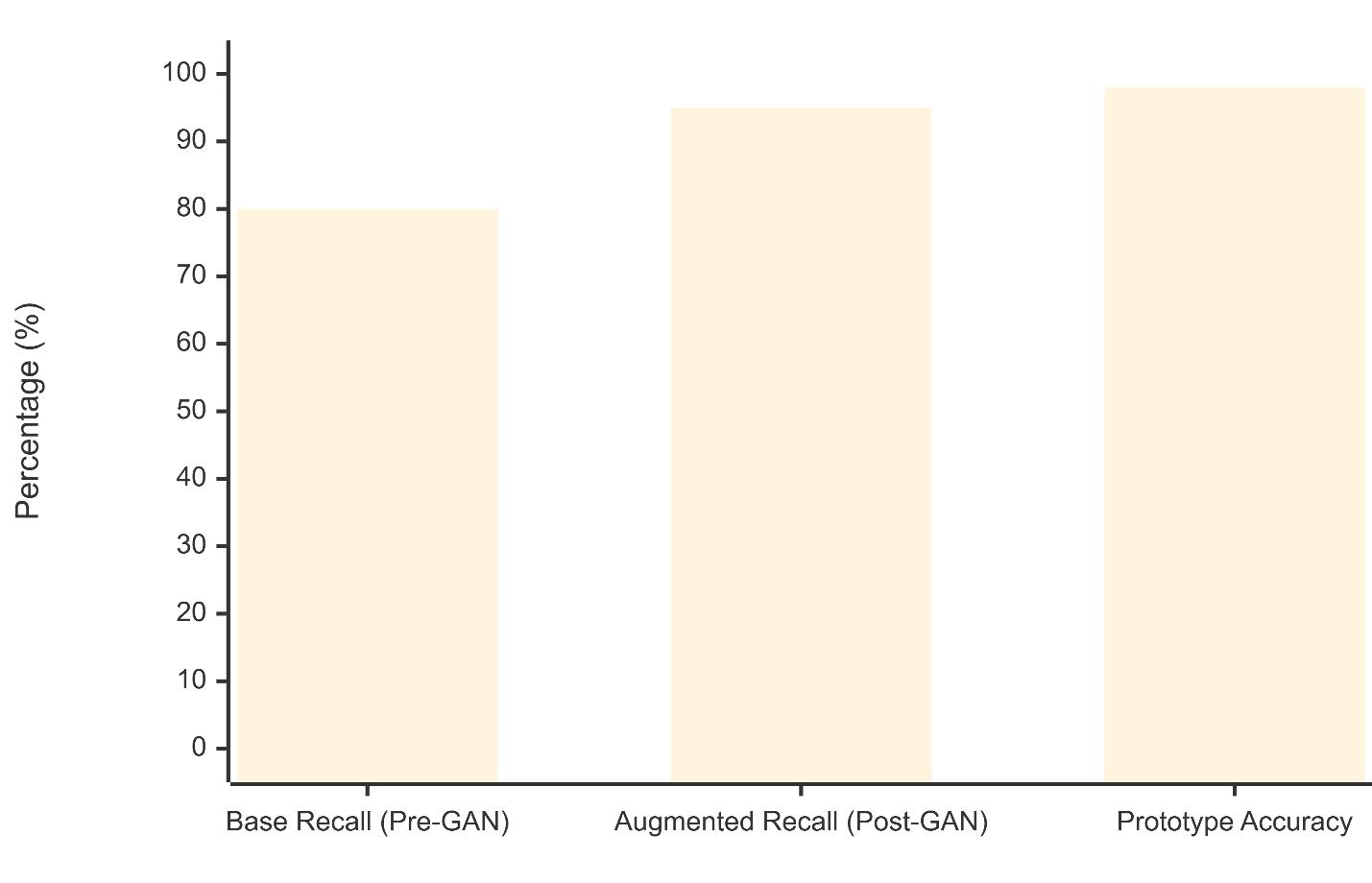
Class imbalance occurs in intrusion detection systems (IDS) when the level of benign traffic is oversampled, whereas rare attacks, such as U2R and R2L, are undersampled, causing biased classifiers to generate high false-negative rates. This study proposes a novel architecture that enables real-time synthetic data generation and augmentation with integration into existing IDS of an additional module based on Generative Adversarial Networks (GANs). The generator proposed in the GAN variant consists of sequential generative layers with linear activations and reaches (ReLU), with a discriminator whose activation is LeakyReLU and binary cross-entropy loss. Data on minority classes is synthesized with the help of the datasets such as NSL-KDD, CIC-IDS-2017, and CIC-IDS-2018. These features are performed by the architecture to monitor asynchronous traffic using tools (for example, Suricata and tcpdump), GAN activation in response to anomalies, and incremental updates on classifiers (for example, Random Forest) to enable minimal operations. The accuracy of prototypical validation reached up to 98%, and F1 score improvements between 3-5% on minority classes of low latency level of less than 2 s per batch under the acceleration of a graphics card. The early assessments show positive progress regarding the detection performance, cost-effectiveness of the computations, and possible scalability to more modern types of threat, which can be further expanded by developing conditional GANs and federated learning in various areas of cybersecurity.
Downloads
References
J. Li, W. Zong, Y.-W. Chow, and W. Susilo, “Mitigating Class Imbalance in Network Intrusion Detection with Feature-Regularized GANs,” Future Internet, vol. 17, no. 5, p. 216, 2025, doi: 10.3390/fi17050216.
M. Al-Ajlan and M. Ykhlef, “A Review of Generative Adversarial Networks for Intrusion Detection Systems: Advances, Challenges, and Future Directions,” Comput. Mater. Contin., vol. 81, no. 2, pp. 2053–2076, 2024, doi: 10.32604/cmc.2024.055891.
M. A. Rahman, G. A. Francia, and H. Shahriar, “Leveraging gans for synthetic data generation to improve intrusion detection systems,” J. Future Artif. Intell. Technol., vol. 1, no. 4, pp. 429–439, 2025, doi: 10.62411/faith.3048-3719-52.
S. Menssouri and E. M. Amhoud, “A Conditional Tabular GAN-Enhanced Intrusion Detection System for Rare Attacks in IoT Networks,” Feb. 09, 2025, arXiv. doi: 10.48550/arXiv.2502.06031.
Y. Yang et al., “A CE-GAN based approach to address data imbalance in network intrusion detection systems,” Sci Rep, vol. 15, p. 7916, 2025, doi: 10.1038/s41598-025-90815-5.
C. E. L. Asry, I. Benchaji, S. Douzi, and B. E. L. Ouahidi, “Enhancing cybersecurity: A high-performance intrusion detection approach through boosting minority class recognition,” PLOS One, vol. 20, no. 3, p. e0317346, Mar. 2025, doi: 10.1371/journal.pone.0317346.
P. Yadav, G. Sihag, and V. Vijay, “Rebalancing the Scales: A Systematic Mapping Study of Generative Adversarial Networks (GANs) in Addressing Data Imbalance,” Feb. 23, 2025, arXiv: arXiv:2502.16535. doi: 10.48550/arXiv.2502.16535.
G. Agrawal, A. Kaur, and S. Myneni, “A review of generative models in generating synthetic attack data for cybersecurity,” Electronics, vol. 13, no. 2, p. 322, 2024, doi: 10.3390/electronics13020322.
J. Lee, D. Jung, J. Moon, and S. Rho, “Advanced R-GAN: Generating anomaly data for improved detection in imbalanced datasets using regularized generative adversarial networks,” Alex. Eng. J., vol. 111, pp. 491–510, Jan. 2025, doi: 10.1016/j.aej.2024.10.084.
“Class imbalanced data handling with cyberattack classification using Hybrid Salp Swarm Algorithm with deep learning approach,” Alex. Eng. J., vol. 106, pp. 654–663, Nov. 2024, doi: 10.1016/j.aej.2024.08.061.
A. G. Udu, M. T. Salman, M. K. Ghalati, A. Lecchini-Visintini, D. R. Siddle, and H. Dong, “Emerging SMOTE and GAN Variants for Data Augmentation in Imbalance Machine Learning Tasks: A Review,” IEEE Access, vol. 13, pp. 113838–113853, 2025, doi: 10.1109/ACCESS.2025.3584532.
R. Sauber-Cole and T. M. Khoshgoftaar, “The use of generative adversarial networks to alleviate class imbalance in tabular data: a survey,” J. Big Data, vol. 9, no. 1, p. 98, Aug. 2022, doi: 10.1186/s40537-022-00648-6.
E. Strelcenia and S. Prakoonwit, “A Survey on GAN Techniques for Data Augmentation to Address the Imbalanced Data Issues in Credit Card Fraud Detection,” Mach. Learn. Knowl. Extr., vol. 5, no. 1, Art. no. 1, Mar. 2023, doi: 10.3390/make5010019.
X. Zhao, K. W. Fok, and V. L. Thing, “Enhancing network intrusion detection performance using generative adversarial networks,” Comput. Secur., vol. 145, p. 104005, 2024.
“Deep learning-driven methods for network-based intrusion detection systems: A systematic review,” ICT Express, vol. 11, no. 1, pp. 181–215, Feb. 2025, doi: 10.1016/j.icte.2025.01.005.
W. Almuseelem, “Perspective Chapter: Intrusion Detection Systems in Cloud Environment,” Mastering Intrusion Detect. Cybersecurity, 2025, doi: 10.5772/intechopen.1008756.
O. E. Aeraj and C. Leghris, “Study of the SNORT intrusion detection system based on machine learning,” in 2023 7th IEEE Congress on Information Science and Technology (CiSt), Dec. 2023, pp. 33–37. doi: 10.1109/CiSt56084.2023.10409876.
A. Oun, K. Wince, and X. Cheng, “The Role of Artificial Intelligence in Boosting Cybersecurity and Trusted Embedded Systems Performance: A Systematic Review on Current and Future Trends,” IEEE Access, vol. 13, pp. 55258–55276, 2025, doi: 10.1109/ACCESS.2025.3554739.
W. Lim, K. S. C. Yong, B. T. Lau, and C. C. L. Tan, “Future of generative adversarial networks (GAN) for anomaly detection in network security: A review,” Elsevier, vol. 139, p. 103733, 2024, doi: 10.1016/j.cose.2024.103733.
“An intelligent intrusion detection system for cyber-physical systems using GAN-LSTM networks,” Frankl. Open, vol. 11, p. 100281, Jun. 2025, doi: 10.1016/j.fraope.2025.100281.
“SYN-GAN: A robust intrusion detection system using GAN-based synthetic data for IoT security,” Internet Things, vol. 26, p. 101212, Jul. 2024, doi: 10.1016/j.iot.2024.101212.
M. Poongodi and M. Hamdi, “Intrusion detection system using distributed multilevel discriminator in GAN for IoT system,” Trans. Emerg. Telecommun. Technol., vol. 34, no. 11, doi: doi.org/10.1002/ett.4815.
D. Singh, B. Raman, A. K. Luhach, and P. Lingras, Eds., Advanced Informatics for Computing Research. in Communications in Computer and Information Science. Singapore: Springer, 2017. doi: 10.1007/978-981-10-5780-9.
H. N. Nguyen, T. Lan-Phan, and C.-J. Song, “Generative Adversarial Network-Based Network Intrusion Detection System for Supervisory Control and Data Acquisition System,” in 2024 IEEE International Conference on Consumer Electronics-Asia (ICCE-Asia), Nov. 2024, pp. 1–3. doi: 10.1109/ICCE-Asia63397.2024.10773791.
“Generative adversarial networks-enabled anomaly detection systems: A survey,” Expert Syst. Appl., vol. 296, p. 128978, Jan. 2026, doi: 10.1016/j.eswa.2025.128978.
V. Kumar and D. Sinha, “Synthetic attack data generation model applying generative adversarial network for intrusion detection,” Comput. Secur., vol. 125, p. 103054, 2023, doi: 10.1016/j.cose.2022.103054.
S. K. Erskine, “Real-Time Large-Scale Intrusion Detection and Prevention System (IDPS) CICIoT Dataset Traffic Assessment Based on Deep Learning,” Appl Syst Innov, vol. 8, no. 2, 2025, doi: 10.3390/asi8020052.
S. Kaushik et al., “Robust machine learning based Intrusion detection system using simple statistical techniques in feature selection,” Sci. Rep., vol. 15, no. 1, p. 3970, Feb. 2025, doi: 10.1038/s41598-025-88286-9.
S. Aldhaheri and A. Alhuzali, “SGAN-IDS: Self-Attention-Based Generative Adversarial Network against Intrusion Detection Systems,” Sensors, vol. 23, no. 18, Art. no. 18, Jan. 2023, doi: 10.3390/s23187796.
D. Xu and B. Cao, “Adaptive Multiobjective Evolutionary Generative Adversarial Network for Metaverse Network Intrusion Detection,” Research, vol. 8, p. 0665, doi: 10.34133/research.0665.
M. Ozkan-Okay et al., “A Comprehensive Survey: Evaluating the Efficiency of Artificial Intelligence and Machine Learning Techniques on Cyber Security Solutions,” IEEE Access, vol. 12, pp. 12229–12256, 2024, doi: 10.1109/ACCESS.2024.3355547.
P. V. Chavan and N. V. Alone, “Optimizing Intrusion Detection with Random Forest: A High-Accuracy Approach using CIC-IDS 2017,” Int. J. Comput. Appl., vol. 187, no. 3, pp. 17–22.
M. M. Rahma, Shaharia Al Shakil, and M. R. Mustakim, “A survey on intrusion detection system in IoT networks,” Cyber Secur. Appl., vol. 3, no. 100082, Dec. 2025, doi: 10.1016/j.csa.2024.100082.
Downloads
Published
How to Cite
Issue
Section
License
Copyright (c) 2026 Zainab A. Abdulazeez, Israa Abdulkadhim Jabbar Al Ali, Basma Mustafa M. H.

This work is licensed under a Creative Commons Attribution-NonCommercial-NoDerivatives 4.0 International License.