Architecting for Scale: A Microservices-Oriented Framework for High-Efficiency Big Data Processing and Real-Time Analytics
DOI:
https://doi.org/10.29304/jqcsm.2026.18.32655Keywords:
Big Data Architecture, Microservices, Scalability, Real-Time Analytics, Data Lakehouse, Kubernetes, Event-Driven Architecture, Stream Processing, Polyglot PersistenceAbstract
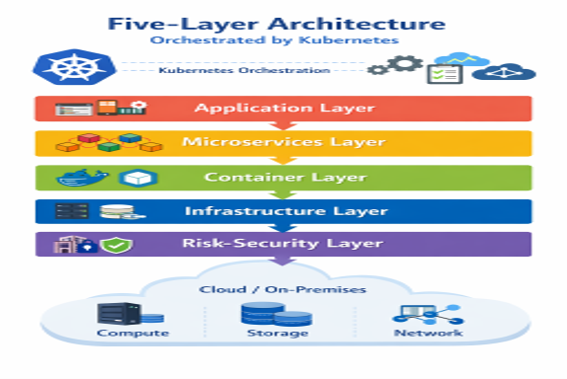
The exponential growth of data from IoT, social media, and transactional systems has exposed critical limitations in traditional monolithic data platforms, which struggle to deliver real-time insights while maintaining operational efficiency. This paper presents a validated, microservices-oriented framework for high-efficiency big data processing and real-time analytics, addressing the persistent gap between theoretical microservices adoption and practical implementation in distributed data systems. The proposed five-layer reference architecture integrates event-driven ingestion, a data lakehouse (Apache Iceberg), streaming microservices (Apache Flink), and unified orchestration (Kubernetes). The central contribution is a novel self-adaptive scaling controller—implemented as a Kubernetes operator—that dynamically adjusts Flink job parallelism based on Kafka consumer lag metrics, optimizing both latency and resource efficiency under fluctuating workloads. Through rigorous empirical evaluation on a 5-node Kubernetes cluster using a realistic ride-hailing workload, the proposed architecture was compared against monolithic and static microservices baselines. Results demonstrate that the self-adaptive architecture achieves 68% lower average latency (270 ms vs. 850 ms), 37% higher peak throughput (7,100 events/sec), and 99.95% system uptime compared to static microservices deployments, while maintaining comparable CPU utilization. This work provides a reproducible, empirically validated framework that demonstrates how intelligent self-adaptive mechanisms enable microservices to meet the scalability, resilience, and performance demands of modern big data systems.
Downloads
References
Kleppmann, M. (2017). Designing Data-Intensive Applications. O'Reilly Media.
Stonebraker, M., & Çetintemel, U. (2005). "One Size Fits All": An Idea Whose Time Has Come and Gone. In Proceedings of the 21st International Conference on Data Engineering (ICDE).
Richards, M. (2015). Software Architecture Patterns. O'Reilly Media.
Fowler, M., & Lewis, J. (2014). Microservices.
Kreps, J. (2014). The Log: What every software engineer should know about real-time data's unifying abstraction. LinkedIn Engineering.
Dehghani, Z. (2019). How to Move Beyond a Monolithic Data Lake to a Distributed Data Mesh.
Apache Software Foundation. (2023). Apache Kafka Documentation.
Cloud Native Computing Foundation. (2023). Kubernetes Documentation.
Armbrust, M., et al. (2020). Delta Lake: High-Performance ACID Table Storage over Cloud Object Stores. Proceedings of the VLDB Endowment, 13(12).
Hussein, S., Frikha, M., & Bouhamed, H. (2024). Assessing Quality Attributes of Microservices In Hadoop and Spark Clusters: A Performance Benchmarking Approach. Journal of Intelligent Systems and Internet of Things, *18*(2), 220-238.
Hussein, S., Frikha, M., & Bouhamed, H. (2024). Intelligent orchestration and energy-aware microservices for scalable big data processing in hybrid cloud environments. International Journal of Applied Mathematics, *38*(3s).
Hussein, S., et al. (2024). Assessing the quality of microservice and monolithic-based architectures: a systematic literature review. Oresta, 7(2), 417-446.
Isah, H., & Zulkernine, F. (2019). A Scalable and Robust Framework for Data Stream Processing in the Cloud. Future Generation Computer Systems, 93, 548-561.
Hadi, N. K., et al. (2025). Enhancing Software Reusability in Higher Education Applications through Microservices Architecture. Journal of Wireless and Ad Hoc Networks, 2025(1).
Hamad, S. H. A., et al. (2025). A Comparative Analysis of Programming Languages Used in Microservices. International Journal of Computational and Experimental Science and Engineering, 11(1).
Hamad, S. H. A. (2023). Reusability of Legacy Software Using Microservices: An Online Exam System Example. *Journal of Al-Qadisiyah for Computer Science and Mathematics, 15*(3), 35-46.
Villamizar, M., et al. (2015). Evaluating the monolithic and the microservice architecture pattern to deploy web applications in the cloud. In 10th Colombian Computing Conference.
Downloads
Published
How to Cite
Issue
Section
License
Copyright (c) 2026 Thaer Mufeed Taha Al-Hadithy1, Saad Hussein2*, Gamal Fathalla Ali3

This work is licensed under a Creative Commons Attribution-NonCommercial-NoDerivatives 4.0 International License.