An Interpretable Classical Machine Learning Framework for EEG-Based Brain Abnormality Detection
DOI:
https://doi.org/10.29304/jqcsm.2026.18.22662Keywords:
EEG, Dataset, Machine learning, Feature Extraction,, Brain tumorAbstract
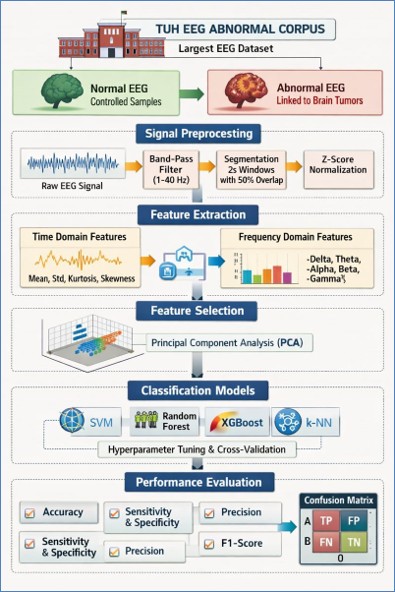
Although electroencephalography (EEG) provides an excellent, non-invasive method for monitoring brain activity, the complexity and density of these signals present a significant challenge for automated analysis. Therefore, this paper proposes an intelligent, machine learning-based framework that is both understandable and computationally efficient for classifying these signals and detecting Brain Abnormalities. The study adopted traditional machine learning techniques as a practical alternative to deep learning models, which typically consume enormous amounts of data and computing resources. It started with TUH recordings being processed with frequency filtering and subdivision into overlapping windows in order to deal with signal instability. The research then meticulously extracted the time and frequency domain features manually with emphasis on statistics and power density and used PCA to simplify the data and still maintain its central features. To improve the accuracy of the results and improve the data analysis process, the study used a number of machine learning algorithms. Such algorithms are Support Vector machine (SVM), random forest (RF), k-Nearest neighbors and extreme gradient boosting (XGboost). With experiments on these algorithms, the Supporting Vector Machine (SVM) proved to be the most successful with a fine balance between performance and an accuracy of 88.6 per cent. This shows that the traditional approaches, where they are backed by effective feature extraction, are still very competitive in the area, particularly because the suggested system focuses on clarity, modifiability, and low complexity, thus suit best the intelligent software and decision-making systems.
Downloads
References
S. Zhao et al., "A Systematic Review of Machine Learning Methods for Multimodal EEG Data in Clinical Application," arXiv preprint arXiv:2501.08585, 2024.
Y. Berrich and Z. Guennoun, "EEG-based epilepsy detection using CNN-SVM and DNN-SVM with feature dimensionality reduction by PCA," Scientific Reports, vol. 15, no. 1, p. 14313, 2025.
S. Abhishek, S. Kumar, N. Mohan, and K. Soman, "EEG based automated detection of seizure using machine learning approach and traditional features," Expert Systems with Applications, vol. 251, p. 123991, 2024.
F. Mehmood, S. U. Rehman, A. Mehmood, and Y.-J. Kim, "Advances in AI-Driven EEG Analysis for Neurological and Oculomotor Disorders: A Systematic Review," Biosensors, vol. 16, no. 1, p. 15, 2025.
K. Nanthini, D. Sivabalaselvamani, M. MadhanKumar, and R. Kaviya, "Comprehensive eeg signal feature extraction for neurological disorder diagnosis: Focus on alzheimer’s parkinson’s and seizure disorders," International Research Journal of Multidisciplinary Technovation, 2024.
A. A. Akinyelu, F. Zaccagna, J. T. Grist, M. Castelli, and L. Rundo, "Brain tumor diagnosis using machine learning, convolutional neural networks, capsule neural networks and vision transformers, applied to MRI: a survey," Journal of imaging, vol. 8, no. 8, p. 205, 2022.
E. Özer, "Brain Abnormalities using Deep CNNs and Ensemble Algorithms over MRI Images," Computer Science, vol. 9, no. 2, pp. 142-150, 2024.
A. Singh and S. Jain, "Enhanced Brain Abnormalities from brain MRI images using convolutional neural networks," AIMS Bioengineering, vol. 12, no. 2, pp. 215-224, 2025.
A. H. Mousa et al., "Diabetes at a Glance: Assessing AI Strategies for Early Diabetes Detection and Intervention via a Mobile App," Mesopotamian Journal of Computer Science, vol. 2025, pp. 288-301, 2025.
P. Wang et al., "A Comprehensive Survey on Emerging Techniques and Technologies in Spatio-Temporal EEG Data Analysis," Chinese Journal of Information Fusion, vol. 1, no. 3, pp. 183-211, 2024.
U. R. Acharya, S. V. Sree, G. Swapna, R. J. Martis, and J. S. Suri, "Automated EEG analysis of epilepsy: a review," Knowledge-Based Systems, vol. 45, pp. 147-165, 2013, doi: https://doi.org/10.1016/j.knosys.2013.02.014.
T.-H. Eom, "Electroencephalography source localization," Clinical and Experimental Pediatrics, vol. 66, no. 5, p. 201, 2022, doi: 10.3345/cep.2022.00962.
R. Shalbaf, H. Behnam, and H. Jelveh Moghadam, "Monitoring depth of anesthesia using combination of EEG measure and hemodynamic variables," Cognitive Neurodynamics, vol. 9, no. 1, pp. 41-51, 2015, doi: https://doi.org/10.1007/s11571-014-9295-z.
C. Jamunadevi, J. Bharanitharan, S. Deepa, and T. J. P. Antony, "Brain Tumor Prediction from EEG Signal using Machine Learning Algorithm," in 2023 4th International Conference on Electronics and Sustainable Communication Systems (ICESC), 2023: IEEE, pp. 1083-1089.
M. H. Al-Adhaileh, S. Ahmad, A. A. Alharbi, M. Alarfaj, M. Dhopeshwarkar, and T. H. Aldhyani, "Diagnosis of epileptic seizure neurological condition using EEG signal: a multi-model algorithm," Frontiers in Medicine, vol. 12, p. 1577474, 2025.
R. M. Al-Amri, A. A. Hadi, M. S. Kadhim, A. H. Mousa, A. Z. Matloob, and H. F. Hasan, "Enhancement of The Performance of Machine Learning Algorithms to Rival Deep Learning Algorithms in Predicting Stock Prices," Babylonian Journal of Artificial Intelligence, vol. 2024, pp. 118-127, 2024.
P. Bomatter, J. Paillard, P. Garces, J. Hipp, and D.-A. Engemann, "Machine learning of brain-specific biomarkers from EEG," EBioMedicine, vol. 106, 2024.
R. Al-Amri, A. Hadi, A. H. Mousa, H. Hasan, and M. Kadhim, "The development of a deep learning model for predicting stock prices," J. Adv. Res. Appl. Sci. Eng. Technol, vol. 31, pp. 208-219, 2023.
A. B. Bektaş and M. Gönen, "Machine Learning for Medicine Must Be Interpretable, Shareable, Reproducible and Accountable by Design," arXiv preprint arXiv:2508.16097, 2025.
G. Demirezen, T. Taşkaya Temizel, and A.-M. Brouwer, "Reproducible machine learning research in mental workload classification using EEG," Frontiers in Neuroergonomics, vol. 5, p. 1346794, 2024.
T. Lee, J. H. Lee, S. H. Yoon, S. H. Park, and H. Kim, "Availability and transparency of artificial intelligence models in radiology: a meta-research study," European Radiology, pp. 1-12, 2025.
M. Poziomska et al., "Quantity versus diversity: Influence of data on detecting EEG pathology with advanced ML models," Neural Networks, p. 108073, 2025.
S. Kinahan, P. Saidi, A. Daliri, J. Liss, and V. Berisha, "Achieving reproducibility in eeg-based machine learning," in Proceedings of the 2024 ACM Conference on Fairness, Accountability, and Transparency, 2024, pp. 1464-1474.
H. Jubair, "EEG-Based Machine and Deep Learning Approaches for the Diagnosis of Dissociative Disorders: A Comprehensive Review," Biological Psychiatry Global Open Science, p. 100654, 2025.
C. P. Da Silva, S. Tedesco, and B. O’Flynn, "EEG datasets for healthcare: a scoping review," IEEE Access, vol. 12, pp. 39186-39203, 2024.
A.-K. Kiessner, R. T. Schirrmeister, L. A. Gemein, J. Boedecker, and T. Ball, "An extended clinical EEG dataset with 15,300 automatically labelled recordings for pathology decoding," NeuroImage: Clinical, vol. 39, p. 103482, 2023.
S. M. Sanchez et al., "Pediatric ICU EEG monitoring: current resources and practice in the United States and Canada," Journal of Clinical Neurophysiology, vol. 30, no. 2, pp. 156-160, 2013.
M. Sengupta and M. W. Bagnall, "Spinal interneurons: diversity and connectivity in motor control," Annual review of neuroscience, vol. 46, no. 1, pp. 79-99, 2023.
S. Mancinelli, S. Bariselli, and S. Lodato, "The emergence of electrical activity in human brain organoids," Stem Cell Reports, vol. 20, no. 9, 2025.
N. Khaleghi et al., "EEG-based functional connectivity analysis of brain abnormalities: A systematic review study," Informatics in Medicine Unlocked, vol. 47, p. 101476, 2024.
M. Cursi, A. Bellini, and M. Filippi, "EEG at the Edge: Signals, Selves, and Systems," Journal of Mental Health Disorders, vol. 5, no. 1, pp. 116-123, 2025.
F. A. Alturki, K. AlSharabi, A. M. Abdurraqeeb, and M. Aljalal, "EEG signal analysis for diagnosing neurological disorders using discrete wavelet transform and intelligent techniques," Sensors, vol. 20, no. 9, p. 2505, 2020.
T. D. d. C. Costa, C. Godeiro Júnior, R. A. e. Silva, S. F. Dos Santos, D. G. d. S. Machado, and S. M. Andrade, "The Effects of Non-Invasive Brain Stimulation on Quantitative EEG in Patients With Parkinson's Disease: A Systematic Scoping Review," Frontiers in Neurology, vol. 13, p. 758452, 2022.
R. Dhiman, "Machine learning techniques for electroencephalogram based brain-computer interface: A systematic literature review," Measurement: Sensors, vol. 28, p. 100823, 2023.
M. Naderi and A. Jahanian-Najafabadi, "A systematic review of EEG-based machine learning classifications for obsessive-compulsive disorder: current status and future directions," BMC psychiatry, vol. 25, no. 1, p. 854, 2025.
H. Albaqami, G. M. Hassan, A. Subasi, and A. Datta, "Automatic detection of abnormal EEG signals using wavelet feature extraction and gradient boosting decision tree," Biomedical Signal Processing and Control, vol. 70, p. 102957, 2021.
M. A. Alsuwaiket, "Feature extraction of EEG signals for seizure detection using machine learning algorthims," Engineering, Technology & Applied Science Research, vol. 12, no. 5, pp. 9247-9251, 2022.
Y. Wu et al., "Neural networks for epilepsy detection and prediction with EEG signals: a systematic review," Artificial Intelligence Review, vol. 59, no. 1, p. 30, 2026.
S. Mohsen, S. Oraby, and M. Abdel-Aziz, "Deep LearnIng and Machine Learning for Brain Abnormalities: A Review, Challenges, and Future Directions," Archives of Computational Methods in Engineering, pp. 1-25, 2025.
S. K. Gatfan, "A review on deep learning for electroencephalogram signal classification," Journal of Al-Qadisiyah for Computer Science and Mathematics, vol. 16, no. 1, pp. 137-151, 2024.
Ali, A.M.A.A., Analysis of Neurological Disorder and Diagnosis using Artificial Intelligence. International Journal of Research and Analytical Reviews, 2025. 12(3): p. pp.768-779.
Albaqami, H., G.M. Hassan, and A. Datta, Automatic detection of abnormal EEG signals using WaveNet and LSTM. Sensors, 2023. 23(13): p. 5960.
Lopez, S., et al. Automated identification of abnormal adult EEGs. in 2015 IEEE signal processing in medicine and biology symposium (SPMB). 2015. IEEE
Downloads
Published
How to Cite
Issue
Section
License
Copyright (c) 2026 Asam Almohamed

This work is licensed under a Creative Commons Attribution-NonCommercial-NoDerivatives 4.0 International License.