Predicting Cancer Treatment Response Using Machine Learning and Tabular Deep Learning
DOI:
https://doi.org/10.29304/jqcsm.2026.18.32670Keywords:
Cancer, Treatment Response, CatBoost, Logistic Regression, Extra Tree, TabNet.Abstract
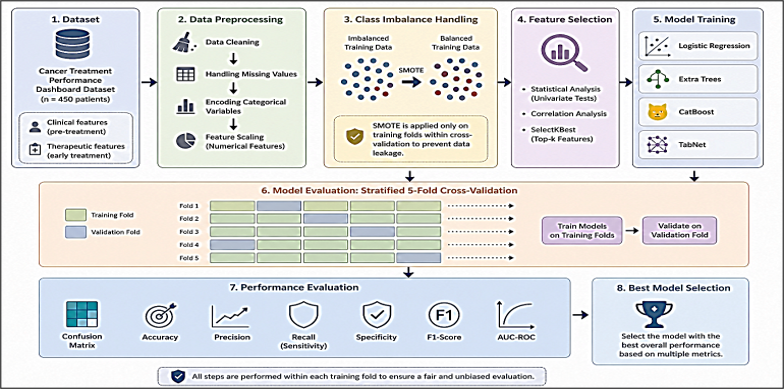
Cancer is one of the most difficult and prevalent diseases around the globe. It is characterized by different signs among patients and their mode of treatments also varies. Despite the development of numerous advanced therapeutic approaches, selecting the most suitable treatment for each of the patients still remains one of the main problems. This study aims to develop a predictive framework according to machine learning as well as deep learning algorithms to determine a patient’s response to the cancer treatment using the Cancer Treatment Performance Dashboard Dataset. The proposed approach involved data preprocessing, feature selection and model training using: Logistic Regression (LR), Extra Trees (ET), CatBoost (CB), and TabNet (TN). The framework was evaluated using 5-fold cross validation and multiple evaluation metrics including accuracy, precision, recall,F1-score and AUC-ROC. The experimental results indicated that TabNet achieved the highest performance in term of F1-score (0.90) and AUC-ROC, followed closely to CatBoost (F1-score=0.89) which reflects their ability to comply with complex nonlinear relationship in clinical data. In contrast, Extra trees demonstrated competitive performance (F1-score=0.86), while logistic regression demonstrated lower performance (F1-score=0.83) due its linear nature. This study suggests that predict patients’ treatment response at an early stage using machine learning and deep learning algorithms in analyzing clinical and therapeutic data will assist to predicting cancer treatment response to cancer and can support clinical decision-making by enabling the early identification of patients likely to benefit from specific treatments, thereby improving treatment outcomes and reducing exposure to ineffective treatments.
Downloads
References
G. A. C. Karen M. Emmons, "Realizing the Potential of Cancer Prevention — The Role of Implementation Science," The New England Journal of Medicine, vol. 376, no. 10, 2017. DOI: 10.1056/NEJMsb1609101.
L. e. a. Galluzzi, "Cancer cell death: Cell-autonomous and immunogenic dimensions," Cancer Cell, vol. 44, no. 2, pp. 281-305, 2025. DOI: 10.1016/j.ccell.2025.12.005
S. S. R. F. a. e. a. Keene L. Abbott, "Site of breast cancer metastasis is independent of single nutrient levels," bioRxiv, vol. 10, no. 24, 2024. DOI: 10.1101/2024.10.24.616714
S. M. P. A. Eric K. A. Atsu, "An Exploratory Study of ResNet and Capsule Neural Networks for Brain Tumor Detection in MRI," medRxiv, vol. 2, no. 5, 2026.
M. S.-T. R. B.-R. Claudia Mendoza-Pinto, "Machine learning in the prediction of treatment response in rheumatoid arthritis: A systematic review," Seminars in Arthritis and Rheumatism, vol. 68, 2024. DOI: 10.1016/j.semarthrit.2024.152501
C. D. Joshua Curtiss, "Machine learning in the prediction of treatment response for emotional disorders: A systematic review and meta-analysis," Clinical Psychology Review, vol. 120, 2025.DOI: 10.1016/j.cpr.2025.102593
A. H. R. Z. C. P. T. C. I. F. R. H. M. a. H. J. A. Yiwen Xu, "Deep Learning Predicts Lung Cancer Treatment Response from Serial Medical Imaging," Clin Cancer Res., vol. 25, no. 11, 2019.DOI: 10.1158/1078-0432.CCR-18-2495
C.-Y. C. T.-H. C. Chun-Chi Lai, "Predicting Pathological Complete Response Following Neoadjuvant Therapy in Patients With Breast Cancer:Development of Machine Learning–Based Prediction Models in a Retrospective Study," JMIR CANCER, vol. 1, no. 11, 2025. DOI: https://doi.org/10.1038/s41598-025-99496-6
W. C. R. R. Z. Z. a. e. a. Yifan Liu1, "Deep learning based digital pathology for predicting treatment response to first-line PD-1 blockade in advanced gastric cancer," Journal of Translational Medicine, vol. 22, no. 438, 2024. DOI: 10.1186/s12967-024-05262-z
M. H. T. M. W. a. e. a. Peter Zhukovsky, "Generalizability of Treatment Outcome Prediction Across Antidepressant Treatment Trials in Depression," JAMA Network Open, vol. 8, no. 3, 2025. DOI: 10.1001/jamanetworkopen.2025.1310
F. A. M. M. T. e. a. Butt, "Deep learning-driven prediction of chemotherapy response in breast cancer: a pathway toward precision medicine," Soft Comput , 2026.DOI: https://doi.org/10.1007/s00500-025-11048-2
Kaggle, "Cancer Treatment Performance Dashboard Dataset," 2023. [Online]. Available: https://www.kaggle.com/datasets/olagokeblissman/cancer-treatment-performance-dashboard-dataset.URL: https://www.kaggle.com/datasets/olagokeblissman/cancer-treatment-performance-dashboard-dataset
G. G. A. V. A. V. D. a. A. G. L. Prokhorenkova, "CatBoost: unbiased boosting with categorical features," in 32nd Conference on Neural Information Processing Systems (NeurIPS 2018), Montréal, Canada, 2018.
G. N. Z. H. Li C, "Anticancer drug synergy prediction based on CatBoost," PeerJ Computer Science, vol. 11, no. e2829, 2025. DOI: 10.7717/peerj-cs.2829
S. L. a. R. X. S. D. W. Hosmer, Applied Logistic Regression, W. S. i. P. a. statistics, Ed., 3rd ed. Wiley, 2013. DOI: 10.1002/9781118548387
C. C. J. F. M. F. R. H. K. Goto T, "Machine Learning-Based Prediction of Clinical Outcomes for Children During Emergency Department Triage," JAMA Netw Open, vol. 2, no. 1, 2019. DOI: 10.1001/jamanetworkopen.2018.6937
D. E. a. L. W. P. Geurts, "Extremely randomized trees," Machine Learning, vol. 63, no. 1, pp. 3-42, 2006. DOI: https://doi.org/10.1007/s10994-006-6226-1
S. G. H. M. A. K. S. Z. A. Arya M, "A Novel Extra Tree Ensemble Optimized DL Framework (ETEODL) for Early Detection of Diabetes," Front Public Health, vol. 9, 2022. DOI: https://doi.org/10.3389/fpubh.2021.797877
S. Ö. A. a. T. Pfister, "TabNet: Attentive interpretable tabular learning," in in Proceedings of the AAAI Conference on Artificial Intelligence, 2021. DOI:https://doi.org/10.48550/arXiv.1908.07442
Z. W. G. X. Z. Z. &. C. Z. Maiqiang Zhou, "Deep learning with TabNet: rapid coal ash content estimation via X-ray fluorescence," International Journal of Coal Preparation and Utilization, vol. 45, pp. 523-547, 2024. DOI:10.1080/19392699.2024.2341952
S. S. I. T. V. e. a. Hicks, "On evaluation metrics for medical applications of artificial intelligence," Sci Rep, vol. 12, no. 5979, 2022. DOI: https://doi.org/10.1038/s41598-022-09954-8
z. n. s. weli, "Deep Belief Network for Predicting the Predisposition to Lung Cancer in TP53 Gene," Iraqi Jornal of Science, vol. 61, no. 1, pp. 171-177, 2020. DOI:https://doi.org/10.24996/ijs.2020.61.1.19
S. B. Sri Chandana K, "Cancer Treatment Recommendation using Machine LearningTechnologies," International Journal of Precious Engineering Research and Applications (IJPERA), vol. 7, no. 1, pp. 83-88, 2022.
M. Cruz-Fernandez, F. Castillo-Velásquez, C. Fuentes-Silva, O. Rodríguez-Abreo, R. Rojas-Galván, M. Avilés and J. Rodríguez-Reséndiz, "Predicting Breast Cancer Mortality Using SEER Data: A Comparative Analysis of L1-Logistic Regression and Neural Networks," Technologies, vol. 14, no. 66, 2026. DOI: https://doi.org/10.3390/technologies14010066
Downloads
Published
How to Cite
Issue
Section
License
Copyright (c) 2026 Zahraa Naser Shahweli

This work is licensed under a Creative Commons Attribution-NonCommercial-NoDerivatives 4.0 International License.