An Intelligent Decipher System to Examine Cipher Algorithms
DOI:
https://doi.org/10.29304/jqcsm.2026.18.22690Keywords:
Neural Cryptanalysis, Deep Learning, ResNet, Attention-LSTM, AES, SPECK, Lightweight Cryptography, Automated Security AuditingAbstract
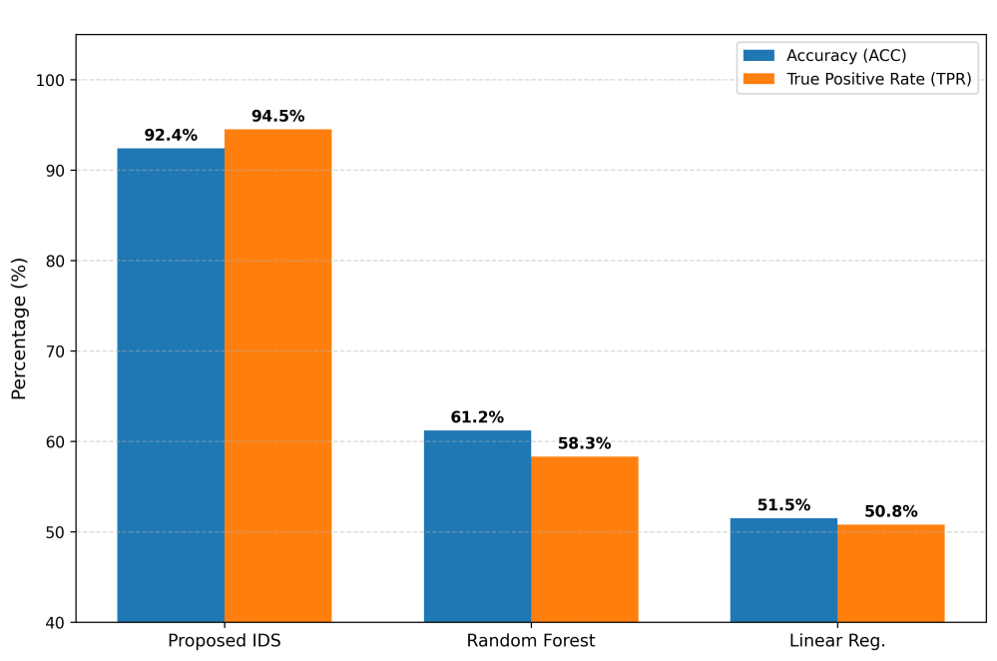
The high rate of cryptographic primitive development requires improved, automatic assessment structures that guarantee effective data security. The traditional cryptanalysis, which is mostly based on special linear and differential approaches, is both computationally infeasible and needs substantial domain knowledge. To overcome technical deficiencies like the Curse of Dimensionality and limitations under high-degree algebraic transformations, this paper presents the Intelligent Decipher System (IDS). The IDS architecture combines a Deep Residual Network (ResNet) and Attention-based Long Short-Term Memory (LSTM) to extract both spatial and sequential features, capturing differential properties and long-range dependencies. We compare the given system with reduced-round SPECK32/64 and AES-128, and classical polyalphabetic systems. The experimental findings indicate the IDS has a distinguishing accuracy of 92.4% on 5-round SPECK and that its bias detection is effective up to 7 rounds (61.5%), which is remarkably better than traditional differential distinguishers and baseline machine learning models. The framework offers a scalable black-box auditing device for detecting structural weaknesses in current lightweight cryptography.
Downloads
References
S. Yadao, N. T. Dieu Linh, A. Fatima, and B. Puri, “AI -Driven Cryptographic Algorithm Identification: Exploring Methodologies and Practical Applications,” in 2024 IEEE International Conference on Machine Learning and Applied Network Technologies (ICMLANT), IEEE, (2024), pp. 56–61.
E. Biham and A. Shamir, “Differential cryptanalysis of DES-like cryptosystems,” Journal of Cryptology, vol. 4, no. 1,(1991), pp. 3–72.
A. Gohr, “Improving Attacks on Round-Reduced Speck32/64 Using Deep Learning, Advances in Cryptology-RYPTO 2019,(2019), pp. 150–179.
I. Meraouche, S. Dutta, H. Tan, and K. Sakurai, “Neural Networks-Based Cryptography: A Survey,” IEEE Access, vol. 9,(2021), pp. 124727–124740.
L. Zhang, Y. Wu, Y. Wen, C. Xiao, D. Ding, and Q. Lv, “Differential Cryptanalysis of Block Ciphers Through the Lens of Symmetry: A Review, “ Symmetry, vol. 18, no. 1,(2026).
K. A. McKay, L. Bassham, M. S. Turan, and N. Mouha, “Report on lightweight cryptography,” Gaithersburg, MD, (2017).
M. Rossi, “Automatic differential cryptanalysis of symmetric ciphers,” PhD Thesis, University of Trento, Trento, (2024).
H. Kim et al., “Deep-Learning-Based Cryptanalysis of Lightweight Block Ciphers Revisited,” Entropy, vol. 25, no. 7,(2023), p. 986.
L. Ericsson, H. Gouk, C. C. Loy, and T. M. Hospedales, “Self-Supervised Representation Learning: Introduction, advances, and challenges,” IEEE Signal Process. Mag., vol. 39, no. 3, (2022), pp. 42–62.
S. Khan, P. A. Ferreira Lopes martins, B. Sousa, and V. Pereira, “A Comprehensive Review on Lightweight Cryptographic Mechanisms for Industrial Internet of Things Systems,” ACM Comput. Surv., vol. 58, no. 1, (2026), pp. 1–37.
J. Dani, K. Nakka, and N. Saxena, “A Machine Learning-Based Framework for Assessing Cryptographic Indistinguishability of Lightweight Block Ciphers,” in 2025 22nd Annual International Conference on Privacy, Security, and Trust (PST), IEEE, (2025), pp. 1–10.
O. Jeong, E. Ahmadzadeh, and I. Moon, “Comprehensive Neural Cryptanalysis on Block Ciphers Using Different Encryption Methods,” Mathematics, vol. 12, no. 13, (2024), p. 1936.
A. Bose, D. Pal, and D. Roy Chowdhury, “Deep learning-based differential distinguishers for cryptographic sequences, “ in International Conference on Cryptology in India, Cham: Springer Nature Switzerland, (2024), pp. 114–133.
S. Sikdar and M. Kule, “Intelligent identification of cryptographic ciphers using machine learning techniques,“ Int. J. Intell. Syst. Appl., vol. 16, (2024), pp. 20–39.
A. Mukherjee et al., “Detection of cipher types using machine learning techniques, “ in International Conference on Computational Intelligence in Pattern Recognition, Singapore: Springer Nature Singapore, (2022), pp. 297–307.
V. Saravanan, “AI-Based Cryptanalysis of RSA Using Transformer Models and Quantized Fully Connected Neural Networks, “ Doctoral dissertation, Univ. Guelph, (2025).
O. Jeong, S. Park, and I. Moon, “Scalable Neural Cryptanalysis of Block Ciphers in Federated Attack Environments,” Mathematics, vol. 14, no. 2, (2026), p. 373.
J. P. Aumasson, Serious cryptography: a practical introduction to modern encryption, 2nd Edition. San Francisco: No Starch Press, Inc., (2024).
Downloads
Published
How to Cite
Issue
Section
License
Copyright (c) 2026 Ayad osama Jalal

This work is licensed under a Creative Commons Attribution-NonCommercial-NoDerivatives 4.0 International License.