Enhancing Sentiment Analysis through Hybrid Transformer Architectures and Contextual Embeddings
DOI:
https://doi.org/10.29304/jqcsm.2026.18.32704Keywords:
Sentiment analysis, Transformer networks, Hybrid neural architectures, Feature representation, Natural language processing, Deep learning, Text categorization, Attention mechanismsAbstract
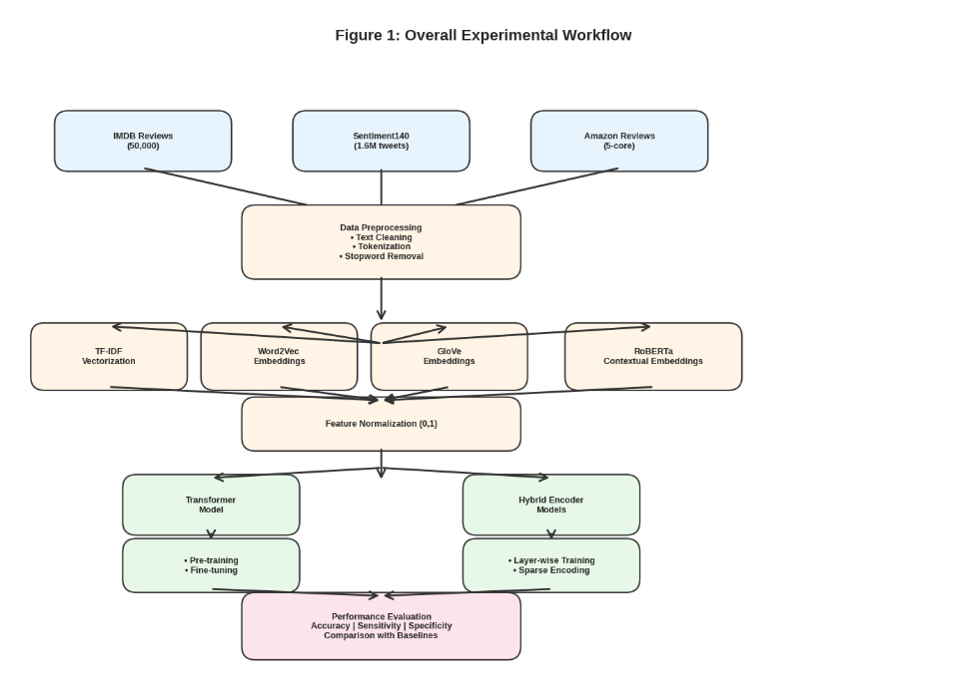
Understanding emotions in text allows computers to grasp how people truly mean their words. Hidden sentiments within sentences reveal themselves through careful analysis, offering clarity in areas such as social media monitoring or feedback interpretation. A fresh technique appears here, rooted deeply in neural computation, combining stacked architectures with adaptive contextual reasoning to boost performance. Older methods take a back seat while varied strategies emerge - TF-IDF transforms appear next to Word2Vec mappings, GloVe embeddings sit beside dynamic representations drawn from BERT and RoBERTa - to explore which inputs strengthen prediction depth. This approach leads to a system named the Extended Transformer Belief Network (ETBN), shaped by layers that learn both structure and meaning across diverse linguistic patterns. This setup initially picks up structures using unlabeled data, relying on selective focus methods. Then, precision improves when real-world examples steer the adjustment phase. Meaning deepens step by step, mirroring actual human phrasing habits. Testing kicks off across IMDB, Sentiment 140, alongside Amazon feedback - performance reaches 97.5% correct, with mistakes only at 2.5%. Leading models based on transformers beat prior techniques, showing noticeable gains. Still further ahead, it positions new benchmarks alongside today’s hybrid models when identifying emotional states. Evidence appears clear: linking deep learning architectures with refined feature extraction pushes accuracy beyond conventional methods.
Downloads
References
Audet, C. (2014). A survey on direct search methods for blackbox optimization and their applications. Mathematics without boundaries: Surveys in interdisciplinary research, 31-56
Alarie, S., Audet, C., Gheribi, A. E., Kokkolaras, M., & Le Digabel, S. (2021). Two decades of blackbox optimization applications. EURO Journal on Computational Optimization, 9, 100011.
Stork, J., Eiben, A. E., & Bartz-Beielstein, T. (2022). A new taxonomy of global optimization algorithms. Natural Computing, 21(2), 219-242.
Gruver, N., Stanton, S., Frey, N., Rudner, T. G., Hotzel, I., Lafrance-Vanasse, J., ... & Wilson, A. G. (2023). Protein design with guided discrete diffusion. Advances in neural information processing systems, 36, 12489-12517.
Larson, J., Menickelly, M., & Wild, S. M. (2019). Derivative-free optimization methods. Acta Numerica, 28, 287-404.
Audet, C., & Hare, W. (2017). Introduction: tools and challenges in derivative-free and blackbox optimization. In Derivative-Free and Blackbox Optimization (pp. 3-14). Cham: Springer International Publishing.
Venkatramanan, S., Lewis, B., Chen, J., Higdon, D., Vullikanti, A., & Marathe, M. (2018). Using data-driven agent-based models for forecasting emerging infectious diseases. Epidemics, 22, 43-49.
Vu, K. K., d'Ambrosio, C., Hamadi, Y., & Liberti, L. (2017). Surrogate‐based methods for black‐box optimization. International Transactions in Operational Research, 24(3), 393-424.
Naser, M. Z., Al‐Bashiti, M. K., Tapeh, A. T. G., Naser, A., Kodur, V., Hawileh, R., ... & Eslamlou, A. D. (2025). A review of benchmark and test functions for global optimization algorithms and metaheuristics. Wiley Interdisciplinary Reviews: Computational Statistics, 17(2), e70028.
Audet, C., Dzahini, K. J., Kokkolaras, M., & Le Digabel, S. (2021). Stochastic mesh adaptive direct search for blackbox optimization using probabilistic estimates. Computational Optimization and Applications, 79(1), 1-34.
Alarie, S., Audet, C., Gheribi, A. E., Kokkolaras, M., & Le Digabel, S. (2021). Two decades of blackbox optimization applications. EURO Journal on Computational Optimization, 9, 100011.
Diouane, Y., Picheny, V., Riche, R. L., & Perrotolo, A. S. D. (2023). TREGO: a trust-region framework for efficient global optimization. Journal of Global Optimization, 86(1), 1-23.
Downloads
Published
How to Cite
Issue
Section
License
Copyright (c) 2026 Waleed Nawaf Hammadi

This work is licensed under a Creative Commons Attribution-NonCommercial-NoDerivatives 4.0 International License.