An Enhanced Image Encryption Framework Integrating Hyper-Chaotic Maps with the Serpent Block Cipher for Secure Medical and Biometric Data Transmission
DOI:
https://doi.org/10.29304/jqcsm.2026.18.22711Keywords:
Image Encryption, Serpent Algorithm, Block Cipher, Cryptography, CBC Mode, PythonAbstract
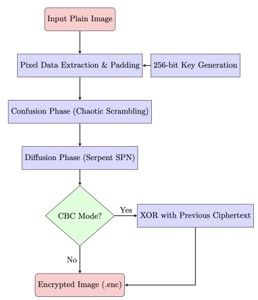
The secure transmission of sensitive e-images, especially medical records and biometric templates, remains a vital challenge because of the characteristics of images, including high adjacency correlation between the pixels, large volumes of data, and vulnerability to statistical attacks. This study presents an enhanced multi stage confusion–diffusion image encryption framework employing a four-dimensional (4D) hyper-chaotic map with the Serpent block cipher (via Cipher Block Chaining (CBC) mode). The confusion stage employs a 4D hyperchaotic system that permutes pixels through a variation at the pixel-level to destabilize the spatial temporal structure of the original image, subsequently leading to a diffusion stage where 32-rounds of the Serpent 192 -bit cipher homogenizes the distribution of gray-levels over the entire image. The framework is wrapped in a modular three-layer software architecture: a User Interface Layer, a Logic Layer and a Cryptographic Core, and coded for implementation in Python with CustomTkinter-based graphical user interface. Experimental evaluation on standard test images and representative medical and biometric datasets shows excellent security performance: information entropy of 7.9996 (close to the theoretical maximum of 8.0), Number of Pixels Change Rate (NPCR) > 99.6%, a Unified Average Changing Intensity (UACI) ≈ 33.47%, and nearzero horizontal and vertical correlation coefficients. These results confirm that the proposed framework provides robust protection for clinical and biometric authentication contexts.
Downloads
References
References
M. Ahmad, S. Khan, and A. S. Al-Amri, “Secure medical image transmission using hyperchaotic maps and DNA sequence in IoThealthcare,” J. Inf. Secur. Appl., vol. 80, p. 103671, 2024, doi:10.1016/j.jisa.2023.103671.
M. Alawida, J. S. Teh, and M. A. Al-Shabi, “A new hybrid digital chaotic system for image encryption,” Multimed. Tools Appl., vol. 82, no. 4, pp. 5413–5436, 2023, doi: 10.1007/s11042-022-13426-1.
A. Alenezi, A. El-Haddad, and S. Mohammed, “Evaluating the performance of Serpent and AES in secure image transmission over 5G networks,” Int. J. Inf. Secur., vol. 23, no. 1, pp. 112–128, 2024, doi: 10.1007/s10207-023-00715-x.
M. U. Hassan, M. H. Rehman, and N. Ahmed, “A robust medical image encryption framework for healthcare 4.0,” Sci. Rep., vol. 13, no. 1, p. 1245, 2023, doi: 10.1038/s41598-023-28456-w.
Z. Hua, Y. Zhou, and H. Huang, “Information entropy analysis for image encryption: A survey,” Inf. Sci., vol. 622, pp. 1146–1165, 2023, doi: 10.1016/j.ins.2022.11.163.
S. Hussain, A. Rehman, and S. Ahmad, “Redesigning the Serpent algorithm by PA-loop and its image encryption application,” IEEE Access, vol. 11, pp. 29698–29706, 2023, doi: 10.1109/ACCESS.2023.3259871.
M. Kaur and V. Kumar, “Comprehensive review on image encryption techniques based on chaotic maps,” Arch. Comput. Methods Eng., vol. 29, no. 2, pp. 1185–1215, 2022, doi: 10.1007/s11831-021-09613-2.
Y. Li, Y. Zhao, and G. Chen, “Privacy-preserving medical image encryption based on deep learning and chaotic systems in cloud computing,” IEEE J. Biomed. Health Inform., vol. 27, no. 2, pp. 856–867, 2023, doi: 10.1109/JBHI.2022.3214567.
X. Liu and X. Tong, “Image encryption algorithm based on hyperchaotic system and dynamic S-box,” IEEE Access, vol. 11, pp. 25431– 25445, 2023, doi: 10.1109/ACCESS.2023.3254311.
S. Mansoori and P. Singla, “A comparative study of block ciphers for secure multimedia data,” J. Discrete Math. Sci. Cryptogr., vol. 25, no. 4, pp. 1105–1115, 2022, doi: 10.1080/09720529.2022.2084531.
B. Sowmiya, N. Pappa, and V. Sreeram, “Biometric template protection using hyper-chaotic encryption for secure tele-healthcare,”
Sustain. Comput. Inform. Syst., vol. 35, p. 100742, 2022, doi:
1016/j.suscom.2022.100742.
W. Stallings, Cryptography and Network Security: Principles and Practice, 9th Global ed. Pearson, 2023.
L. Teng, X. Zheng, and J. Wang, “A lightweight image encryption algorithm using Serpent-like structure for resource-constrained IoT devices,” Comput. Stand. Interfaces, vol. 88, p. 103789, 2024, doi: 10.1016/j.csi.2023.103789.
X. Wang and N. Guan, “A new image encryption scheme based on 5D hyper-chaotic system and DNA coding,” Opt. Laser Technol., vol. 149, p. 107858, 2022, doi: 10.1016/j.optlastec.2021.107858.
Y. Xian and X. Wang, “Fractal sorting matrix and its application in image encryption,” Inf. Sci., vol. 547, pp. 1154–1169, 2021, doi: 10.1016/j.ins.2020.09.023.
S. Zhu and K. Sun, “A new hyperchaotic system with hidden attractors and its application in image encryption,” Chaos Solitons Fractals, vol.
Downloads
Published
How to Cite
Issue
Section
License
Copyright (c) 2026 Abdulhadi Nadhim Mohsin Alzamili

This work is licensed under a Creative Commons Attribution-NonCommercial-NoDerivatives 4.0 International License.