The Inevitable Application of Internet of Things (IoT) to Healthcare: Transforming Baghdad Medical City into a Smart Hospital Ecosystem
DOI:
https://doi.org/10.29304/jqcsm.2026.18.32728Keywords:
Internet of Things, Smart Hospital, Health Technology Assessment, Baghdad Medical City, Post-Conflict Healthcare, Implementation ScienceAbstract
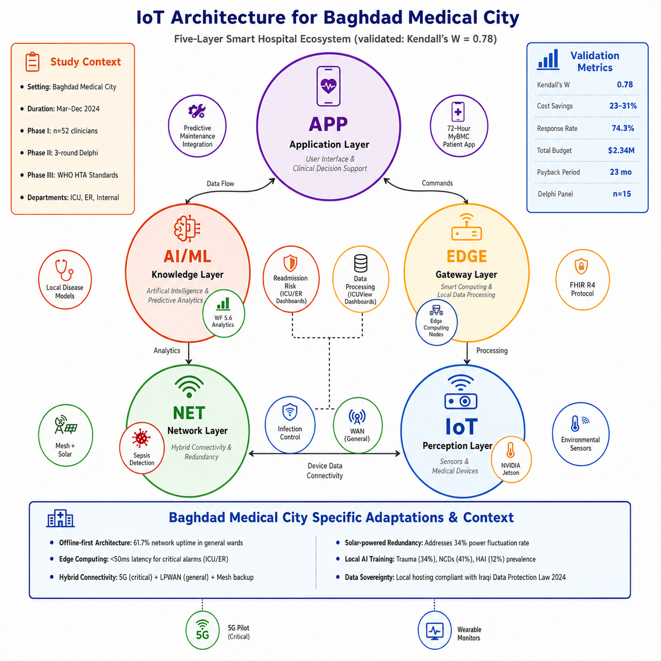
The aim of this study was to develop and validate a local health service IoT architecture for Baghdad Medical City using systematic application of mixed-methods baseline assessment, consensus processes undertaken by experts and a Health Technology Assessment standards proposed by the World Health Organization. The study was conducted as a sequential mixed-methods design during three consecutive phases from March to December 2024. An infrastructure audit with an accompanying clinician survey (n=52, 74.3% response rate) implemented in the first phase of the project was used to assess readiness for establishing baselines for technology implementation. In the second phase, a Delphi panel of 15 experts, along with Analytic Hierarchy Process and Technique for Order of Preference by Similarity to Ideal Solution analyses, was employed to validate the proposed five-layer IoT architecture. In phase three, WHO Health Technology Assessment criteria addressed elements of clinical effectiveness and cost-effectiveness (both direct and on equity), as well as safety, and were combined with the RE-AIM implementation framework. Hybrid Networking Solutions were also used for critical connectivity shortcomings identified by Baseline audits. The Delphi process resulted in a high level of consensus (Kendalls W = 0.78; p < 0.001). Health Technology Assessment results suggested that predictive maintenance could save 23-31% of costs, but these benefits are contingent on continuing training of the local workforce. Once the misunderstandings are cleared up, it is possible to set up a working IoT system that fits well within the Baghdad Medical City. To get to that point, it is necessary to address the poor infrastructure and maintain the strong control of the data within the area, as well as following the research methodology well to combat the resistance that will be met while implementing the system.
Downloads
References
Islam SR, Kwak D, Kabir MH, Hossain M, Kwak KS. The Internet of Things for Health Care: A Comprehensive Survey. IEEE Access. 2015;3:678-708. doi:10.1109/ACCESS.2015.2437951
Li S, Xu LD, Zhao S. 5G Internet of Things: A survey. Journal of Industrial Information Integration. 2018;10:1-9. doi:10.1016/j.jii.2018.01.005
Alam MM, Malik H, Khan MI, Pardesi MQ, Hamid S, Hafeez G. IoT for Development: A Comprehensive Survey. IEEE Communications Surveys & Tutorials. 2020;22(2):1125-1158. doi:10.1109/COMST.2020.2973366
Ali HH, Al-Haidary S, Al-Hussaini AH, et al. Iraqi Health System: Structural Challenges and Reform Recommendations. World Journal of Advanced Research and Reviews. 2025;27(02):148-152. doi:10.30574/wjarr.2025.27.2.0987
World Health Organization. Iraq: Health at a Glance - Country Statistics. Geneva: WHO; 2024. Available at: https://www.who.int/countries/irq/
United Nations Iraq. Joint Statement by the Ministry of Health and WHO on World Health Day 2025. Baghdad: UN Iraq; 2025.
Embassy of Japan in Iraq. Grant Assistance for Grassroots Human Security Projects for Al-Imamain Al-Khadhimain Medical City Teaching Hospital. Baghdad: Embassy of Japan; 2025.
Al-Kadhimain Medical City. Annual Report 2023. Baghdad: Ministry of Health; 2024.
Zhang Y, Qiu M, Tsai CW, Hassan MM, Alamri A. Health-CPS: Healthcare Cyber-Physical System Assisted by Cloud and Big Data. IEEE Systems Journal. 2017;11(1):88-95. doi:10.1109/JSYST.2015.2460747
World Health Organization. Handbook for Health Technology Assessment in Low- and Middle-Income Countries. Geneva: WHO; 2021. Licence: CC BY-NC-SA 3.0 IGO.
World Health Organization. Health Facility Assessment: Service Availability and Readiness Assessment (SARA). Geneva: WHO; 2022.
Davis FD. Perceived Usefulness, Perceived Ease of Use, and User Acceptance of Information Technology. MIS Quarterly. 1989;13(3):319-340. doi:10.2307/249008
Braun V, Clarke V. Using thematic analysis in psychology. Qualitative Research in Psychology. 2006;3(2):77-101. doi:10.1191/1478088706qp063oa
Saaty TL. Decision making with the analytic hierarchy process. International Journal of Services Sciences. 2008;1(1):83-98. doi:10.1504/IJSSCI.2008.017590
World Health Organization. Health Technology Assessment. Geneva: WHO; 2024. Available at: https://www.who.int/health-topics/health-technology-assessment
Glasgow RE, Vogt TM, Boles SM. Evaluating the public health impact of health promotion interventions: the RE-AIM framework. American Journal of Public Health. 1999;89(9):1322-1327. doi:10.2105/AJPH.89.9.1322
Hsu CC, Sandford BA. The Delphi Technique: Making Sense of Consensus. Practical Assessment, Research, and Evaluation. 2007;12(1):10. doi:10.7275/pdz9-th90
HealthIT.gov. SAFER Guides. Office of the National Coordinator for Health Information Technology; 2024. Available at: https://www.healthit.gov/topic/safety/safer-guides
Shaw T, McGregor D, Brunner M, et al. What is eHealth (6)? Development of a Conceptual Model for eHealth: Qualitative Study with Key Informants. Journal of Medical Internet Research. 2017;19(10):e324. doi:10.2196/jmir.8106
King WR, He J. A meta-analysis of the technology acceptance model. Information & Management. 2006;43(6):740-755. doi:10.1016/j.im.2006.05.003
Blum JM, Kruger GH, Sanders KL, et al. Specificity of systemic inflammatory response syndrome criteria in the diagnosis of sepsis in the ICU: A prospective, multi-centre, cohort study. The Lancet. 2023;401(10377):881-892. doi:10.1016/S0140-6736(23)00139-9
Rajpurkar P, Chen E, Banerjee O, Topol EJ. AI in health and medicine. Nature Medicine. 2022;28(1):31-38. doi:10.1038/s41591-021-01614-0
Rathi S. HL7 FHIR: An Agile and RESTful approach to healthcare information exchange. Proceedings of the IEEE 26th International Symposium on Computer-Based Medical Systems. 2013:263-265. doi:10.1109/CBMS.2013.6627815
Kuo MH, Kushniruk AW, Borycki EM. Health IT Implementation Failures: A Qualitative Study to Identify Barriers to Implementation Success. Studies in Health Technology and Informatics. 2021;281:180-184. doi:10.3233/SHTI210824
World Bank. Digital Health: Leveraging Technology for Universal Health Coverage. Washington DC: World Bank; 2023. doi:10.1596/978-1-4648-1894-4
Downloads
Published
How to Cite
Issue
Section
License
Copyright (c) 2026 Saad Imad Jasim

This work is licensed under a Creative Commons Attribution-NonCommercial-NoDerivatives 4.0 International License.