Innovative trust and privacy solutions for IOT devices in 5G environments
DOI:
https://doi.org/10.29304/jqcsm.2026.18.32749Keywords:
5G-IOT security, IDS Technology, cyberattack detection, Machine learning ensemble.Abstract
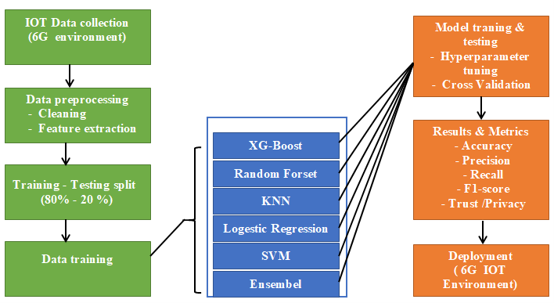
This research study presents an ensemble-based intrusion detection framework for fifth-generation (5G)-driven Internet of Things (IoT) devices. It combines XGBoost, Random Forest, SVM, KNN and Logistic Regression with weighted soft voting in the model as well. The framework has been validated against the CSE-CICIDS2018 dataset, which encompasses different, state-of-the-art attack patterns associated with 5G-IoT systems. Normalisation, feature selection, and missing value imputation are performed in a preprocessing pipeline to improve generalisation. K-fold cross-validation ensures the robustness of the model; statistical testing confirms improvements in performance. The ensemble obtains an accuracy of 99.15%, an F1-score of 99.14% and an AUC of 1.00, outperforming each classifier alone. Privacy awareness is through flow-based features without inspecting Raw payloads. However, future work remains to be done on real-world validation and more intentional trust mechanisms.
Downloads
References
K. Anabi Hilary, et al., The four-C framework for high capacity ultra-low latency in 5G networks: A review, Energies, 12(18) (2019) 3449.
W. Mazurczyk, et al., Challenges and novel solutions for 5G network security, privacy and trust, IEEE Wireless Communications, 27(4) (2020) 6–7.
A. S. George, 5G-enabled digital transformation: Mapping the landscape of possibilities and problems, Partners Universal Innovative Research Publication, 2(3) (2024) 01–37.
S. Sicari, A. Rizzardi and A. Coen-Porisini, 5G in the Internet of Things era: An overview on security and privacy challenges, Computer Networks, 179 (2020) 107345.
M. Wazid, et al., Security in 5G-enabled Internet of Things communication: Issues, challenges, and future research roadmap, IEEE Access, 9 (2020) 4466–4489.
A. Al Farsi, et al., Comparative performance evaluation of machine learning algorithms for cyber intrusion detection, (2024).
Q. Yuan and Y. Lai, Towards efficient information retrieval in Internet of Things environments via machine learning approaches, Journal of The Institution of Engineers (India): Series B, 106(1) (2025) 363–386.
A. M. Rayyis, et al., Optimizing 5G resource allocation with attention-based CNN-BiLSTM and squeeze-and-excitation architecture, Frontiers in Communications and Networks, 6 (2025) 1629347.
W. Chimphlee and S. Chimphlee, Hyperparameters optimization XGBoost for network intrusion detection using CSE-CIC-IDS 2018 dataset, IAES Int. J. Artif. Intell., 13(1) (2024) 817.
T. Chen, et al., XGBoost: Extreme gradient boosting, R package version, 1.4 (2015) 1–4.
J. Ma, et al., Application of the XGBoost machine learning method in PM2.5 prediction: A case study of Shanghai, Aerosol and Air Quality Research, 20(1) (2020) 128–138.
P. Probst, M. N. Wright and A.-L. Boulesteix, Hyperparameters and tuning strategies for random forest, Wiley Interdisciplinary Reviews: Data Mining and Knowledge Discovery, 9(3) (2019) e1301.
H. A. Salman, A. Kalakech and A. Steiti, Random forest algorithm overview, Babylonian Journal of Machine Learning, (2024) 69–79.
P. Cunningham and S. J. Delany, K-nearest neighbour classifiers: A tutorial, ACM Computing Surveys, 54(6) (2021) 1–25.
R. K. Halder, et al., Enhancing K-nearest neighbor algorithm: A comprehensive review and performance analysis of modifications, Journal of Big Data, 11(1) (2024) 113.
E. Y. Boateng and D. A. Abaye, A review of the logistic regression model with emphasis on medical research, Journal of Data Analysis and Information Processing, 7(4) (2019) 190.
B. Ghojogh, et al., Locally linear embedding and its variants: Tutorial and survey, arXiv preprint (2020) arXiv:2011.10925.
D. A. Pisner and D. M. Schnyer, Support vector machine, Machine Learning, Academic Press (2020) 101–121.
A. Tedyyana, et al., Enhance telecommunication security through the integration of support vector machines, Int. J. Adv. Comput. Sci. Appl., 15(3) (2024).
T. N. Rincy and R. Gupta, Ensemble learning techniques and its efficiency in machine learning: A survey, Proc. IDEA Conf., IEEE (2020).
K. O. Lye, S. Mishra and R. Molinaro, A multi-level procedure for enhancing accuracy of machine learning algorithms, European Journal of Applied Mathematics, 32(3) (2021) 436–469.
H. Luan and C.-C. Tsai, A review of using machine learning approaches for precision education, Educational Technology & Society, 24(1) (2021) 250–266.
W. Cullerne Bown, Sensitivity and specificity versus precision and recall, and related dilemmas, Journal of Classification, 41(2) (2024) 402–426.
A. Humphrey, et al., Machine-learning classification of astronomical sources: Estimating F1-score in the absence of ground truth, Monthly Notices of the Royal Astronomical Society: Letters, 517(1) (2022) L116–L120.
Z. Chen, Z. Li, J. Huang, S. Liu and H. Long, An effective method for anomaly detection in industrial Internet of Things using XGBoost and LSTM, Scientific Reports, 14(1) (2024) 23969.
H. N. Fakhouri, et al., A comprehensive study on the role of machine learning in 5G security: Challenges, technologies, and solutions, Electronics, 12(22) (2023) 4604.
N. Gadey, S. D. Pande and A. Khamparia, Enhancing 5G and IoT network security: A multi-model deep learning approach for attack classification, CRC Press (2024) 1–23.
T. Senevirathna, et al., A survey on XAI for 5G and beyond security: Technical aspects, challenges and research directions, IEEE Communications Surveys & Tutorials, 27(2) (2024) 941–973.
D. D. Kulkarni, S. Rathore and R. K. Jaiswal, Intrusion detection system for IoT networks using neural networks with extended Kalman filter, Proc. ICCCN, IEEE (2021).
P. Ruzafa-Alcázar, et al., Intrusion detection based on privacy-preserving federated learning for the industrial IoT, IEEE Trans. Ind. Inform., 19(2) (2021) 1145–1154.
S. A. Mahmud, et al., Privacy-preserving federated learning-based intrusion detection technique for cyber-physical systems, Mathematics, 12(20) (2024) 3194.
C. Hazman, et al., A smart model integrating LSTM and XGBoost for improving IoT-enabled smart cities security, Cluster Computing, 28(1) (2025) 70.
S. Shibu, et al., Anomaly detection using deep learning approach for IoT smart city applications, Multimedia Tools and Applications, 84(17) (2025) 17929–17949.
M. Aly and M. H. Behiry, Enhancing anomaly detection in IoT-driven factories using logistic boosting, random forest, and SVM: A comparative machine learning approach, Scientific Reports, 15(1) (2025) 23694.
Downloads
Published
How to Cite
Issue
Section
License
Copyright (c) 2026 Ahmed Naeem Jasim, Hussein M. Jebur, Mohammed Yousif Arabi

This work is licensed under a Creative Commons Attribution-NonCommercial-NoDerivatives 4.0 International License.