A Methodological Study on the Impact of Several Latin Hypercube Designs in Constructing Ordinary Kriging Models
DOI:
https://doi.org/10.29304/jqcsm.2026.18.32778Keywords:
Ordinary Kriging models,, Space filling design,, Latin hypercube,, computer codeAbstract
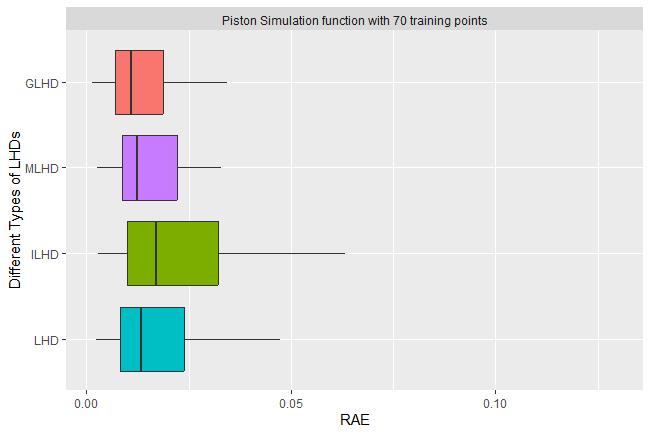
Kriging models (KMs) are utilized in several scientific domains as replacements for physical systems. The KM interprets the output from the computer code as a Gaussian process. A well-designed component is crucial in building the KMs. The design and analysis utilized to create (KMs) for computer experiments are the focus of our study. We are interested in assessing the impact of design on the accuracy of KM predictions. KMs are frequently constructed using Latin hypercube designs (LHDs). We examine and evaluate a variety of LHD types. In this study, we aim to construct several KMs based on various LHD kinds, and we compared each KMs performance. Several measures that assess the KM performance are used to make the comparison. The constructed KMs are applied to a real computer code represented by the Piston Simulation function.
Downloads
References
J. Sacks, W. J. Welch, T. J. Mitchell, and H. P. Wynn, “Design and analysis of computer experiments,” Statistical science, vol. 4, no. 4, pp. 409–423, 1989.
R. Li and A. Sudjianto, “Analysis of computer experiments using penalized likelihood in Gaussian Kriging models,” Technometrics, vol. 47, no. 2, pp. 111–120, 2005.
I. Abdallah, C. Lataniotis, and B. Sudret, “Parametric hierarchical kriging for multi-fidelity aero-servo-elastic simulators—Application to extreme loads on wind turbines,” Probabilistic Engineering Mechanics, vol. 55, pp. 67–77, 2019.
J. P. Fentanes et al., “Quasi-regression,” Journal of complexity, vol. 17, no. 4, pp. 588–607, 2001.
Y. H. Al-Taweel and N. Sadeek, “A comparison of different methods for building Bayesian kriging models,” Pakistan Journal of Statistics and Operation Research, pp. 73–82, 2020.
R. W. Al-Naser and Y. Al-Taweel, “Using Kriging models for approximating computer models and quantifying their uncertainty,” in AIP Conference Proceedings, AIP Publishing, 2023.
J. P. Kleijnen, “Verification and validation of simulation models,” European journal of operational research, vol. 82, no. 1, pp. 145–162, 1995.
Y. Al-Taweel, “Uncertainty quantification of multivariate Gaussian process regression for approximating multivariate computer codes,” TWMS Journal of Applied and Engineering Mathematics, 2024.
M. D. McKay, R. J. Beckman, and W. J. Conover, “A comparison of three methods for selecting values of input variables in the analysis of output from a computer code,” Technometrics, vol. 42, no. 1, pp. 55–61, 2000.
B. Beachkofski and R. Grandhi, “Improved distributed hypercube sampling,” in 43rd AIAA/ASME/ASCE/AHS/ASC Structures, Structural Dynamics, and Materials Conference, 2002, p. 1274.
M. D. Morris and T. J. Mitchell, “Exploratory designs for computational experiments,” Journal of statistical planning and inference, vol. 43, no. 3, pp. 381–402, 1995.
K.-T. Fang, R. Li, and A. Sudjianto, Design and modeling for computer experiments. CRC Press, 2010.
T. W. Simpson, A concept exploration method for product family design. Georgia Institute of Technology, 1998.
M. Liefvendahl and R. Stocki, “A study on algorithms for optimization of Latin hypercubes,” Journal of statistical planning and inference, vol. 136, no. 9, pp. 3231–3247, 2006.
A. M. Overstall and D. C. Woods, “Multivariate emulation of computer simulators: model selection and diagnostics with application to a humanitarian relief model,” Journal of the Royal Statistical Society: Series C (Applied Statistics), 2016.
L. S. Bastos and A. O’Hagan, “Diagnostics for Gaussian process emulators,” Technometrics, vol. 51, no. 4, pp. 425–438, 2009.
R. Kenett and S. Zacks, Modern Industrial Statistics: Design and Control of Quality and Reliability. Duxbury Press, 1998. [Online]. Available: https://books.google.co.uk/books?id=0zcfAQAAIAAJ
Downloads
Published
How to Cite
Issue
Section
License
Copyright (c) 2026 Zainab Abdulateef Rasheed, Younus Al-Taweel, Shaymaa M. Younus

This work is licensed under a Creative Commons Attribution-NonCommercial-NoDerivatives 4.0 International License.