Data-Driven Information Technology Systems: Evaluating Machine Learning Algorithms on the Iris Dataset
DOI:
https://doi.org/10.29304/jqcsm.2026.18.22780Keywords:
Naive Bayes, Machine learning, Classification, Decision Trees, Iris dataset and SVMAbstract
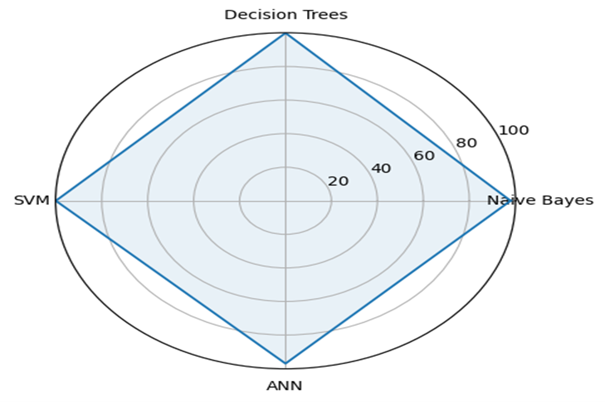
Machine learning is the core of the present-day Information Technology (IT) systems. It allows processing the data intelligently and allowing the decision making to be automated. The present study uses four classification algorithms, namely Naive Bayes, Decision Trees, Support Vector Machines (SVM) and a Deep Learning model that is built upon an Artificial Neural Network (ANN), as a benchmark to run on the Iris dataset. The experiment replicates a classic IT setting where data has been preprocessed, divided into training and testing data, and it has been utilized to create predictive models. The experimental findings prove the fact that both Decision Trees and SVM have 100 percent accuracy, which proves their suitability as the means of working with structured data. Naive Bayes had an accuracy of 98% and it is a fast and computationally efficient problem solver that is applicable in real time IT applications. ANN model has an 97% accuracy which shows that it is capable of representing complex patterns, but this is affected by the fact that the dataset is relatively small. These results demonstrate why proper choice of machine learning methods is important in developing intelligent IT systems, including decision support system, data analytics platform, and automated classification applications. All in all, this paper provides a viable basis to implementing machine learning algorithms into the modern information systems and improving efficiency, scalability, and decision-making processes.
Downloads
References
E. M. K. Reddy, A. Gurrala, V. B. Hasitha, and K. V. R. Kumar, “Introduction to Naive Bayes and a review on its subtypes with applications,” in Bayesian Reasoning and Gaussian Processes for Machine Learning Applications, 2022, pp. 1–14.
A. Géron, Hands-On Machine Learning with Scikit-Learn, Keras, and TensorFlow, 3rd ed. Sebastopol, CA, USA: O’Reilly Media, 2022.
S. Raschka and V. Mirjalili, Machine Learning with PyTorch and Scikit-Learn. Birmingham, U.K.: Packt Publishing, 2022.
K. P. Murphy, Probabilistic Machine Learning: An Introduction. Cambridge, MA, USA: MIT Press, 2022.
S. B. Kotsiantis, “Decision trees: A recent overview,” Artificial Intelligence Review, vol. 39, pp. 261–283, 2013.
B. De Ville, “Decision trees,” Wiley Interdisciplinary Reviews: Computational Statistics, vol. 5, no. 6, pp. 448–455, 2013.
M. Idrissi Khaldi et al., “In-Depth Comparison of Supervised Classification Models - Performance and Adaptability to Practical Requirements,” International Journal of Advanced Computer Science and Applications (IJACSA), vol. 16, no. 8, 2025.
S. Hariyanto, A. Wibowo, and R. Pratama, “Comparative Analysis of Support Vector Machine, Decision Tree, and Naive Bayes in Evaluating Machine Learning Effectiveness,” RUBIN Journal, 2025.
D. A. Pisner and D. M. Schnyer, “Support vector machine,” in Machine Learning, Academic Press, 2020. doi: 10.1016/B978-0-12-815739-8.00006-7.
C. El Morr, M. Jammal, H. Ali-Hassan, and W. El-Hallak, “Support vector machine,” in Machine Learning for Practical Decision Making, Springer, 2022. doi: 10.1007/978-0-12-815739-8_13.
K. G., K. P. Indumathi, J. Hasin, L. F. Jency, S. Siluvai, and K. G., “Support vector machines: A literature review on their application in analyzing mass data for public health,” Cureus, vol. 17, no. 1, 2025. doi: 10.7759/cureus.77169.
S. Huang et al., “Applications of support vector machine (SVM) learning in cancer genomics,” Cancer Genomics & Proteomics, vol. 15, no. 1, pp. 41–51, 2018.
Y. Wu et al., “Enhanced classification models for iris dataset,” Procedia Computer Science, vol. 162, pp. 946–954, 2019.
B. T. Chicho et al., “Machine learning classifiers based classification for IRIS recognition,” Qubahan Academic Journal, vol. 1, no. 2, pp. 106–118, 2021.
M. Poojithaa and K. Malathi, “Decision tree over support vector machine for better accuracy in identifying the problem based on the Iris flower,” Advances in Parallel Computing, vol. 41, p. 209, 2022.
S. Tayade, R. Gupta, D. Kherde, and C. Ubale, “Case study: Prediction on Iris dataset using KNN algorithm,” 2023.
B. H. Sadiq, N. S. Ahmed, and O. M. Ahmed, “Comprehensive analysis of Iris dataset using K-means and fuzzy K-means clustering algorithm,” in Proc. Int. Conf. Innovations in Computing Research, Springer, 2024, pp. 75–83.
S. Sangeetha and R. Sujatha, “Deep learning approaches for iris damage prediction using CNN and image processing,” in Proc. Int. Conf. Information, Communication and Computing Technology, Springer, 2025, pp. 145–157.
Downloads
Published
How to Cite
Issue
Section
License
Copyright (c) 2026 Maha Khalil Ibrahim

This work is licensed under a Creative Commons Attribution-NonCommercial-NoDerivatives 4.0 International License.