A Hybrid GAN-CNN Framework for Enhanced Brain Tumor Classification from MRI Images
DOI:
https://doi.org/10.29304/jqcsm.2026.18.32795Keywords:
Brain Tumor Classification, MRI Imaging, Deep Learning, Convolutional Neural Networks (CNN), Generative Adversarial Networks (GAN)Abstract
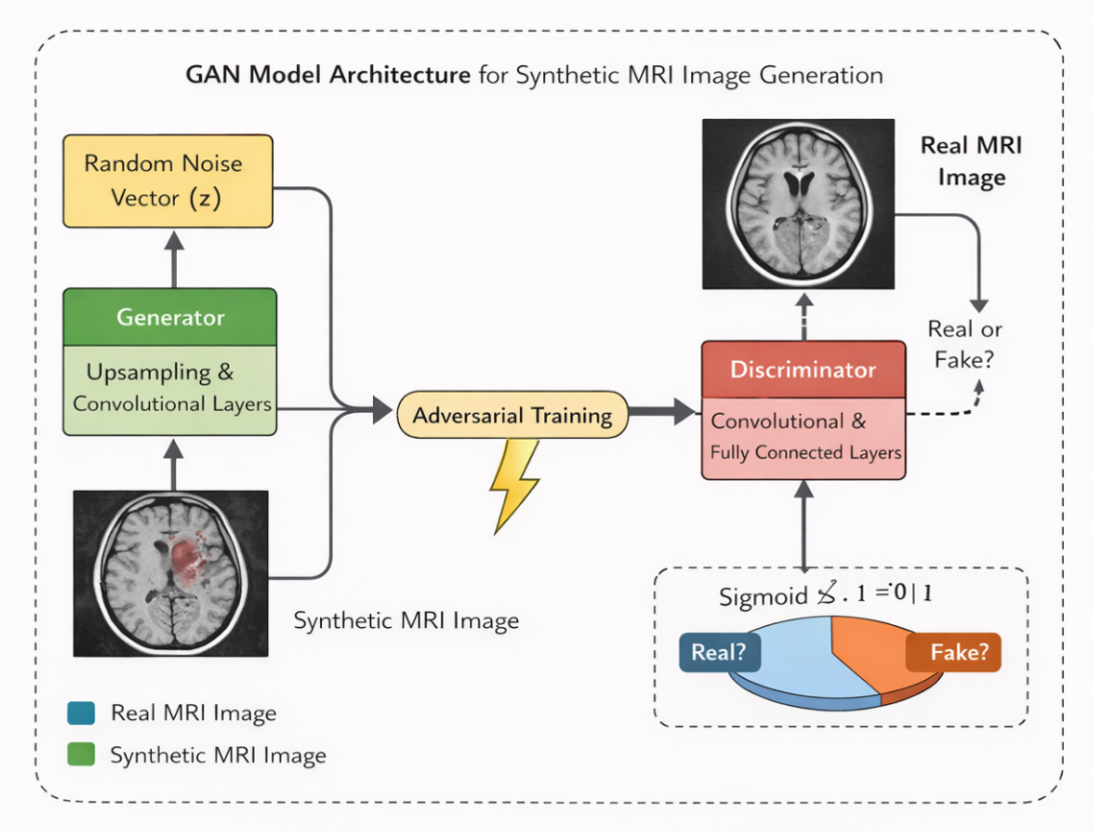
This paper introduces a hybrid deep learning model, a combination of Generative Adversarial Networks (GANs) and Convolutional Neural Networks (CNNs) to improve brain tumor classification with MRI images. The diagnosis of brain tumors has been a major dilemma in medical imaging because of the complexity of the tumor structures, lack of data, and imbalance of the classes. To overcome these issues, the proposed framework encourages the use of GAN-based data augmentation in order to create real-world synthetic MRI images, which will enhance the dataset and enhance the generalization of the models. Moreover, traditional preprocessing and augmentation methods like normalization, contrast enhancement, and noise reduction are used to enhance the quality of the data. This is followed by the design of a strong CNN architecture to automatically project hierarchical features as well as multi-classify into glioma, meningioma, pituitary tumor, and no tumor. The model is trained and tested on a rich dataset of publicly accessible sources, making sure that there is diversity in the imaging perspectives and conditions. The experimental results show that the proposed method has a high classification rate of around 99 percent and a low loss value, which reflects high predictive performance and stability. The hybrid GAN-CNN model, compared to the current methods, demonstrates superior performance in comparison to the traditional CNN-based methods, as well as other hybrid techniques. Moreover, the analysis of confusion matrix and ROC curve proves that the model is able to differentiate between the various classes of tumors effectively. The suggested framework provides a credible and scalable solution to automated brain tumor diagnosis, and it has a high probability of its clinical use.
Downloads
References
. F. Bray , M. Laversanne, H. Sung, J. Ferlay, R. L. Siegel, I. Soerjomataram, & A. Jemal (2024). Global cancer statistics 2022: GLOBOCAN estimates of incidence and mortality worldwide for 36 cancers in 185 countries.CA: a cancer journal for clinicians, 74(3), 229-263.
. M. J. Sullivan & D. D. Eisenstat (2025). The 2021 WHO classification of tumors of the central nervous system: Responding to the challenge in low-and middle-income countries. Neuro-Oncology Practice, 12(3), 355-356.
. B. J. A. Pereira, A. N. de Almeida, W. S. Paiva, & S. K. N. Marie (2024). Impact on natural history of atypical meningioma after changes in 2016 edition of the world health organization (WHO) classification of central nervous system tumors: a literature review. Neurosurgical Review, 47(1), 704.
. Shobeiri, P., Seyedmirzaei, H., Kalantari, A., Mohammadi, E., Rezaei, N., & Hanaei, S. (2023). The epidemiology of brain and spinal cord tumors. In Human Brain and Spinal Cord Tumors: From Bench to Bedside. Volume 1: Neuroimmunology and Neurogenetics (pp. 19-39). Cham: Springer International Publishing.
. Aziz, P. A., Memon, S. F., Hussain, M., Memon, A. R., Abbas, K., Qazi, S. U., ... & Ahmed, M. (2023). Supratotal resection: An emerging concept of glioblastoma multiforme surgery—systematic review and meta-analysis. World Neurosurgery, 179, e46-e55.
. Cao, W., Qin, K., Li, F., & Chen, W. (2024). Comparative study of cancer profiles between 2020 and 2022 using global cancer statistics (GLOBOCAN). Journal of the National Cancer Center, 4(2), 128-134.
. Marina, S. (2025). Improving diagnostic accuracy of brain tumor MRI classification using generative AI and deep learning techniques. Babylonian Journal of Artificial Intelligence, 2025, 55-63.
. Jiang, Y., Luo, X., Chen, L., Lin, H., & Gao, J. (2023). Multicolor 19F magnetic resonance imaging: A promising medical technique for in vivo visualization of multiple biological targets. Fundamental Research, 3(4), 529-533.
. Zhang, H., & Qie, Y. (2023). Applying deep learning to medical imaging: a review. Applied Sciences, 13(18), 10521.
. Aggarwal, M., Tiwari, A. K., Sarathi, M. P., & Bijalwan, A. (2023). An early detection and segmentation of brain tumor using deep neural network. BMC Medical Informatics and Decision Making, 23(1), 78.
. Dhaygude, A. D., Varma, R. A., Yerpude, P., Swarnkar, S. K., Jindal, R. K., & Rabbi, F. (2023, December). Deep learning approaches for feature extraction in big data analytics. In 2023 10th IEEE Uttar Pradesh section international conference on electrical, electronics and computer engineering (UPCON) (Vol. 10, pp. 964-969). IEEE.
. Haq, E. U., Jianjun, H., Li, K., Haq, H. U., & Zhang, T. (2023). An MRI-based deep learning approach for efficient classification of brain tumors. Journal of Ambient Intelligence and Humanized Computing, 14(6), 6697-6718.
. Ghorbian, M., Ghorbian, S., & Ghobaei-Arani, M. (2025). Advancements in Machine Learning for Brain Tumor Classification and Diagnosis: A Comprehensive Review of Challenges and Future Directions. Archives of Computational Methods in Engineering, 1-36.
. Kumar, S., & Kumar, D. (2023). Human brain tumor classification and segmentation using CNN. Multimedia Tools and Applications, 82(5), 7599-7620.
. M. I. Sharif et al., "Brain tumor detection and classification by hybrid CNN-DWT model," Multimedia Tools Appl., vol. 78, pp. 2085–2099, 2020.
. Makhlouf, A., Maayah, M., Abughanam, N., & Catal, C. (2023). The use of generative adversarial networks in medical image augmentation. Neural Computing and Applications, 35(34), 24055-24068.
. C. Han et al., "GAN-based synthetic brain MRI augmentation to improve brain tumor classification," IEEE Access, vol. 8, pp. 97213–97223, 2020.
. Rao, V. S., Balakrishna, R., El-Ebiary, Y. A. B., Thapar, P., Saravanan, K. A., & Godla, S. R. (2024). AI driven anomaly detection in network traffic using hybrid CNN-GAN. Journal of Advances in Information Technology, 15(7), 886-895.
. Jabbar, A., Naseem, S., Mahmood, T., Saba, T., Alamri, F. S., & Rehman, A. (2023). Brain tumor detection and multi-grade segmentation through hybrid caps-VGGNet model. IEEE Access, 11, 72518-72536.
. S. Afshar et al., "Capsule networks for brain tumor classification from MRI images," IEEE Transactions on Medical Imaging, vol. 39, no. 9, pp. 2561–2572, 2020.
. S. Rehman et al., "Brain tumor classification and detection using hybrid convolutional neural network model," Diagnostics, 2021, vol. 11, no. 11, pp. 2085–2102.
Downloads
Published
How to Cite
Issue
Section
License
Copyright (c) 2026 Huda Salloom Sultana, Rawa Ali Hassanb

This work is licensed under a Creative Commons Attribution-NonCommercial-NoDerivatives 4.0 International License.