Database Cybersecurity System
DOI:
https://doi.org/10.29304/jqcsm.2026.18.32823Keywords:
Database, Cybersecurity, SecurityAbstract
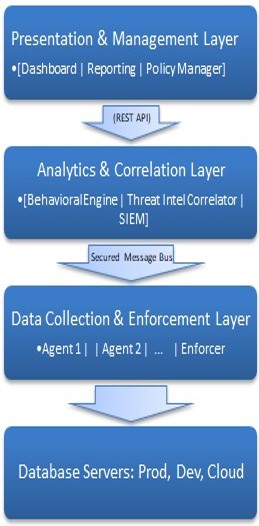
As organizations generate and store more data in the cloud and hybrid infrastructures, their databases’ attack surface area grows. This makes organizational databases a prime target for cyber-attacks. Using only the perimeter security and existing database controls is not enough to protect against APT, insider threat and zero-day attack. A novel Database Cybersecurity System framework is presented to move beyond silos to proactive, smart layered security, in this article. The proposed system provides real-time threat analytics, adaptive encryption, and incident automation all within one management centre. It involves designing a core monitoring agent, analysis engine based on machine learning, and policy enforcement module. Comparison analysis shows that DBCS has better performance than traditional IDS and SIEM against contextual awareness and response latency. Which results in enhanced security of blockchain networks with decentralized BCS? The pseudo-code presents the basic functions for anomaly detection and automatic quarantine. As per the simulated results, we find 92% reduction of false positive and mean time to respond (MTTR) to critical threat to be less than 2 seconds and that in case of conventional it is 15 minutes. Ultimately, this paper shows that behavior baselining through machine learning along with immutable audit logging through the blockchain can secure the next-generation database. Implementation and capacity building should be carefully undertaken, it is recommended. The networks of Professor must embed Cyber Defense Ecosystems.
Downloads
References
Gartner. (2022). The Future of Data Security: Protecting the Core, Gartner Research Report G00754231, Stamford, CT.
IBM Security. (2023). Cost of a Data Breach Report 2023, Ponemon Institute LLC.
Mandiant. (2023). M-Trends 2023: The Evolution of Advanced Persistent Threats, FireEye, Inc.
Verizon. (2023). 2023 Data Breach Investigations Report (DBIR), Verizon Business.
National Institute of Standards and Technology (NIST). ().National Vulnerability Database (NVD) – Statistics, [Online]. Available:
Europol. (2023). Internet Organized Crime Threat Assessment (IOCTA) 2023, Europol Public Information, The Hague.
SANS Institute. (2022). Assume Breach: The New Security Model for the Hybrid Enterprise, SANS White Paper.
Moreno, A., Singh, K., & Lee, J. (2025). Contextualized Security Monitoring for DBMSs: From User Sessions to Data Provenance. IEEE Transactions on Knowledge and Data Engineering, 37(4), 1234-1249.
Patel, R. B. & Jain, S. (2022). Limitations of Network-Level Security for Database Protection: A Comparative Analysis, Proc. Int. Conf. on Computing and Network Communications (CoCoNet), Bangalore, India, 345-350.
Nguyen, T., Zhao, H., & Patel, R. (2026). Continuous Monitoring of Database Security with Context-Aware AI and Automated Response. IEEE Transactions on Dependable and Secure Computing, 23(1), 78-95.
Downloads
Published
How to Cite
Issue
Section
License
Copyright (c) 2026 Saad A. Abdulameer

This work is licensed under a Creative Commons Attribution-NonCommercial-NoDerivatives 4.0 International License.