Energy-Aware Hybrid AI Framework for Intelligent Threat and Anomaly Detection in Resource-Constrained Wireless Sensor Networks
DOI:
https://doi.org/10.29304/jqcsm.2026.18.32828Keywords:
AI, Wireless Sensor Networks (WSNs); Energy-Aware Security; Anomaly Detection; Convolutional Neural Networks (CNN); and Random Forest (RF).Abstract
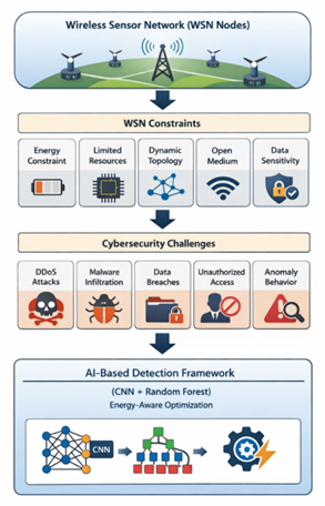
This paper presents an energy aware hybrid Artificial Intelligence (AI) approach to intelligent threat detection and anomaly identification in resource restricted Wireless Sensor Networks (WSNs). However, securing the computer systems remains one of the challenging issues due to limited energy resources, computational capacity, and dynamic characteristics of WSN nodes. To overcome all of the above problems, this paper introduces a hybrid framework that combines Convolutional Neural Networks (CNN) and Random Forest (RF) algorithms to enable accurate and efficient detection of multiple cyber threats such as Distributed Denial of Service (DDoS) attacks, malware intrusions, data breaches, unauthorized access attempts and more. Furthermore, an adaptive anomaly detection method is designed to learn from network traffic and sensor data in order to detect abnormal patterns that may reflect security vulnerabilities. The proposed model adopts an energy-awareness approach, unlike traditional approaches; minimizing computational efforts while achieving high detection performance that is suitable for WSN environments with resource constraints. The results of our exploration show that the hybrid CNN+RF model provides high accuracy for threat classification and uniquely detects anomalies in real-time approaches. The proposed study shows a greener way of providing lightweight energy efficient intelligent detection for an anomalous event using modern techniques in WSN by means of deep learning and machine learning approaches. thus, this gives rise to better threat discovery and detection at earliest stages which in turn, helps in enhanced functionality from a security point of view all over WSN.
Downloads
References
. Butun, I., Morgera, S. D., & Sankar, R. (2013). A survey of intrusion detection systems in wireless sensor networks. IEEE communications surveys & tutorials, 16(1), 266-282.
. Sadia, H., Farhan, S., Haq, Y. U., Sana, R., Mahmood, T., Bahaj, S. A. O., & Khan, A. R. (2024). Intrusion detection system for wireless sensor networks: A machine learning based approach. IEEE Access, 12, 52565-52582.
. Abbood, Z. A., Oleiwi, A. H., Al-Hassani, R. T., & Ayad, J. (2025). Optimizing Cybersecurity in 5G-Enabled IoT Networks via a Resource-Efficient Random Forest Model. Mesopotamian Journal of CyberSecurity, 5(2), 886-898.
. Sadia, H., Farhan, S., Haq, Y. U., Sana, R., Mahmood, T., Bahaj, S. A. O., & Khan, A. R. (2024). Intrusion detection system for wireless sensor networks: A machine learning based approach. IEEE Access, 12, 52565-52582.
. Safaei, M., Driss, M., Boulila, W., Sundararajan, E. A., & Safaei, M. (2022). Global outliers detection in wireless sensor networks: A novel approach integrating time‐series analysis, entropy, and random forest‐based classification. Software: Practice and Experience, 52(1), 277-295.
. Ghadi, Y. Y., Mazhar, T., Al Shloul, T., Shahzad, T., Salaria, U. A., Ahmed, A., & Hamam, H. (2024). Machine learning solutions for the security of wireless sensor networks: A review. Ieee Access, 12, 12699-12719.
. Elsayed, S., Mohamed, K., & Madkour, M. A. (2024). A comparative study of using deep learning algorithms in network intrusion detection. IEEE Access, 12, 58851-58870.
. Nizamudeen, S. M. T. (2023). Intelligent intrusion detection framework for multi-clouds–IoT environment using swarm-based deep learning classifier. Journal of Cloud Computing, 12(1), 134.
. Lafta, N., & Abbood, Z. (2024). Comprehensive review and comparative analysis of keras for deep learning applications: a survey on face detection using convolutional neural networks. Int. J. Relig, 5(11), 1203-1213.
. Abdul Mahdi, E. A. A., Ali Al-Askery, Adnan Hussein Ali, & Safiye Ghasemi. (2024). A Survey of Datacenter and Optical Data Center Networks. Journal of Techniques, 6(3), 66–75. https://doi.org/10.51173/jt.v6i3.1875.
. Elsayed, M. S., Le-Khac, N. A., Dev, S., & Jurcut, A. D. (2020, August). Ddosnet: A deep-learning model for detecting network attacks. In 2020 IEEE 21st International Symposium on" A World of Wireless, Mobile and Multimedia Networks"(WoWMoM) (pp. 391-396). IEEE.
. Chen, J., Zhang, J., Qian, R., Yuan, J., & Ren, Y. (2023). An anomaly detection method for wireless sensor networks based on the improved isolation forest. Applied Sciences, 13(2), 702.
. Pai, V., Devidas, & Adesh, N. D. (2021, January). Comparative analysis of machine learning algorithms for intrusion detection. In IOP Conference Series: Materials Science and Engineering (Vol. 1013, No. 1, p. 012038). IOP Publishing.
. Kumar, K. S., Nair, S. A. H., Roy, D. G., Rajalingam, B., & Kumar, R. S. (2021). Security and privacy-aware artificial intrusion detection system using federated machine learning. Computers & Electrical Engineering, 96, 107440.
. Latif, M., Abro, A. A., Daniyal, S. M., Algarni, A. D., Ahmad, S., Ateya, A. A., & Abbasi, M. M. (2026). AI-based intelligent sensing detection of cybersecurity threats using multimodal sensor data in smart devices. Scientific Reports.
. Bharati, T. S., Kumar, R., & Tadiboina, S. N. (2015). Intrusion detection system for manet using machine learning and state transition analysis. Int J Comput Eng Technol, 6(12), 1-8.
. Albonda, H. D., & Yousef, S. (2014). Multi-carrier coded division multiple access multiplexing against multi-path fading. International Journal of Electronic Security and Digital Forensics 9, 6(2), 140-146.
. Osanaiye, O., Ogundile, O., Aina, F., & Periola, A. (2019). Feature selection for intrusion detection system in a cluster-based heterogeneous wireless sensor network. Facta Universitatis, Series: Electronics and Energetics, 32(2), 315-330.
. Zahariadis, T., Leligou, H. C., Voliotis, S., Maniatis, S., Trakadas, P., & Karkazis, P. (2009). Energy-aware secure routing for large wireless sensor networks. WSEAS Transactions on Communications, 8(9), 981-991.
. Dong, Y., Wang, R., & He, J. (2019, October). Real-time network intrusion detection system based on deep learning. In 2019 IEEE 10th International Conference on Software Engineering and Service Science (ICSESS) (pp. 1-4). IEEE.
. Maheswari, M., & Karthika, R. A. (2022). A Novel Hybrid Deep Learning Framework for Intrusion Detection Systems in WSN-IoT Networks. Intelligent Automation & Soft Computing, 33(1).
. Nti, I. K., Manikanta, M. S., Alex, C., & Ning, L. J. (2025). Lightweight Neural Anomaly Detection for Resource-Constrained Edge-ICN Environments: A Systematic Literature Review.
. Albonda, H. D., & Yousef, S. (2014). Multi-carrier coded division multiple access multiplexing against multi-path fading. International Journal of Electronic Security and Digital Forensics 9, 6(2), 140-146.
. Hossain, M. A., & Islam, M. S. (2023). Ensuring network security with a robust intrusion detection system using ensemble-based machine learning. Array, 19, 100306.
. Kuzlu, M., Catak, F. O., Zhao, Y., Sarp, S., & Catak, E. (2023). Security and privacy concerns in next-generation networks using artificial intelligence-based solutions: A potential use case. In Wireless Networks: Cyber Security Threats and Countermeasures (pp. 205-226). Cham: Springer International Publishing.
. Sadia, H., Farhan, S., Haq, Y. U., Sana, R., Mahmood, T., Bahaj, S. A. O., & Khan, A. R. (2024). Intrusion detection system for wireless sensor networks: A machine learning based approach. IEEE Access, 12, 52565-52582.
. Aly, M., & Behiry, M. H. (2025). Enhancing anomaly detection in IoT-driven factories using Logistic Boosting, Random Forest, and SVM: A comparative machine learning approach. Scientific Reports, 15(1), 23694.
. Ejeofobiri, C. K., Victor-Igun, O. O., & Okoye, C. (2024). Ai-driven secure intrusion detection for internet of things (iot) networks. Asian journal of mathematics and computer research, 31(4), 40-55.
. Ghadi, Y. Y., Mazhar, T., Al Shloul, T., Shahzad, T., Salaria, U. A., Ahmed, A., & Hamam, H. (2024). Machine learning solutions for the security of wireless sensor networks: A review. Ieee Access, 12, 12699-12719.
. Al-Taleb, N., & Saqib, N. A. (2022). Towards a hybrid machine learning model for intelligent cyber threat identification in smart city environments. Applied Sciences, 12(4), 1863.
. Soliman, H. H., Hikal, N. A., & Sakr, N. A. (2012). A comparative performance evaluation of intrusion detection techniques for hierarchical wireless sensor networks. Egyptian Informatics Journal, 13(3), 225-238.
. Hayder Fadhil Jawad, Ali Al-Askery, & Adnan Hussein Ali. (2022). Design and Implementation of a Healthcare Monitoring System Based on LoRa. Journal of Techniques, 4(4), 80–94. https://doi.org/10.51173/jt.v4i4.792
. Alahmadi, A. A., Aljabri, M., Alhaidari, F., Alharthi, D. J., Rayani, G. E., Marghalani, L. A., ... & Bajandouh, S. A. (2023). DDoS attack detection in IoT-based networks using machine learning models: a survey and research directions. Electronics, 12(14), 3103.
. Nadia Ahmad Mohamad, Al-Askery, Adnan Hussein Ali, & Ghasemi, S. G. (2023). Optical Sensor Implementation for Health Care Monitoring Based on Optical Fiber Technology: A Review. Journal of Techniques, 5(4), 65.
. Raghad Tariq Al_Hassani, & Dogu Cagdas Atilla (2023). Human Activity Detection Using Smart Wearable Sensing Devices with Feed Forward Neural Networks and PSO. Applied Sciences, 13(6), 3716.
Downloads
Published
How to Cite
Issue
Section
License
Copyright (c) 2026 Raghad Tariq Al_Hassania, Zainab Ali Abboodb, Adil M. Salmanc

This work is licensed under a Creative Commons Attribution-NonCommercial-NoDerivatives 4.0 International License.