A Novel Approach for Optimal Service Placement in Fog-Based Internet of Things Using the Cappuccino Optimization
DOI:
https://doi.org/10.29304/jqcsm.2026.18.32834Keywords:
Fog Computing, Internet of Things, Task Scheduling, Metaheuristic Algorithm, Cappuccino OptimizationAbstract
Abstract
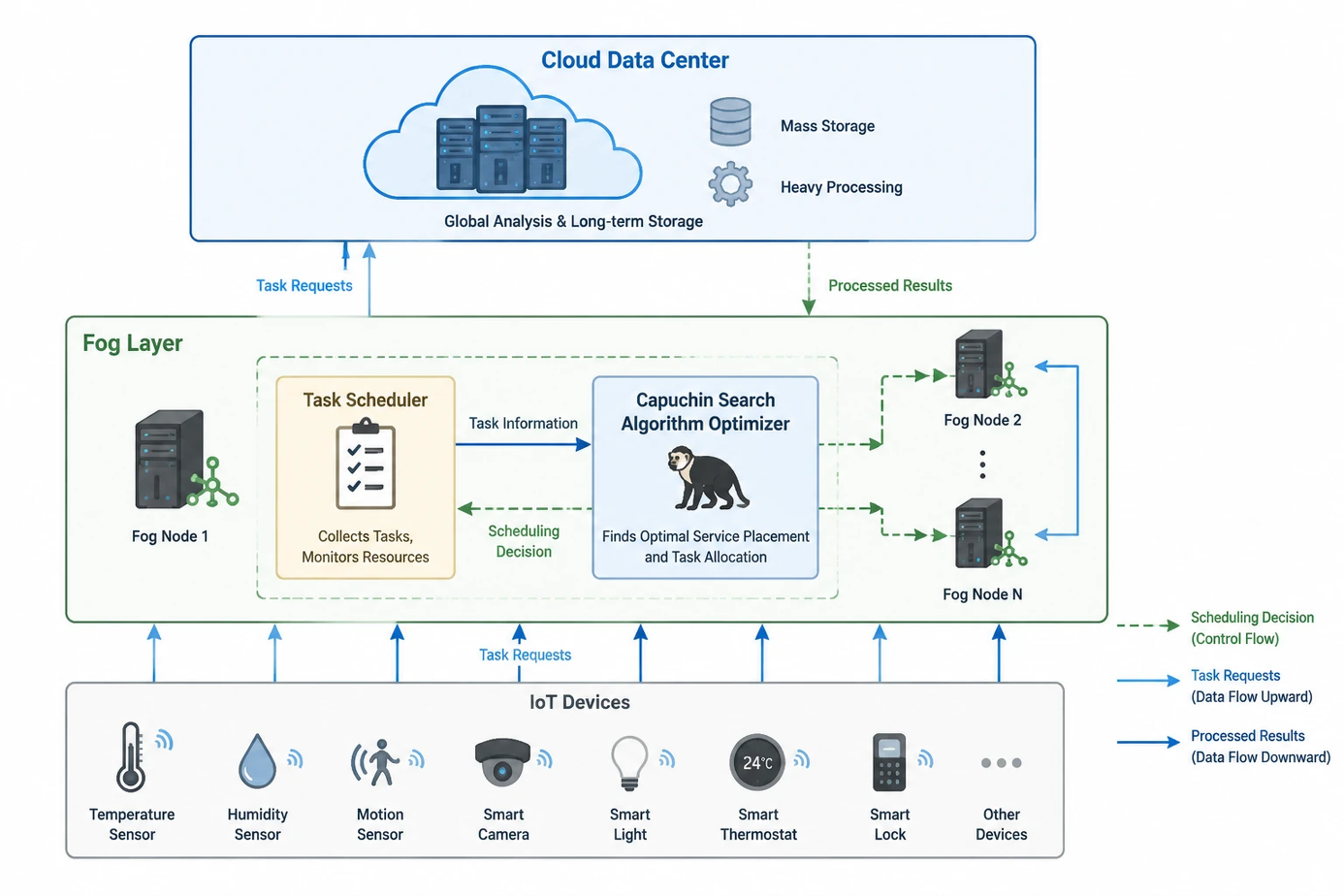
With the increasing expansion of the Internet of Things (IoT) and the increasing volume of data generated by devices, the need for fast and efficient processing is increasingly felt. In this regard, fog computing has been proposed as an intermediary approach between cloud computing and edge devices, which aims to reduce latency, improve efficiency, and better resource management. Despite these advantages, challenges such as suboptimal resource allocation, high energy consumption, increased response time, and processing load imbalance are still considered major obstacles in this field. In order to overcome these problems, this research presents a novel approach based on the Cappuccino optimization algorithm that focuses on improving task scheduling and location of IoT services in the fog environment. The proposed algorithm is designed as a meta-heuristic method and is able to improve the quality of service (QoS) by optimizing resource allocation, reducing energy consumption, and balancing the load between nodes. To evaluate the performance, the algorithm was simulated in three test scenarios with different amounts of physical machines and tasks. The results showed that the proposed method has made improvements compared to reference algorithms such as CAWPQ and CAWTPQ; in one scenario, the scheduling delay was reduced by 12.5%, in another test, the energy consumption was improved by about 18%, and in the third case, the load balancing was increased by 23%. The findings indicate that the use of the Cappuccino algorithm in fog computing can be an effective step in promoting distributed processing, reducing task execution time, and optimizing the location of IoT services. However, the evaluation is based on simulations, and future work should test the approach in real fog computing environments. These achievements draw a positive outlook for future research in the field of fog computing and the Internet of Things.
Downloads
References
L. B. Sokolinsky, "BSF: a parallel computation model for scalability estimation of iterative numerical algorithms on cluster computing systems," Journal of Parallel and Distributed Computing, vol. 149, pp. 193-206, 2020.
D. Gadasin, A. Shvedov, and A. Koltsova, "Cluster Model for Edge Computing," in 2020 International Conference on Engineering Management of Communication and Technology (EMCTECH), 2020, pp. 1-4: IEEE.
C. Cicconetti, M. Conti, A. Passarella, and D. Sabella, "Toward distributed computing environments with serverless solutions in edge systems," IEEE Communications Magazine, vol. 58, no. 3, pp. 40-46, 2020.
F. Arvaneh, F. Zarafshan, and A. Karimi, "Using fog computing (FC) and optimization techniques for tasks migration and resource allocation in the internet of things (IoT)," International Journal of Computers and Applications, pp. 1-9, 2024.
M. Harouni, M. Karimi, A. Nasr, H. Mahmoudi, and Z. Arab Najafabadi, "Health monitoring methods in heart diseases based on data mining approach: A directional review," Prognostic models in healthcare: Ai and statistical approaches, pp. 115-159: Springer, 2022.
A. Ali A, M. Ali K, M. Marwah M, and F. Tibah, “A Review of Machine Learning in Banking Risk Management and Possible Research Topics,” Journal of Engineering, Mechanics and Modern Architecture, vol. 4, no. 1, pp. 50-57, 2025.
I. Z. Yakubu and M. Murali, "An efficient meta-heuristic resource allocation with load balancing in IoT-Fog-cloud computing environment," Journal of Ambient Intelligence and Humanized Computing, vol. 14, no. 3, pp. 2981-2992, 2023.
K. Gasmi, S. Dilek, S. Tosun, and S. Ozdemir, "A survey on computation offloading and service placement in fog computing-based IoT," The Journal of Supercomputing, vol. 78, no. 2, pp. 1983-2014, 2022.
A. A. Alaidany and A. Lakizadeh, "Improving the Accuracy of Cancer Driver Gene Identification based on Dimensionality Reduction Using Deep AutoEncoders," International Journal of Intelligent Engineering & Systems, vol. 18, no. 9, 2025.
A. Khoshnoudi, R. Sadeghi, and F. Faghani, “Performance Improvement of Data Offloading using Multi-rate IEEE 802.11 WLAN,” Majlesi Journal of Electrical Engineering, vol. 13, no. 1, pp. 121-126, 2019.
M. Aliabadi, M. Karimi, Z. Karimi, and M. Fard, “The Effect of Photoplethysmography Signal Denoising on Compression Quality,” Iranian Journal of Electrical & Electronic Engineering, vol. 21, no. 1, 2025.
D. A. Shafiq, N. Z. Jhanjhi, A. Abdullah, and M. A. Alzain, "A load balancing algorithm for the data centres to optimize cloud computing applications," IEEE Access, vol. 9, pp. 41731-41744, 2021.
Z. Pei, L. Ping, and L. Shengmei, "Cloud computing technology and its applications," ZTE Communications, vol. 8, no. 4, pp. 34-38, 2020.
A. S. Naruka and J. C. Patni, "Recent Trends and Challenges in Cloud Computing," Future Connected Technologies: Growing Convergence and Security Implications, p. 229, 2023.
K. Ramkumar and G. Gunasekaran, "Preserving security using crisscross AES and FCFS scheduling in cloud computing," International Journal of Advanced Intelligence Paradigms, vol. 12, no. 1-2, pp. 77-85, 2019.
M. Runsungnoen and T. Anusas-amornkul, "Round Robin Scheduling Based on Remaining Time and Median," Smart Trends in Computing and Communications: Proceedings of SmartCom 2019, vol. 165, p. 21, 2019.
A. I. Khalyasmaa, A. I. Stepanova, S. A. Eroshenko, and P. V. Matrenin, "Review of the Digital Twin Technology Applications for Electrical Equipment Lifecycle Management," Mathematics, vol. 11, no. 6, p. 1315, 2023.
G. Goel and R. Tiwari, "Resource Scheduling Techniques for Optimal Quality of Service in Fog Computing Environment: A Review," Wireless Personal Communications, pp. 1-24, 2023.
F. Liao et al., "A survey on correlation and its structural analysis method for failure factors in cloud service," in International Conference on Cloud Computing, Performance Computing, and Deep Learning (CCPCDL 2023), 2023, vol. 12712, pp. 22-31: SPIE.
S. Narayan, N. Kumar, N. Koul, C. Verma, F. M. Enescu, and M. S. Raboaca, "Hybrid Approach for Resource Allocation and Task Scheduling on Cloud Computing: A Review," in Proceedings of International Conference on Recent Innovations in Computing: ICRIC 2022, Volume 1, 2023, pp. 527-545: Springer.
M. Barcelo, A. Correa, J. Llorca, A. M. Tulino, J. L. Vicario, and A. Morell, "IoT-cloud service optimization in next generation smart environments," IEEE Journal on Selected Areas in Communications, vol. 34, no. 12, pp. 4077-4090, 2016.
O. Skarlat, M. Nardelli, S. Schulte, M. Borkowski, and P. Leitner, "Optimized IoT service placement in the fog," Service Oriented Computing and Applications, vol. 11, no. 4, pp. 427-443, 2017.
A. Brogi, S. Forti, and A. Ibrahim, "How to best deploy your fog applications, probably," in 2017 IEEE 1st International Conference on Fog and Edge Computing (ICFEC), 2017, pp. 105-114: IEEE.
H. A. Alharbi, T. E. Elgorashi, and J. M. Elmirghani, "Energy Efficient Virtual Machines Placement over Cloud-Fog Network Architecture," IEEE Access, vol. 8, pp. 94697-94718, 2020.
E. E. Abel and M. S. Abd Latiff, "The utilization of algorithms for cloud internet of things application domains: a review," Frontiers of Computer Science, vol. 15, no. 3, pp. 1-27, 2021.
J. Jiang, X. Lu, L. Zhao, R. Dazeley, and M. Wang, "Masked autoencoders in 3D point cloud representation learning," arXiv preprint arXiv:2207.01545, 2022.
K. K. Gola, B. M. Singh, B. Gupta, N. Chaurasia, and S. Arya, "Multi‐objective hybrid capuchin search with genetic algorithm based hierarchical resource allocation scheme with clustering model in cloud computing environment," Concurrency and Computation: Practice and Experience, p. e7606.
B. Jeong, S. Baek, S. Park, J. Jeon, and Y.-S. Jeong, "Stable and efficient resource management using deep neural network on cloud computing," Neurocomputing, vol. 521, pp. 99-112, 2023.
K. Lv and T. Huang, "Construction of Cloud Computing Task Scheduling Model Based on Simulated Annealing Hybrid Algorithm," International Journal of Advanced Computer Science & Applications, vol. 15, no. 5, 2024.
S. Mirjalili, "The ant lion optimizer," Advances in engineering software, vol. 83, pp. 80-98, 2015.
W. Zhao, L. Wang, and S. Mirjalili, "Artificial hummingbird algorithm: A new bio-inspired optimizer with its engineering applications," Computer Methods in Applied Mechanics and Engineering, vol. 388, p. 114194, 2022.
V. Rajput, P. Mulay, and C. M. Mahajan, "Bio-inspired algorithms for feature engineering: analysis, applications and future research directions," Information Discovery and Delivery, 2024.
L. Ming et al., "Bio-inspired drug delivery systems: A new attempt from bioinspiration to biomedical applications," International Journal of Pharmaceutics, p. 124221, 2024.
N. Patil and D. Aeloor, "A review-different scheduling algorithms in cloud computing environment," in 2017 11th International Conference on Intelligent Systems and Control (ISCO), 2017, pp. 182-185: IEEE.
M. A. Alworafi and S. Mallappa, "An enhanced task scheduling in cloud computing based on deadline-aware model," International Journal of Grid and High Performance Computing (IJGHPC), vol. 10, no. 1, pp. 31-53, 2018.
A. Gupta, H. Bhadauria, and A. Singh, "Load balancing based hyper heuristic algorithm for cloud task scheduling," Journal of Ambient Intelligence and Humanized Computing, vol. 12, no. 6, pp. 5845-5852, 2021.
Al-shareeda, M. A., Abdul-Jabbar, R. D., ALqanatee, H. R., Alghrawy, M. A., Alaidany, A. A., Almaiah, M. A., ... & Shehab, R. (2026). Post-Quantum Authentication for Emergency Messaging in 5G Vehicular Fog Networks. Journal of Robotics and Control (JRC), 7(1), 3239-3250.
Alaidany, A. A., Altimary, M., Mohamed-Saeed, H. A., & Abdulabbas, Z. A. (2026). A Machine Learning-Based Optimisation Framework for Estimating Gas Injection and Enhancing Oil Recovery in Petroleum Reservoirs. African Journal of Applied Research, 12(3), 94-119.
Dahoos, Z. B., Elbai, S., Alghrawy, M. A., Amir, A. H. A., Hussien, G. H., Elayati, K., & Alaidany, A. A. (2026). Detection of Pneumonia from Chest X-Ray Images using Ensemble Deep Learning with A Voting Mechanism. African Journal of Applied Research, 12(3), 120-152.
Amir, A. H. A., & Nemer, Z. N. (2025). Inclusive Review on Advances in Masked Human Face Recognition Technologies. arXiv preprint arXiv:2508.00841.
Downloads
Published
How to Cite
Issue
Section
License
Copyright (c) 2026 Zahraa Sabah Ali

This work is licensed under a Creative Commons Attribution-NonCommercial-NoDerivatives 4.0 International License.