Machine Learning-Based Ternary Risk Stratification of Adolescent Social Media Addiction Using an Adapted Bergen Framework, PHQ-A Indicators, and Objective Screen-Time Data
DOI:
https://doi.org/10.29304/jqcsm.2026.18.32867Keywords:
Adolescents, Ensemble Methods, Hybrid Models, Screen Time, Depression (PHQ-A), Predictive ModelingAbstract
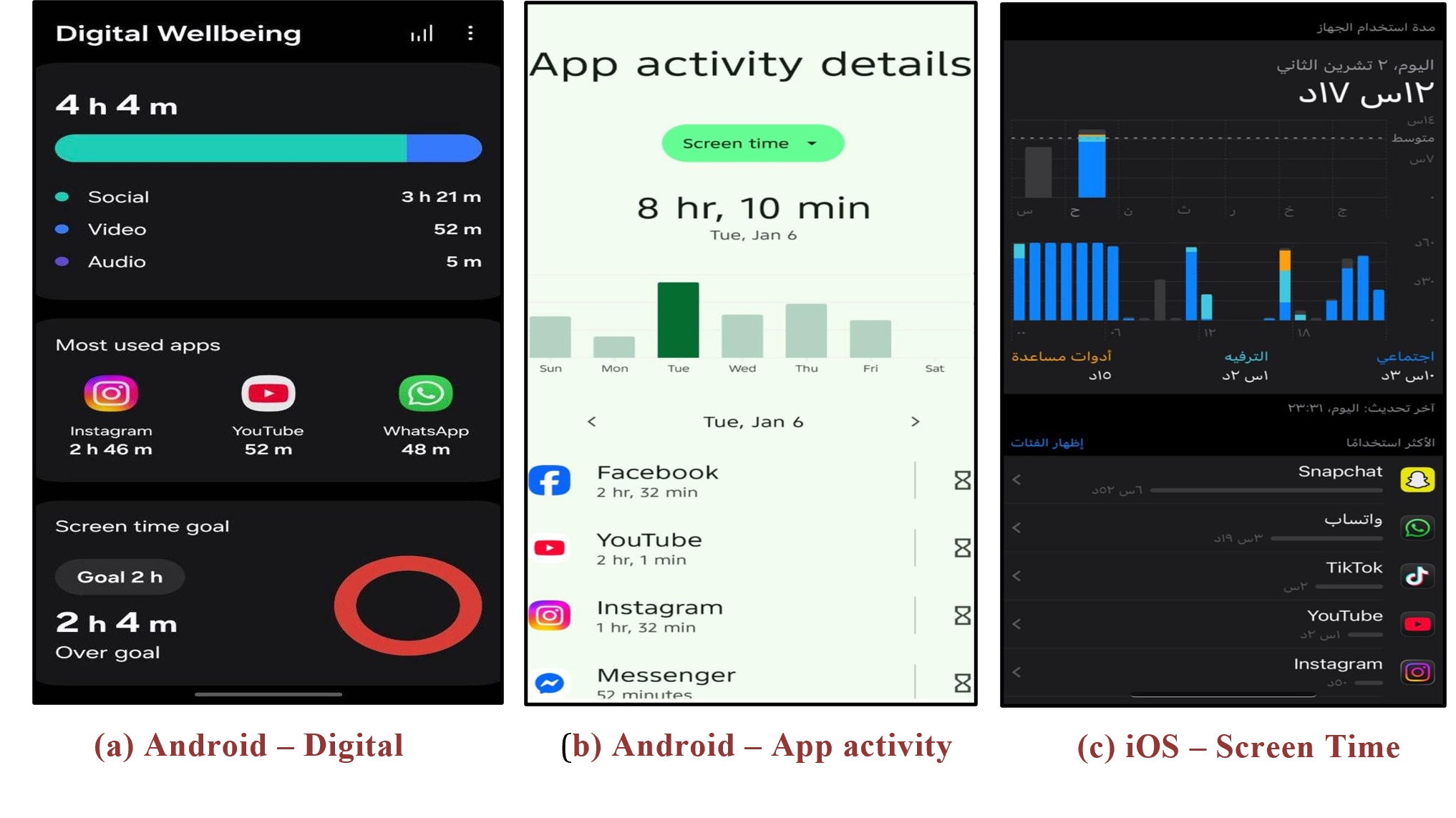
Social media addiction among adolescents is a complex psychological and behavioral construct, which cannot be estimated simply by the screen-time duration. In this study, the development and validation of a machine learning model to quantify and categorize the level of social media addiction among adolescents by combining various factors, including psychometric addiction indicators, depressive symptoms, demographic and behavioral measures, and empirical smartphone screen-time data. A local cross-sectional data set was obtained from 808 adolescents aged 13-18 years attending intermediate and preparatory schools in Baghdad, Iraq. The severity of social media addiction was quantified using an extended Bergen-based scale in Arabic language with 18 items grouped into six addiction dimensions: salience, mood modification, tolerance, withdrawal, conflict, and relapse. Following the Bergen Social Media Addiction Scale scoring protocol, the three items per addiction dimension were averaged, and the averages were summed up to obtain the overall score between 6 and 30. The classification criteria were established based on two different data sources: a local Iraqi study utilizing the same Bergen score threshold value of 24 to diagnose social media addiction and an international item response theory study endorsing the use of Bergen scores as severity scales especially values around 14 and 19. The outcome variable was defined as a Bergen-anchored composite risk score, not as the Bergen score alone or the PHQ-A score alone. The adapted 18-item Bergen-based score was used as the primary addiction component, while the PHQ-A score was aligned to the same 6–30 range and incorporated as a supporting psychological severity component, not as an independent depression diagnosis. Participants were then classified into three risk categories: low, moderate, and high. Objective smartphone screen-time indicators collected over ten consecutive days were used only as independent predictive features and were not included in target construction. Six machine-learning models were evaluated in their baseline configurations—Random Forest, XGBoost, LightGBM, CatBoost, SVM with RBF kernel, and Logistic Regression (L2)—along with optimized, hybrid, and soft-voting variants. The modeling pipeline used a stratified 80/20 train/test split, five-fold stratified cross-validation within the training data, and SMOTE applied only to the training set. The original ternary target distribution was imbalanced, with 313 low-risk, 474 moderate-risk, and 21 high-risk cases; after the train/test split, SMOTE balanced the training classes from 250/379/17 to 379/379/379 cases. In ternary classification, the best performance was achieved by the PSO-optimized CatBoost+XGBoost hybrid model, with test accuracy of 91.77%, weighted F1-score of 0.9173, and MCC of 0.8452. This model slightly outperformed the best simple baseline model, Random Forest, which achieved test accuracy of 91.14%, weighted F1-score of 0.9131, and MCC of 0.8347. These findings suggest that combining adapted psychometric responses, PHQ-A-supported psychological severity information, self-reported behavioral variables, and objective screen-time indicators may support early risk stratification of adolescent social media addiction. However, the findings should be interpreted as internal, cross-sectional decision-support evidence, because objective screen-time data were available only for a subsample and the model was not designed to replace clinical assessment
Downloads
References
B. Keles, N. McCrae, and A. Grealish, “A systematic review: The influence of social media on depression, anxiety and psychological distress in adolescents,” International Journal of Adolescence and Youth, vol. 25, no. 1, pp. 79–93, 2020, doi: 10.1080/02673843.2019.1590851.
M. D. Griffiths, “A components model of addiction within a biopsychosocial framework,” Journal of Substance Use, vol. 10, no. 4, pp. 191–197, 2005, doi: 10.1080/14659890500114359.
C. S. Andreassen, J. Billieux, M. D. Griffiths, D. J. Kuss, Z. Demetrovics, E. Mazzoni, and S. Pallesen, “The relationship between addictive use of social media and video games and symptoms of psychiatric disorders: A large-scale cross-sectional study,” Psychology of Addictive Behaviors, vol. 30, no. 2, pp. 252–262, 2016, doi: 10.1037/adb0000160.
J. M. Nagata et al., “Social media use and depressive symptoms during early adolescence,” JAMA Network Open, vol. 8, no. 5, e2511704, 2025, doi: 10.1001/jamanetworkopen.2025.11704.
Y. Xiao et al., “Addictive screen use trajectories and suicidal behaviors, suicidal ideation, and mental health in youths,” JAMA, 2025, doi: 10.1001/jama.2025.7829.
R. Y. Abdullah, B. M. S. Ismail, H. Q. Ezzat, and H. A. Sadeeq, “Social media addiction among high school students in Iraqi Kurdistan Region,” Egyptian Journal of Community Medicine, vol. 42, no. 4, pp. 223–232, 2024, doi: 10.21608/ejcm.2024.271694.1286.
D. Zarate, B. A. Hobson, E. March, M. D. Griffiths, and V. Stavropoulos, “Psychometric properties of the Bergen Social Media Addiction Scale: An analysis using item response theory,” Addictive Behaviors Reports, vol. 17, p. 100473, 2023, doi: 10.1016/j.abrep.2022.100473.
J. G. Johnson, E. S. Harris, R. L. Spitzer, and J. B. W. Williams, “The Patient Health Questionnaire for Adolescents: Validation of an instrument for the assessment of mental disorders among adolescent primary care patients,” Journal of Adolescent Health, vol. 30, no. 3, pp. 196–204, 2002, doi: 10.1016/S1054-139X(01)00333-0.
G. S. Collins et al., “TRIPOD+AI statement: Updated guidance for reporting clinical prediction models that use regression or machine learning methods,” BMJ, vol. 385, e078378, 2024, doi: 10.1136/bmj-2023-078378.
L. Breiman, “Random forests,” Machine Learning, vol. 45, pp. 5–32, 2001, doi: 10.1023/A:1010933404324.
T. Chen and C. Guestrin, “XGBoost: A scalable tree boosting system,” in Proceedings of the 22nd ACM SIGKDD International Conference on Knowledge Discovery and Data Mining, 2016, pp. 785–794, doi: 10.1145/2939672.2939785.
G. Ke, Q. Meng, T. Finley, T. Wang, W. Chen, W. Ma, Q. Ye, and T.-Y. Liu, “LightGBM: A highly efficient gradient boosting decision tree,” in Advances in Neural Information Processing Systems, vol. 30, 2017.
L. Prokhorenkova, G. Gusev, A. Vorobev, A. V. Dorogush, and A. Gulin, “CatBoost: Unbiased boosting with categorical features,” in Advances in Neural Information Processing Systems, vol. 31, 2018.
C. Cortes and V. Vapnik, “Support-vector networks,” Machine Learning, vol. 20, pp. 273–297, 1995, doi: 10.1007/BF00994018.
N. V. Chawla, K. W. Bowyer, L. O. Hall, and W. P. Kegelmeyer, “SMOTE: Synthetic minority over-sampling technique,” Journal of Artificial Intelligence Research, vol. 16, pp. 321–357, 2002, doi: 10.1613/jair.953.
J. Kennedy and R. Eberhart, “Particle swarm optimization,” in Proceedings of ICNN’95 - International Conference on Neural Networks, vol. 4, pp. 1942–1948, 1995, doi: 10.1109/ICNN.1995.488968.
S. Mirjalili, S. M. Mirjalili, and A. Lewis, “Grey Wolf Optimizer,” Advances in Engineering Software, vol. 69, pp. 46–61, 2014, doi: 10.1016/j.advengsoft.2013.12.007.
A. A. Heidari, S. Mirjalili, H. Faris, I. Aljarah, M. Mafarja, and H. Chen, “Harris hawks optimization: Algorithm and applications,” Future Generation Computer Systems, vol. 97, pp. 849–872, 2019, doi: 10.1016/j.future.2019.02.028.
S. M. Lundberg and S.-I. Lee, “A unified approach to interpreting model predictions,” in Advances in Neural Information Processing Systems, vol. 30, 2017.
M. T. Ribeiro, S. Singh, and C. Guestrin, “Why should I trust you? Explaining the predictions of any classifier,” in Proceedings of the 22nd ACM SIGKDD International Conference on Knowledge Discovery and Data Mining, 2016, pp. 1135–1144, doi: 10.1145/2939672.2939778.
D. Marengo, M. A. Fabris, C. Longobardi, and M. Settanni, “Smartphone and social media use contributed to individual tendencies towards social media addiction in Italian adolescents during the COVID-19 pandemic,” Addictive Behaviors, vol. 126, Art. no. 107204, 2022, doi: 10.1016/j.addbeh.2021.107204.
B. Xiao, N. Parent, L. Rahal, and J. Shapka, “Using Machine Learning to Explore the Risk Factors of Problematic Smartphone Use among Canadian Adolescents during COVID-19: The Important Role of Fear of Missing Out (FoMO),” Applied Sciences, vol. 13, no. 8, Art. no. 4970, 2023, doi: 10.3390/app13084970.
K. Kim, Y. Yoon, and S. Shin, “Explainable prediction of problematic smartphone use among South Korea’s children and adolescents using a machine learning approach,” International Journal of Medical Informatics, vol. 186, Art. no. 105441, 2024, doi: 10.1016/j.ijmedinf.2024.105441.
J. Jović, A. Ćorac, A. Stanimirović, M. Nikolić, M. Stojanović, Z. Bukumirić, and D. Ignjatović Ristić, “Using machine learning algorithms and techniques for defining the impact of affective temperament types, content search and activities on the internet on the development of problematic internet use in adolescents’ population,” Frontiers in Public Health, vol. 12, Art. no. 1326178, 2024, doi: 10.3389/fpubh.2024.1326178.
M. N. Mim, M. Firoz, M. M. Islam, M. Hasan, and M. T. Habib, “A study on social media addiction analysis on the people of Bangladesh using machine learning algorithms,” Bulletin of Electrical Engineering and Informatics, vol. 13, no. 5, 2024, doi: 10.11591/eei.v13i5.5680.
T. Ehsan and J. Basit, “Machine Learning for Detecting Social Media Addiction Patterns: Analyzing User Behavior and Mental Health Data,” International Journal of Innovations in Science & Technology, vol. 6, no. 4, pp. 1789–1807, 2024.
K. Hylkilä, M. Kääriäinen, A. Peltonen, S. Castrén, T. Mustonen, J. Konttila, and N. Männikkö, “Young adults’ risk profiles and predictive factors of Problematic Social Media Use (PSMU): A cross-sectional study,” Current Psychology, vol. 44, pp. 6848–6862, 2025, doi: 10.1007/s12144-025-07662-w.
A. Ali, M. S. Hosain, M. A. B. Siddik, M. Hasan, M. A. Habib, M. A. Kabir, M. M. Rahman, P. A. Shanto, N. Hasan, and A. Mahmud, “Classifying Internet Addiction Using Machine Learning Approach: A Study Among Adolescents in Bangladesh,” Public Health Challenges, vol. 4, no. 4, Art. no. e70165, 2025, doi: 10.1002/puh2.70165.
Nurjoko, A. D. Praditya, N. Triyasri, M. R. Octa, and A. Rahardi, “Perbandingan Performa Model Naïve Bayes dan Regresi Logistik dalam Klasifikasi Kecanduan Media Sosial pada Siswa,” Journal of Data Science Methods and Applications, vol. 1, no. 2, pp. 92–101, 2025, doi: 10.30873/jodmapps.v1i2.pp92-101.
A. T. B. S. Tegar, H. Hasanah, and I. Oktaviani, “Predicting Social Media Addiction Using Machine Learning and Interactive Visualization with Streamlit,” bit-Tech, vol. 8, no. 1, pp. 778–788, 2025, doi: 10.32877/bt.v8i1.2715.
Downloads
Published
How to Cite
Issue
Section
License
Copyright (c) 2026 Fatima Ali Mohammed, Sarah Saadoon Jasim

This work is licensed under a Creative Commons Attribution-NonCommercial-NoDerivatives 4.0 International License.