Sensor-Fusion Baselines and Robustness Envelopes for Real-Time UAV Obstacle Detection on Embedded Platforms
DOI:
https://doi.org/10.29304/jqcsm.2026.18.32882Keywords:
UAV, Obstacle Detection, Sensor Fusion, LiDAR, XGBoost, LightGBM, Embedded AIAbstract
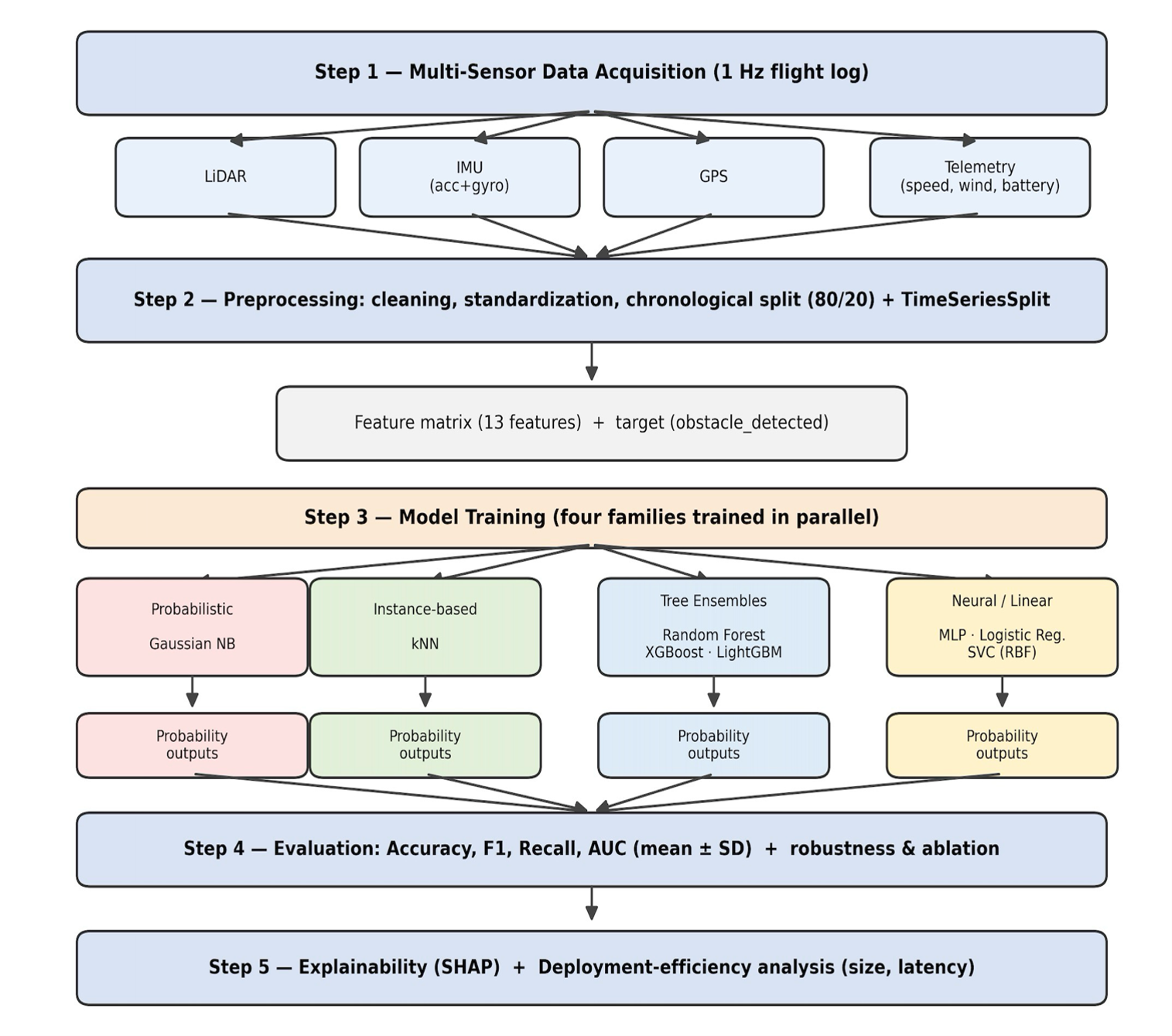
While achieving effective obstacle identification and secure navigation under computational limitations, autonomous unmanned aerial vehicles (UAVs) rely on precise sensor fusion. This paper explores a wide-ranging benchmark and robustness analyses of eight artificial intelligence (AI) models over a multi-sensor UAV navigation dataset, including Light Detection and Ranging (LiDAR), GPS, IMU, and telemetry data. In this paper, standard machine-learning (logistic regression, SVC, k-NN, and Gaussian Naive Bayes) classifiers are compared with ensemble learners (Random Forest, XGBoost, and LightGBM) and a shallow MLP. The accuracy, F1-score, recall, AUC, calibration, inference latency, and memory footprint of each model are evaluated to measure their realistic baselines for onboard implementation. Boosting ensembles are well-suited to embedded UAV applications, reaching near-perfect obstacle-detection accuracy with high computational efficiency (XGBoost, LightGBM). Robustness envelopes constructed under LiDAR noise and sensor ablation scenarios reveal the operational boundaries of sensor-dominant regimes and highlight the importance of redundancy in sensor fusion. The results explained with SHAP show that the main decision variables are LiDAR distance and IMU dynamics. The framework provides repeatable baselines, measures of effectiveness, and safety-aware decision-making that can inform future efforts in energy-efficient and interpretable UAV autonomy.
Downloads
References
I. Munasinghe, A. Perera, and R. C. Deo, “A Comprehensive Review of UAV-UGV Collaboration: Advancements and Challenges,” Journal of Sensor and Actuator Networks 2024, Vol. 13, Page 81, vol. 13, no. 6, p. 81, Nov. 2024, doi: 10.3390/JSAN13060081.
A. Merei, H. Mcheick, A. Ghaddar, and D. Rebaine, “A Survey on Obstacle Detection and Avoidance Methods for UAVs,” Drones 2025, Vol. 9, Page 203, vol. 9, no. 3, p. 203, Mar. 2025, doi: 10.3390/DRONES9030203.
A. Biswas and H. C. Wang, “Autonomous Vehicles Enabled by the Integration of IoT, Edge Intelligence, 5G, and Blockchain,” Sensors 2023, Vol. 23, Page 1963, vol. 23, no. 4, p. 1963, Feb. 2023, doi: 10.3390/S23041963.
H. Qian, M. Wang, M. Zhu, and H. Wang, “A Review of Multi-Sensor Fusion in Autonomous Driving,” Sensors 2025, Vol. 25, Page 6033, vol. 25, no. 19, p. 6033, Oct. 2025, doi: 10.3390/S25196033.
C. K. Ha, H. Nguyen, and L. H. Le, “AAB-FusionNet: A real-time object detection model for UAV edge computing platforms,” MethodsX, vol. 15, p. 103654, Dec. 2025, doi: 10.1016/J.MEX.2025.103654.
L. Obaid, K. Hamad, R. Al-Ruzouq, S. A. Dabous, K. Ismail, and E. Alotaibi, “State-of-the-art review of unmanned aerial vehicles (UAVs) and artificial intelligence (AI) for traffic and safety analyses: Recent progress, applications, challenges, and opportunities,” Transp Res Interdiscip Perspect, vol. 33, p. 101591, Sep. 2025, doi: 10.1016/J.TRIP.2025.101591.
G. Raftopoulos, N. Fazakis, G. Davrazos, and S. Kotsiantis, “A Comprehensive Review and Benchmarking of Fairness-Aware Variants of Machine Learning Models,” Algorithms 2025, Vol. 18, Page 435, vol. 18, no. 7, p. 435, Jul. 2025, doi: 10.3390/A18070435.
A. Zeghina, A. Leborgne, F. Le Ber, and A. Vacavant, “Deep learning on spatiotemporal graphs: A systematic review, methodological landscape, and research opportunities,” Neurocomputing, vol. 594, p. 127861, Aug. 2024, doi: 10.1016/J.NEUCOM.2024.127861.
S. Sarkar, S. Shafaei, T. S. Jones, and M. W. Totaro, “Secure Communication in Drone Networks: A Comprehensive Survey of Lightweight Encryption and Key Management Techniques,” Drones 2025, Vol. 9, Page 583, vol. 9, no. 8, p. 583, Aug. 2025, doi: 10.3390/DRONES9080583.
B. Bartlett, M. Santos, T. Dorian, M. Moreno, P. Trslic, and G. Dooly, “Real-Time UAV Surveys with the Modular Detection and Targeting System: Balancing Wide-Area Coverage and High-Resolution Precision in Wildlife Monitoring,” Remote Sens (Basel), vol. 17, no. 5, p. 879, Mar. 2025, doi: 10.3390/RS17050879/S1.
F. Zoghlami, M. Kaden, T. Villmann, G. Schneider, and H. Heinrich, “AI-Based Multi Sensor Fusion for Smart Decision Making: A Bi-Functional System for Single Sensor Evaluation in a Classification Task,” Sensors 2021, Vol. 21, Page 4405, vol. 21, no. 13, p. 4405, Jun. 2021, doi: 10.3390/S21134405.
G. Kumar, S. Basri, A. A. Imam, S. A. Khowaja, L. F. Capretz, and A. O. Balogun, “Data Harmonization for Heterogeneous Datasets: A Systematic Literature Review,” Applied Sciences 2021, Vol. 11, Page 8275, vol. 11, no. 17, p. 8275, Sep. 2021, doi: 10.3390/APP11178275.
H. Shi et al., “Advances in UAV Path Planning: A Comprehensive Review of Methods, Challenges, and Future Directions,” Drones 2025, Vol. 9, Page 376, vol. 9, no. 5, p. 376, May 2025, doi: 10.3390/DRONES9050376.
L. Madeyski and S. Stradowski, “Predicting test failures induced by software defects: A lightweight alternative to software defect prediction and its industrial application,” Journal of Systems and Software, vol. 223, p. 112360, May 2025, doi: 10.1016/J.JSS.2025.112360.
M. M. Haji-Esmaeili and G. Montazer, “Large-scale Monocular Depth Estimation in the Wild,” Eng Appl Artif Intell, vol. 127, p. 107189, Jan. 2024, doi: 10.1016/J.ENGAPPAI.2023.107189.
M. R. Giordano et al., “From low-cost sensors to high-quality data: A summary of challenges and best practices for effectively calibrating low-cost particulate matter mass sensors,” J Aerosol Sci, vol. 158, p. 105833, Nov. 2021, doi: 10.1016/J.JAEROSCI.2021.105833.
G. Liu, W. Gao, and S. Pan, “Analysis of Factors Affecting Random Measurement Error in LiDAR Point Cloud Feature Matching Positioning,” Remote Sensing 2025, Vol. 17, Page 1457, vol. 17, no. 8, p. 1457, Apr. 2025, doi: 10.3390/RS17081457.
S. Choi, X. Han, E. Chang, and H. Jeong, “LiDAR-IMU Sensor Fusion-Based SLAM for Enhanced Autonomous Navigation in Orchards,” Agriculture 2025, Vol. 15, Page 1899, vol. 15, no. 17, p. 1899, Sep. 2025, doi: 10.3390/AGRICULTURE15171899.
C. Sarkar et al., “Artificial Intelligence and Machine Learning Technology Driven Modern Drug Discovery and Development,” International Journal of Molecular Sciences 2023, Vol. 24, Page 2026, vol. 24, no. 3, p. 2026, Jan. 2023, doi: 10.3390/IJMS24032026.
C. S. Hung et al., “FADEL: Ensemble Learning Enhanced by Feature Augmentation and Discretization,” Bioengineering 2025, Vol. 12, Page 827, vol. 12, no. 8, p. 827, Jul. 2025, doi: 10.3390/BIOENGINEERING12080827.
R. Rahimi Nejadbougar, E. Ghanbari Parmehr, A. Afary, and S. Mavaddati, “A new deep learning framework for intelligent aerial monitoring of power transmission line insulators,” Eng Appl Artif Intell, vol. 161, p. 112290, Dec. 2025, doi: 10.1016/J.ENGAPPAI.2025.112290.
Z. Zhang and J. Li, “A Review of Artificial Intelligence in Embedded Systems,” Micromachines 2023, Vol. 14, Page 897, vol. 14, no. 5, p. 897, Apr. 2023, doi: 10.3390/MI14050897.
Z. Chen et al., “Predictive Autonomy for UAV Remote Sensing: A Survey of Video Prediction,” Remote Sensing 2025, Vol. 17, Page 3423, vol. 17, no. 20, p. 3423, Oct. 2025, doi: 10.3390/RS17203423.
L. Longo et al., “Explainable Artificial Intelligence (XAI) 2.0: A manifesto of open challenges and interdisciplinary research directions,” Information Fusion, vol. 106, p. 102301, Jun. 2024, doi: 10.1016/J.INFFUS.2024.102301.
P. V. Dantas, W. Sabino da Silva, L. C. Cordeiro, and C. B. Carvalho, “A comprehensive review of model compression techniques in machine learning,” Applied Intelligence, vol. 54, no. 22, pp. 11804–11844, Nov. 2024, doi: 10.1007/S10489-024-05747-W/FIGURES/2.
I. S. Gherghina, N. Bizon, G. V. Iana, and B. V. Vasilică, “Recent Advances in Fault Detection and Analysis of Synchronous Motors: A Review,” Machines 2025, Vol. 13, Page 815, vol. 13, no. 9, p. 815, Sep. 2025, doi: 10.3390/MACHINES13090815.
O. Ghoneim, P. Dobias, and O. Romain, “Survey of neural network optimization methods for sustainable AI: From data preprocessing to hardware acceleration,” Machine Learning with Applications, vol. 22, p. 100762, Dec. 2025, doi: 10.1016/j.mlwa.2025.100762.
“UAV Autonomous Navigation Dataset.” Accessed: Oct. 24, 2025. [Online]. Available: https://www.kaggle.com/datasets/ziya07/uav-autonomous-navigation-dataset?resource=download
Downloads
Published
How to Cite
Issue
Section
License
Copyright (c) 2026 Abdullah Thair Al-obaidi

This work is licensed under a Creative Commons Attribution-NonCommercial-NoDerivatives 4.0 International License.