A Plaintext Dependent Chaos based Image Encryption Scheme using Bit-Plane Scrambling and XOR based Diffusion
DOI:
https://doi.org/10.29304/jqcsm.2026.18.32908Keywords:
image encryption, Cryptography, Logistic Map, Plaintext-dependent Key, Bit-plane Decomposition, Zigzag Permutation, XOR Diffusion, Chaotic Sequence, Image SecurityAbstract
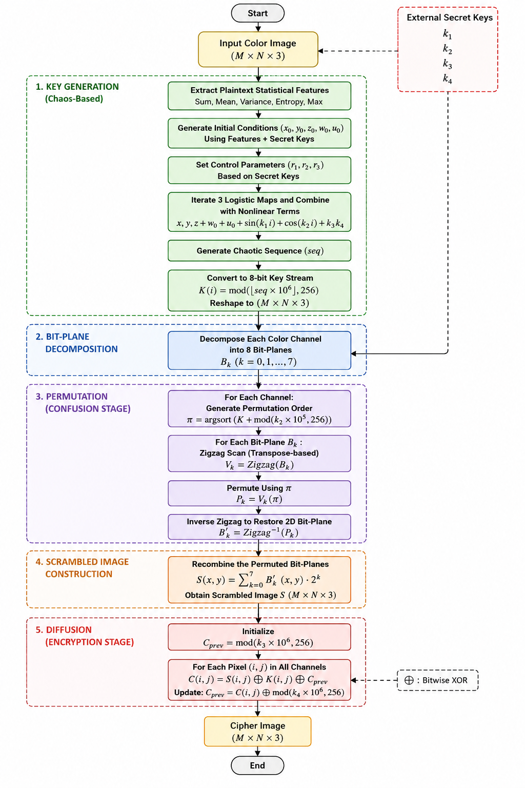
Secure image encryption algorithms received considerable development in cyber security applications in the age of digital data. This paper proposes a new hybrid image encryption scheme based on a chaotic system and bit-plane processing. The suggested algorithm uses a key generation mechanism based on plaintext, where the initial condition in a standard Logistic map is influenced by statistical features of the input image in addition to four external secret keys to increase key sensitivity and expand the size of the key space (2186). It is a two-stage encryption process consisting of a permutation and diffusion. The permutation process separated the input image into eight bit-planes and each plane is reordered according to a key-dependent scanning algorithm. During the diffusion phase, a feedback-based XOR operation is performed by using a chaotic key stream obtained from Logistic map such that adjacent pixels are strongly dependent. The experimental results show the proposed scheme presents favorable security performance of both color and gray image. The correlation coefficients of the encrypted images are low (≈ 0.0004–0.0044), and their entropy values are high (≈ 7.9970). In addition, the cryptographic algorithm is also very robust against differential attack such as Number of Pixel Change Rate (NPCR) = 99.63% and Unified Average Changing Intensity (UACI) = 33.39%. The results validate that the developed encryption scheme exhibits excellent confusion and diffusion characteristics, significant key sensitivity, and a high level of resistance to statistical and differential attacks, thus making it ideal for secure image transmission applications.
Downloads
References
S. Rohith, K. H. Bhat, and A. N. Sharma, "Image encryption and decryption using chaotic key sequence generated by sequence of logistic map and sequence of states of Linear Feedback Shift Register," in 2014 International conference on advances in electronics computers and communications, 2014, pp. 1-6: IEEE.
A. Dinu and M. J. M. Frunzete, "Image encryption using chaotic maps: development, application, and analysis," vol. 13, no. 16, p. 2588, 2025.
S. Wang, Q. Peng, B. J. O. Du, and L. Technology, "Chaotic color image encryption based on 4D chaotic maps and DNA sequence," vol. 148, p. 107753, 2022.
H. Wen, Y. J. J. o. K. S. U.-C. Lin, and I. Sciences, "Cryptanalyzing an image cipher using multiple chaos and DNA operations," vol. 35, no. 7, p. 101612, 2023.
Z. Zhang, J. Tang, F. Zhang, H. Ni, J. Chen, and Z. J. I. A. Huang, "Color image encryption using 2D sine-cosine coupling map," vol. 10, pp. 67669-67685, 2022.
B. Zhang and L. J. M. Liu, "Chaos-based image encryption: Review, application, and challenges," vol. 11, no. 11, p. 2585, 2023.
S. Jadoon, L. Pan, S. Huda, K. H. J. M. T. Khan, and Applications, "A survey of image encryption schemes: Arnold transformation, chaos, bit-plane extraction and permutation based algorithms," vol. 85, no. 3, p. 210, 2026.
J. Zheng and T. J. I. I. P. Lv, "Image encryption algorithm based on cascaded chaotic map and improved Zigzag transform," vol. 16, no. 14, pp. 3863-3875, 2022.
Y. Wan, S. Wang, B. J. M. T. Du, and Applications, "A bit plane image encryption algorithm based on compound chaos," vol. 82, no. 14, pp. 22103-22121, 2023.
J. Xu, K. Liu, Q. Huang, Q. Li, and L. J. P. S. Huang, "A plaintext-related and ciphertext feedback mechanism for medical image encryption based on a new one-dimensional chaotic system," vol. 99, no. 12, p. 125220, 2024.
Y. Niu, H. Zhou, and X. J. S. R. Zhang, "Image encryption scheme based on improved four-dimensional chaotic system and evolutionary operators," vol. 14, no. 1, p. 7033, 2024.
X. Zhang, Y. Liu, M. Liu, Y. J. J. o. K. S. U. C. Niu, and I. Sciences, "Image encryption algorithm based on Zigzag transformation and roulette wheel rotation mechanism," vol. 37, no. 8, p. 239, 2025.
L. Kurz and M. Hafed Benteftifa, Analysis of variance in statistical image processing. 1997.
A. J. M. S. i. C. S. Lesne, "Shannon entropy: a rigorous notion at the crossroads between probability, information theory, dynamical systems and statistical physics," vol. 24, no. 3, p. e240311, 2014.
C. Y. Wong et al., "Image contrast enhancement using histogram equalization with maximum intensity coverage," vol. 63, no. 16, pp. 1618-1629, 2016.
M. Ausloos, The logistic map and the route to chaos: From the beginnings to modern applications. Springer Science & Business Media, 2006.
C. Fu, B.-b. Lin, Y.-s. Miao, X. Liu, and J.-j. J. O. c. Chen, "A novel chaos-based bit-level permutation scheme for digital image encryption," vol. 284, no. 23, pp. 5415-5423, 2011.
R. Candra, S. Madenda, S. A. Sudiro, M. J. J. o. T. Subali, Electronic, and C. Engineering, "The implementation of an efficient zigzag scan," vol. 9, no. 2, pp. 95-98, 2017.
X. Wang and H.-l. J. N. D. Zhang, "A novel image encryption algorithm based on genetic recombination and hyper-chaotic systems," vol. 83, no. 1, pp. 333-346, 2016.
Downloads
Published
How to Cite
Issue
Section
License
Copyright (c) 2026 Zahraa Azhar Muhammad

This work is licensed under a Creative Commons Attribution-NonCommercial-NoDerivatives 4.0 International License.