Data-Augmented Bone Cancer Detection Using a Hybrid CNN–GAN–GNN Framework with Explainable AI
DOI:
https://doi.org/10.29304/jqcsm.2026.18.32938Keywords:
bone cancer detection, CNN, GAN, GNN, Grad-CAM, Data augmentationAbstract
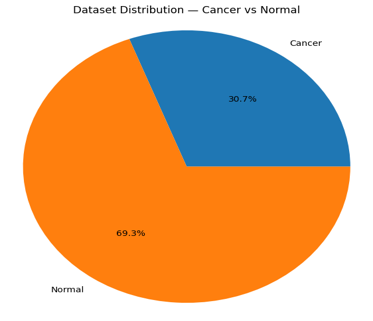
Bone cancer is one of the more aggressive musculoskeletal malignancies and early diagnosis is still a paramount clinical challenge because of the paucity of data and the vague imaging features of early disease. This paper proposes a novel hybrid deep learning framework which is a combination of Convolutional Neural Networks (CNNs), Generative Adversarial. Networks (GANs), Graph Neural Networks (GNNs) and Gradient-weighted Class Activation Mapping (Grad-CAM) to tackle the issues of data-imbalance and interpretability of the existing automated bone cancer detection system. A Deep Convolutional GAN (DCGAN) is used to rebalance the training distribution, Remedying the original class imbalance (30.7% cancer and 69.3% normal) and a balanced training distribution of 1:1 (cancer: normal).The model is trained for 200 epochs and achieves, on the held-out test set (276 cancer and 596 normal) accuracy of 97.4%, recall of 97.1%, precision of 96.8%, F1 score of 96.9% and AUC-ROC of 0.991 on the publicly available Roboflow Bone Cancer Detection benchmark (7,057 training radiographs, 882 validation and 872 test). This framework shows better performance than eight state-of-the-art baseline methods. The heat maps generated by Grad-CAM achieved an 89% agreement between the radiologist and the heat maps, demonstrating clinically plausible explainability.
Downloads
References
References
H. Hosseini, S. Heydari, K. Hushmandi, S. Daneshi, and R. Raesi, “Bone tumors: A systematic review of prevalence, risk determinants, and survival patterns,” Cancers, vol. 17, no. 13, p. 2141, Jul. 2025, doi: 10.1186/s12885-025-13720-0.
R. L. Siegel, A. N. Giaquinto, and A. Jemal, “Cancer statistics, 2024,” CA Cancer J. Clin., vol. 74, no. 1, pp. 12–49, Jan.–Feb. 2024, doi: 10.3322/caac.21820.
S. Breden et al., “Deep learning-based detection of bone tumors around the knee in X-rays of children,” J. Clin. Med., vol. 12, no. 18, p. 5960, Sep. 2023, doi: 10.3390/jcm12185960.
M. Li, Y. Jiang, Y. Zhang, and H. Zhu, “Medical image analysis using deep learning algorithms,” Front. Public Health, vol. 11, p. 1273253, Nov. 2023, doi: 10.3389/fpubh.2023.1273253.
I. D. Mienye, T. G. Swart, G. Obaido, M. Jordan, and P. Ilono, “Deep convolutional neural networks in medical image analysis: A review,” Information, vol. 16, p. 195, 2025, doi: 10.3390/info16030195.
V. Kandasamy, V. Simic, N. Bacanin, and D. Pamucar, “Optimized deep learning networks for accurate identification of cancer cells in bone marrow,” Neural Netw., vol. 181, p. 106822, Jan. 2025, doi: 10.1016/j.neunet.2024.106822.
B. M. de Vries et al., “Explainable artificial intelligence (XAI) in radiology and nuclear medicine: A literature review,” Front. Med. (Lausanne), vol. 10, p. 1180773, May 2023, doi: 10.3389/fmed.2023.1180773.
A. B. Naeem et al., “Lightweight CNN for accurate brain tumor detection from MRI with limited training data,” Front. Med. (Lausanne), vol. 12, p. 1636059, Aug. 2025, doi: 10.3389/fmed.2025.1636059.
M. Alruwaili and M. Mohamed, “An integrated deep learning model with EfficientNet and ResNet for accurate multi-class skin disease classification,” Diagnostics, vol. 15, p. 551, 2025, doi: 10.3390/diagnostics15050551.
P. S. Papageorgiou et al., “Artificial intelligence in primary malignant bone tumor imaging: A narrative review,” Diagnostics (Basel)., vol. 15, no. 13, p. 1714, Jul. 2025, doi: 10.3390/diagnostics15131714.
S. Kantu et al., “Integrating MobileNetV3 and SqueezeNet for multi-class brain tumor classification,” J. Imaging Inform. Med., vol. 39, no. 2, pp. 1274–1288, Apr. 2026, doi: 10.1007/s10278-025-01589-1.
E. Benmalek, W. Rhalem, A. Jbabi, and A. Jilbab, “Edge-based real-time diagnosis of pediatric pneumonia using lightweight CNNs and chest X-rays,” Res. Biomed. Eng., Nov. 2025, doi: 10.1007/s42600-025-00437-z.
T. Kumar and V. Ravi, “Classification of brain tumor using SqueezeNet and ShuffleNet architecture,” in Lecture Notes in Networks and Systems. Springer, 2025, doi: 10.1007/978-981-95-5082-1_23.
M. V. Ramana, P. N. Jyothi, S. Anuradha, and G. Lakshmeeswari, “Enhanced bone cancer diagnosis through deep learning on medical imagery,” Int. J. Comput. Exp. Sci. Eng., vol. 11, no. 1, pp. 911–927, 2025, doi: 10.22399/ijcesen.931.
L. Perez and J. Wang, “The effectiveness of data augmentation in image classification using deep learning,” arXiv preprint arXiv:1712.04621, 2017. [Online]. Available: https://arxiv.org/abs/1712.04621
Y. Jimenez-Gaona, D. Carrion-Figueroa, V. Lakshminarayanan, and M. J. Rodriguez-Alvarez, “GAN-based data augmentation to improve breast ultrasound and mammography mass classification,” Biomed. Signal Process. Control, vol. 94, p. 106255, 2024, doi: 10.1016/j.bspc.2024.106255.
X. Zeng and S. Gong, “Stochastic-based learning for image classification in chest X-ray diagnosis,” Digit. Health, vol. 11, Aug. 2025, doi: 10.1177/20552076251361745.
S.-L. Jeng, “Generative adversarial network for synthesizing multivariate time-series data in electric vehicle driving scenarios,” Sensors, vol. 25, p. 749, 2025, doi: 10.3390/s25030749.
S. G. Paul, A. Saha, M. Z. Hasan, S. R. H. Noori, and A. Moustafa, “A systematic review of graph neural network in healthcare-based applications,” IEEE Access, vol. 12, pp. 15145–15170, 2024, doi: 10.1109/ACCESS.2024.3354809.
M. Ravinder et al., “Enhanced brain tumor classification using graph convolutional neural network architecture,” Sci. Rep., vol. 13, no. 1, p. 14938, Sep. 2023, doi: 10.1038/s41598-023-41407-8.
M. A. Pala and M. B. Navdar, “SPX-GNN: An explainable graph neural network for harnessing long-range dependencies in tuberculosis classifications in chest X-ray images,” Diagnostics, vol. 15, p. 3236, 2025, doi: 10.3390/diagnostics15243236.
J. Abrantes and P. Rouzrokh, “Explaining explainability: The role of XAI in medical imaging,” Eur. J. Radiol., vol. 173, p. 111389, Apr. 2024, doi: 10.1016/j.ejrad.2024.111389.
E. H. Houssein et al., “Explainable artificial intelligence for medical imaging systems using deep learning: A comprehensive review,” Cluster Comput., vol. 28, p. 469, 2025, doi: 10.1007/s10586-025-05281-5.
Roboflow Universe, “Bone Cancer Detection Dataset,” Normal-Bones Workspace, version 1, 2023. [Online]. Available: https://universe.roboflow.com/normal-bones/bone-cancer-detection-xa7ru
A. Radford, L. Metz, and S. Chintala, “Unsupervised representation learning with deep convolutional generative adversarial networks,” arXiv preprint arXiv:1511.06434, Nov. 2015. [Online]. Available: https://arxiv.org/abs/1511.06434
T. N. Kipf and M. Welling, “Semi-supervised classification with graph convolutional networks,” in Proc. 5th Int. Conf. Learn. Representations (ICLR), Toulon, France, 2017. [Online]. Available: https://arxiv.org/abs/1609.02907
R. R. Selvaraju et al., “Grad-CAM: Visual explanations from deep networks via gradient-based localization,” Int. J. Comput. Vis., vol. 128, no. 2, pp. 336–359, Feb. 2020, doi: 10.1007/s11263-019-01228-7.
A. Borji, G. Kronreif, B. Angermayr, and S. Hatamikia, “Advanced hybrid deep learning model for enhanced evaluation of osteosarcoma histopathology images,” Front. Med., vol. 12, p. 1555907, Apr. 2025, doi: 10.3389/fmed.2025.1555907.
S. R. Adiga and Z. A. Khan, “Optimizing deep learning for bone cancer detection: Boosting diagnostic accuracy and efficiency with CNNs,” Int. J. Eng. Res. Technol., vol. 14, no. 5, May 2025.
S. Alsubai et al., “Group teaching optimization with deep learning-driven osteosarcoma detection using histopathological images,” IEEE Access, vol. 12, pp. 34089–34098, 2024, doi: 10.1109/ACCESS.2024.3371518.
R. Aarthy, V. Muthupriya, and G. N. Balaji, “Detection of bone cancer based on a four-phase framework generative deep belief neural network in deep learning,” Alexandria Eng. J., vol. 109, pp. 394–407, 2024, doi: 10.1016/j.aej.2024.08.094.
S. Parisot et al., “Disease prediction using graph convolutional networks: Application to autism spectrum disorder and Alzheimer’s disease,” Med. Image Anal., vol. 48, pp. 117–130, Aug. 2018, doi: 10.1016/j.media.2018.06.001.
Downloads
Published
How to Cite
Issue
Section
License
Copyright (c) 2026 Hasanain Flayyih Hasan, Hasan Mohammed Idan, Muntadher Basim Ali

This work is licensed under a Creative Commons Attribution-NonCommercial-NoDerivatives 4.0 International License.