Spatio-Temporal Meta-Learning for Patient Trajectory in Longitudinal Electronic Health Records: A Review
DOI:
https://doi.org/10.29304/jqcsm.2026.18.22979Keywords:
EHRs, ML, STML, Patient trajectory,, hyper-learning, meta-learning.Abstract
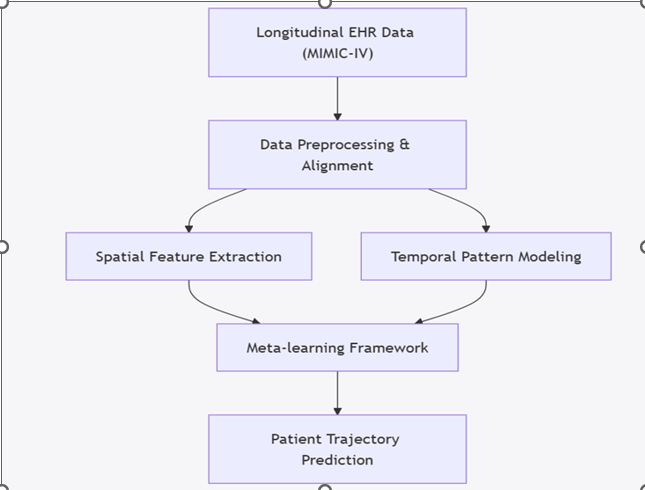
Research on spatiotemporal hyper-learning applied to longitudinal electronic health records (EHRs) provides a concise yet helpful summary. The research problems, innovative methodology, datasets (with a focus on MIMIC-IV), expected findings, and implications of spatiotemporal hyper-learning for patient pathway modelling are all covered in detail in this study. With more and more electronic health record data being available, predictive analytics have grown, particularly in the areas of patient pathways and clinical outcomes. Different problems arise due to the complexity caused by changes in time and the accompanying clinical characteristics. We require state-of-the-art modelling approaches that incorporate spatiotemporal dimensions. By monitoring the development of clinical features and intricate spatial connections, spatiotemporal hyper-learning frameworks have the potential to enhance patient route modelling. The approach is novel because it can adapt to new patient groups and clinical conditions through hyper-learning. Though it is briefly mentioned in the abstract, the MIMIC-IV dataset confirms the framework; however, the method section explains the approach, strategies, and algorithms. Most courses address data processing, feature extraction, learning to represent spatial and temporal components, and hyper-learning for fast adaptation to new patient data. Stochastic hyper-learning has the potential to outperform more conventional methods of prediction in terms of accuracy and flexibility. This method has the potential to enhance clinical decision-making since it can detect patient trajectories.
Downloads
References
F. Xie et al., "Deep learning for temporal data representation in electronic health records: A systematic review of challenges and methodologies," Journal of biomedical informatics, vol. 126, p. 103980, 2022.
T. Hospedales, A. Antoniou, P. Micaelli, and A. Storkey, "Meta-learning in neural networks: A survey," IEEE transactions on pattern analysis and machine intelligence, vol. 44, no. 9, pp. 5149–5169, 2021.
A. E. Johnson et al., "MIMIC-IV, a freely accessible electronic health record dataset,"
Scientific data, vol. 10, no. 1, p. 1, 2023.
B. Liang et al., "Few-shot aspect category sentiment analysis via meta-learning," ACM Transactions on Information Systems, vol. 41, no. 1, pp. 1–31, 2023.
Q. A. A. Hadi, A. S. D. Alfoudi, and A. M. Mahdi, "Hybrid Model-Based Cauchy and Machine Learning Algorithms for IoT-Intrusion Detection System," International Journal of Intelligent Engineering & Systems, vol. 16, no. 6, 2023.
J. Gu, Y. Wang, Y. Chen, V. O. Li, and K. Cho, "Meta-learning for low-resource neural machine translation," in Proceedings of the 2018 conference on empirical methods in natural language processing, 2018, pp. 3622–3631.
L. Trimarchi, R. Caruso, G. Magon, A. Odone, and C. Arrigoni, "Clinical pathways and patient-related outcomes in hospital-based settings: a systematic review and meta-analysis of randomized controlled trials," Acta Bio Medica: Atenei Parmensis, vol. 92, no. 1, p. e2021093, 2021.
J. G. Hanrahan et al., "Process analysis of the patient pathway for automated data collection: an exemplar using pituitary surgery," Frontiers in Endocrinology, vol. 14, p. 1188870, 2024.
Z. Liu et al., "Enhanced strength-ductility synergy in a new 2.2 GPa grade ultra-high strength stainless steel with balanced fracture toughness: Elucidating the role of duplex aging treatment," Journal of Alloys and Compounds, vol. 928, p. 167135, 2022.
Z. Pan et al., "Spatio-temporal meta learning for urban traffic prediction," IEEE Transactions on Knowledge and Data Engineering, vol. 34, no. 3, pp. 1462–1476, 2020.
I. Landi et al., "Deep representation learning of electronic health records to unlock patient stratification at scale," NPJ digital medicine, vol. 3, no. 1, p. 96, 2020.
F. J. Catling and A. H. Wolff, "Temporal convolutional networks allow early prediction of events in critical care," Journal of the American Medical Informatics Association, vol. 27, no. 3, pp. 355–365, 2020.
P. Sharma, I. Qureshi, and M. Tran, "Meta Learning for Few-Shot Medical Text Classification," arXiv preprint arXiv:2212.01552, 2022.
H. Liu et al., "Time Associated Meta Learning for Clinical Prediction," arXiv preprint arXiv:2303.02570, 2023.
J. Tian, A. Xiang, Y. Feng, Q. Yang, and H. Liu, "Enhancing disease prediction with a hybrid cnn-lstm framework in ehrs," Journal of Theory and Practice of Engineering Science, vol. 4, no. 02, pp. 8–14, 2024.
H. O. Boll, A. Amirahmadi, A. Soliman, S. Byttner, and M. Recamonde-Mendoza, "Graph Neural Networks for Heart Failure Prediction on an EHR-Based Patient Similarity Graph," arXiv preprint arXiv:2411.19742, 2024.
K. Ouanes and N. Farhah, "Effectiveness of artificial intelligence (AI) in clinical decision support systems and care delivery," Journal of medical systems, vol. 48, no. 1, p. 74, 2024.
M. Sreenivasan and S. Madhavendranath, "Temporal and Comorbidity-Aware Representation of Longitudinal Patient Trajectories from Electronic Health Records," Biomedical Physics & Engineering Express, 2026.
M. Jin et al., "Large models for time series and spatio-temporal data: A survey and outlook," arXiv preprint arXiv:2310.10196, 2023.
M. Al-Garadi et al., "Scalable Identification of Clinically Relevant COPD Documents: A Lightweight NLP Model for Large-Scale EHR Datasets," medRxiv, p. 2025.04. 22.25326240, 2025.
Z. Yu, Y. Jin, Y. Xu, X. Chu, Y. Wang, and J. Zhao, "IntelliCare: Improving Healthcare Analysis with Variance-Controlled Patient-Level Knowledge from Large Language Models," arXiv preprint arXiv:2408.13073, 2024.
I. Spiero et al., "Comparison of local large language models for extraction of signs and symptoms data from electronic health records," medRxiv, p. 2025.12. 11.25341954, 2025.
K. Pereverdieva, M. Emmerich, A. Deutz, T. Ezendam, T. Bäck, and H. Hofmeyer, "The prism-net search space representation for multi-objective building spatial design," in International Conference on Evolutionary Multi-Criterion Optimization, 2023: Springer,
pp. 476–489.
R. K. Kundu, O. Y. Elsaid, P. Calyam, and K. A. Hoque, "Vr-lens: Super learning-based cybersickness detection and explainable ai-guided deployment in virtual reality," in Proceedings of the 28th international conference on intelligent user interfaces, 2023, pp. 819–834.
H. Xu et al., "SPACEL: deep learning-based characterization of spatial transcriptome architectures," Nature Communications, vol. 14, no. 1, p. 7603, 2023.
S. Khalil, User Element Geolocation in Massive-MIMO Networks with Dynamic Spectrum Access using Hybrid Super Machine Learning. The Catholic University of America, 2022.
N. Acharya, P. Kar, M. Ally, and J. Soar, "Predicting co-occurring mental health and substance use disorders in women: an automated machine learning approach," Applied Sciences, vol. 14, no. 4, p. 1630, 2024.
Y. Wang, M. Khodadadzadeh, and R. Zurita-Milla, "Spatial+: A new cross-validation method to evaluate geospatial machine learning models," International Journal of Applied Earth Observation and Geoinformation, vol. 121, p. 103364, 2023.
M. Karabacak and K. Margetis, "Embracing large language models for medical applications: opportunities and challenges," Cureus, vol. 15, no. 5, 2023.
Y. E. Rachmad, "Redefining Money: Implementation and Challenges of CBDC in the Digital Era," The United Nations and the Nobel Peace Prize Awards, 2025.
D. G. Broo, M. Bravo-Haro, and J. Schooling, "Design and implementation of a smart infrastructure digital twin," Automation in construction, vol. 136, p. 104171, 2022.
S. Sujitha, C. Anita, K. Sudharson, S. R. Rose, S. Sharmila, and V. Keerthana, "OptiANN- LR: augmenting diabetes prediction accuracy through hyper learning rate tuning in optimized artificial neural networks," in 2024 IEEE International Students' Conference on Electrical, Electronics and Computer Science (SCEECS), 2024: IEEE, pp. 1–5.
L. Zhang, J. Zhu, B. Jin, and X. Wei, "Multiview Spatial-Temporal Meta-Learning for Multivariate Time Series Forecasting," Sensors (Basel, Switzerland), vol. 24, no. 14, p. 4473, 2024.
B. Baysal, M. B. Eser, M. B. Dogan, and M. A. Kursun, "Multivariable diagnostic prediction model to detect hormone secretion profile from T2W MRI radiomics with artificial neural networks in pituitary adenomas," Medeniyet Medical Journal, vol. 37, no. 1, p. 36, 2022.
Q. Liu, Y. Zhao, S. Attanti, J. L. Voss, G. Schoenbaum, and T. Kahnt, "Midbrain signaling of identity prediction errors depends on orbitofrontal cortex networks," Nature Communications, vol. 15, no. 1, p. 1704, 2024.
S. Kaur, Y. Kumar, A. Koul, and S. K. Kamboj, "A systematic review on metaheuristic optimization techniques for feature selections in disease diagnosis: open issues and challenges," Archives of computational methods in engineering, vol. 30, no. 3, p. 1863, 2022.
M. Alrifaey et al., "Hybrid deep learning model for fault detection and classification of grid-connected photovoltaic system," IEEE Access, vol. 10, pp. 13852–13869, 2022.
Z. Wang et al., "Neurocomputational mechanisms underlying fear-biased adaptation learning in changing environments," PLoS Biology, vol. 21, no. 5, p. e3001724, 2023.
G. Zhang, X. Dou, and L. Li, "Intelligent Defect Detection of Ancient City Walls Based on Computer Vision," Sensors, vol. 25, no. 16, p. 5042, 2025.
P. M. Terle, L. A. Peebles, A. Verma, and M. J. Kraeutler, "Minimal clinically important difference, substantial clinical benefit, and patient acceptable symptom state values after hip arthroscopy for femoroacetabular impingement are highly dependent on their study population and calculation methods: a systematic review," Arthroscopy: The Journal of Arthroscopic & Related Surgery, vol. 41, no. 6, pp. 2105–2113, 2025.
A. Amirahmadi, F. Etminani, J. Björk, O. Melander, and M. Ohlsson, "Trajectory-Ordered Objectives for Self-Supervised Representation Learning of Temporal Healthcare Data Using Transformers: Model Development and Evaluation Study," JMIR Medical Informatics, vol. 13, no. 1, p. e68138, 2025.
Downloads
Published
How to Cite
Issue
Section
License
Copyright (c) 2026 Qassim A. Hadi 1, Zainab N. Nemer 2

This work is licensed under a Creative Commons Attribution-NonCommercial-NoDerivatives 4.0 International License.